Golden Chain
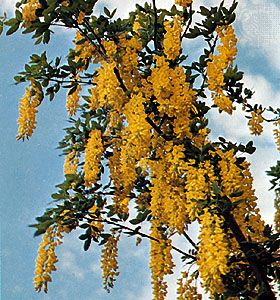
The term "golden chain" most commonly refers to the golden chain tree (Laburnum anagyroides), a small tree or shrub in the pea family (Fabaceae). Native to…
What is Golden chain?
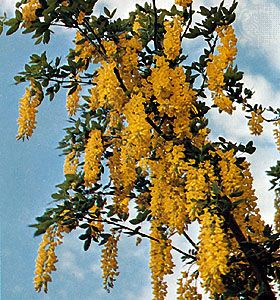
The term “golden chain” most commonly refers to the golden chain tree (Laburnum anagyroides), a small tree or shrub in the pea family (Fabaceae). Native to southern Europe, it is widely cultivated as an ornamental plant for its striking, pendulous clusters of bright yellow flowers.12
It is important to note that all parts of the golden chain tree are poisonous, particularly the seeds, and can be fatal if ingested by cattle. The plant typically grows to about 6 metres (20 feet) and features compound leaves with three leaflets.21
While the term is sometimes confused with the philosophical concept of the Great Chain of Being, which describes a hierarchical, interconnected view of the universe, they are distinct subjects.3
Are all parts of the golden chain tree toxic to humans?
Yes, it is accurate to state that all parts of the golden chain tree (Laburnum anagyroides) are poisonous. The plant contains toxic compounds throughout its structure, with the seeds being particularly dangerous.3
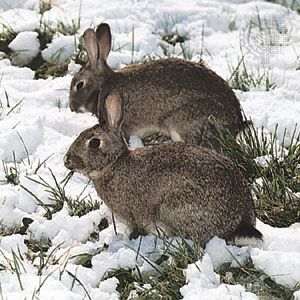
While the plant is frequently cultivated for its ornamental value, it is essential to exercise caution, as ingestion can be fatal to cattle and poses a significant risk to humans. Interestingly, while these toxins are hazardous to many, some animals, such as hares and rabbits, are unaffected by the plant’s toxicity.3
What is the difference between the golden chain and the alpine laburnum?
The golden chain (Laburnum anagyroides) and the alpine, or Scotch, laburnum (L. alpinum) are the only two species within the Laburnum genus, both of which belong to the pea family (Fabaceae).13
While they share many characteristics—including compound leaves with three leaflets, poisonous properties, and pendulous clusters of bright yellow flowers—they have distinct differences in their utility and physical traits:
- Timber Quality: The wood of the alpine laburnum (L. alpinum) is noted for its striking greenish-brown or reddish-brown hue. It takes a high polish and was historically prized as a top-tier timber for cabinetmaking and inlay work in Scotland.3
- Growth and Cultivation: The golden chain (L. anagyroides) is primarily cultivated as an ornamental plant for its attractive flowers. It typically grows to about 6 metres (20 feet) and often begins branching near the ground.13
- Hybrids: A common garden cultivar known as Voss’s laburnum (L. ×watereri) is a hybrid of these two species, combining traits from both parents.1
How does the Great Chain of Being differ from the botanical golden chain?
The golden chain and the Great Chain of Being are entirely unrelated concepts, as one refers to a physical plant and the other to a philosophical framework.
The golden chain (Laburnum anagyroides) is a biological entity—a small tree or shrub in the Fabaceae family. It is a tangible, living organism native to southern Europe, characterized by its compound leaves and drooping clusters of yellow flowers.1
In contrast, the Great Chain of Being is an abstract, metaphysical conception of the universe that dominated Western thought from antiquity through the 18th century. Rather than a physical object, it is a philosophical model defined by three principles:
- Plenitude: The belief that the universe contains every possible form of existence.2
- Continuity: The idea that all forms exist in an infinite series, with each sharing attributes with its neighbors.2
- Gradation: A hierarchical structure ranging from the simplest forms of existence to the ens perfectissimum, or God.2
Sources
- golden chain — Encyclopædia Britannica
- Great Chain of Being — Encyclopædia Britannica
- laburnum — Encyclopædia Britannica
- golden chain — Merriam-Webster
- laburnum — Merriam-Webster
Published on · 2 min read