Groundhog
Groundhog Day, observed annually on February 2, is a North American tradition used to predict the arrival of spring. According to folklore, if a groundhog…
What is the cultural significance of Groundhog Day, and how did this tradition begin?
Groundhog Day, observed annually on February 2, is a North American tradition used to predict the arrival of spring. According to folklore, if a groundhog emerges from its burrow and sees its shadow, winter will persist for six more weeks; if it does not, an early spring is expected. While the tradition is a popular media event—most notably centered on Punxsutawney Phil in Pennsylvania—historical records show these predictions are accurate less than 40 percent of the time.12
The tradition originated from European beliefs dating to the Middle Ages, which linked weather forecasting to animals like badgers or bears emerging from hibernation on Candlemas. German immigrants brought these customs to North America, where the groundhog was substituted for the badger. Culturally, the date is significant as it falls near the midpoint between the winter solstice and the spring equinox, a time historically marked by various cultural and religious observances. The term has also entered modern parlance to describe monotonous, repetitive experiences, popularized by the 1993 film Groundhog Day.1234
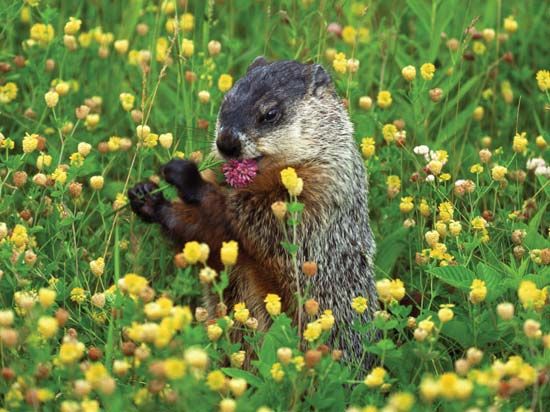
What are the main predators of groundhogs and how do they defend themselves?
Groundhogs face predation from a variety of animals across their North American range. Their primary predators include:
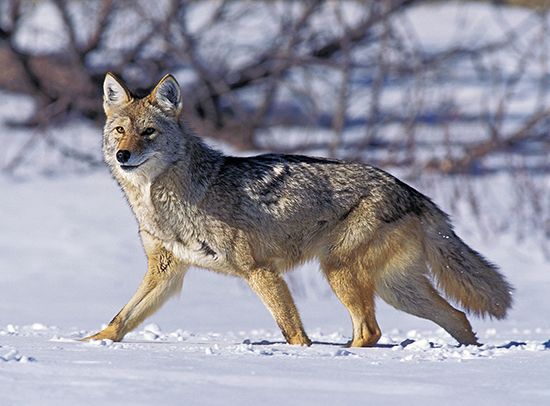
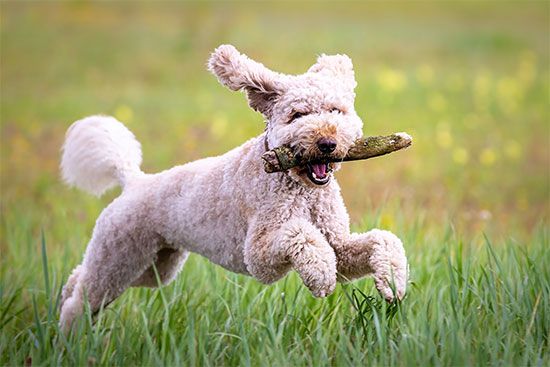
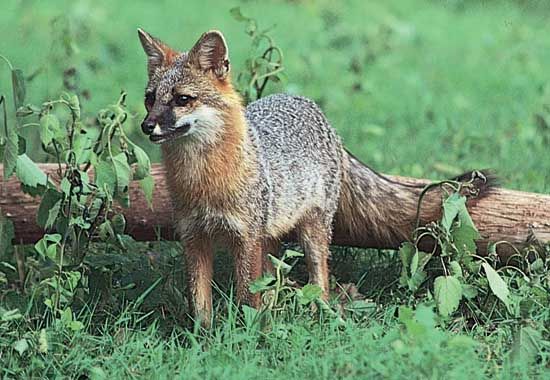
- Mammalian predators: Canids such as wolves, coyotes, dogs, and foxes. Felids like lynx and bobcats, as well as black bears, also hunt them.6
- Other predators: Birds of prey and various species of snakes are also known to prey on groundhogs.6
Regarding defense, groundhogs are well-adapted to evade these threats through their physical capabilities and behavior. They are adept at digging deep and extensive burrow systems, which provide essential refuge from predators. Additionally, despite their stout bodies, groundhogs are capable of climbing tall shrubs and sizable trees to escape danger, and they are also proficient swimmers.6
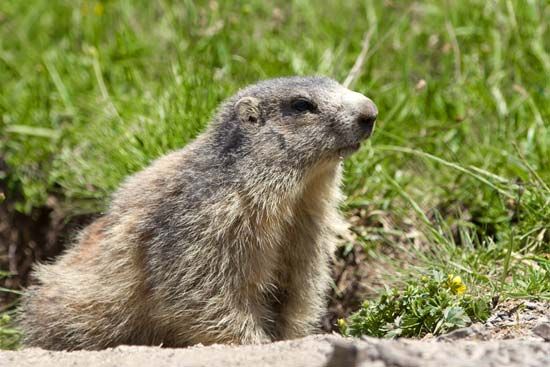
How do groundhogs differ from other marmot species?
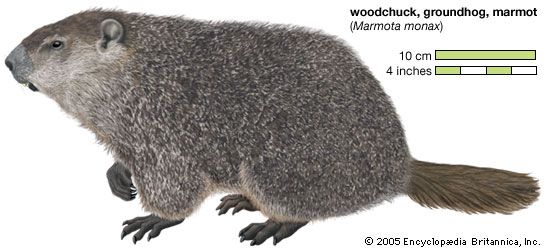
The groundhog (Marmota monax), also known as the woodchuck, is one of 14 species of marmots within the squirrel family. While all marmots share common traits—such as being large, heavy-bodied rodents adapted for digging—groundhogs differ from many of their relatives in several key ways:
- Social Behavior: A primary distinction is that groundhogs are solitary animals, whereas many other marmot species, such as the Alpine marmot and the hoary marmot, are gregarious and social.6
- Habitat: While most mountain-dwelling marmots construct burrows beneath rocky slopes, boulder fields, and cliff crevices for protection, groundhogs typically inhabit forest edges, meadows, and open fields.76
- Activity Patterns: Groundhogs are primarily active during the morning and evening (crepuscular), whereas many other marmot species are diurnal, spending their days sitting on rocks or cliffs to observe their surroundings.76
- Reproductive Frequency: Most marmot species produce young annually; however, some, like the Olympic marmot, have different reproductive cycles, bearing young only every other year.6
What is the significance of the winter solstice and spring equinox in ancient traditions?
In ancient traditions, the winter solstice and spring equinox were pivotal astronomical events that served as foundations for religious, agricultural, and social life.
The Winter Solstice: Rebirth and Light
The winter solstice marks the shortest day and longest night of the year. Because it signals the moment when days begin to lengthen, it was widely celebrated as a time of rebirth and the “return” of the Sun.91011
- Symbolism of Light: Many cultures viewed the solstice as the victory of light over darkness. In ancient Persia, the festival of Yalda celebrated the birthday of the sun god Mithra. Similarly, the Roman religion of Sol observed the solstice as the rebirth of the god and the renovation of life.1012
- Cultural Traditions: Celebrations often involved communal feasts and rituals. The Roman Saturnalia inverted social orders, while the Hopi Soyal ceremony welcomed protective spirits called kachinas.10
- Observatories: The construction of Stonehenge demonstrates a sophisticated understanding of these cycles, with its alignment to the winter solstice sunset indicating its use as an astronomical observatory.13
The Spring Equinox: Renewal and Navigation
The vernal equinox marks the first day of spring, when day and night are of equal length.
- Agricultural Significance: In many ancient societies, the equinox was tied to the cycle of planting and harvesting. Festivals often celebrated the renewal of life in nature, such as the spring festival of the Great Mother in Rome or the Nowruz festival in Zoroastrianism, which symbolizes both the new life of spring and the promise of future restoration.1412
- Scientific Utility: Ancient astronomers utilized the equinox as a “zero point” on the celestial sphere to track the movement of stars. This was essential for navigation, as noted by Julius Caesar in his military planning, and for charting weather patterns.15
Sources
- Groundhog Day: Top Questions — Encyclopædia Britannica
- Groundhog Day — Encyclopædia Britannica
- Why Don't We Call It 'Woodchuck Day'? — Merriam-Webster
- Burrowing into 'Groundhog Day' — Merriam-Webster
- Groundhog Day — Merriam-Webster
- groundhog — Encyclopædia Britannica
- marmot — Encyclopædia Britannica
- Tundra - Alpine mammals — Encyclopædia Britannica
- Winter solstice — Encyclopædia Britannica
- 7 Winter Solstice Celebrations From Around the World — Encyclopædia Britannica
- How was Stonehenge built? — Encyclopædia Britannica
- Winter solstice: Top Questions — Encyclopædia Britannica
- Mesopotamian religion - Sacred times — Encyclopædia Britannica
- Feast - The significance of seasonal renewal in prehistoric times — Encyclopædia Britannica
- mystery religion - Seasonal festivals — Encyclopædia Britannica
- What Does 'Equinox' Mean? — Merriam-Webster
Published on · 4 min read