Guanabara Bay
Guanabara Bay is a bay of the Atlantic Ocean located in southeastern Brazil. The city of Rio de Janeiro is situated on its southwest shore, while Niterói…
What is the geographical location and size of Guanabara Bay?
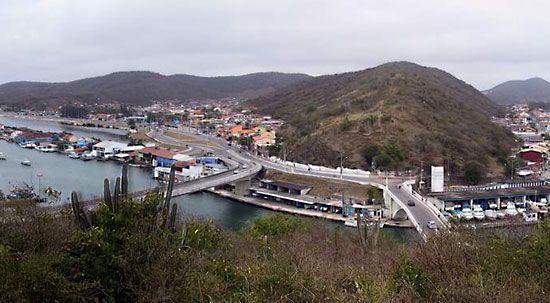
Guanabara Bay is a bay of the Atlantic Ocean located in southeastern Brazil. The city of Rio de Janeiro is situated on its southwest shore, while Niterói lies on its southeast shore.1
Regarding its size, the bay is approximately 19 miles (31 km) long and has a maximum width of 18 miles. It features a narrow entrance that is about one mile wide, flanked by Sugar Loaf Mountain and the São João fortress to the west, and Papagaio Peak and the Santa Cruz fortress to the east. The bay contains numerous islands, the largest of which is Governador Island, covering an area of 12 square miles (31 square km).12
What is the historical significance of Guanabara Bay in Brazil’s development?
Guanabara Bay has been central to Brazil’s development since the early colonial period due to its immense economic and strategic value. Discovered around 1502, the bay became a focal point for European powers, notably attracting French traders seeking pau-brasil (brazilwood). The French even established a short-lived colony, La France Antarctique, on one of the bay’s islands before being expelled by the Portuguese in the 1560s.14
The bay provided the foundation for the city of Rio de Janeiro, which was established on its shores to secure the territory. The surrounding fertile lands were utilized for sugarcane cultivation, which served as the colony’s primary income source. As the region developed, the bay became a critical hub for administration and trade, eventually becoming the colonial capital in 1763.4
Throughout the 18th and 19th centuries, the bay facilitated the movement of goods and people, supporting the growth of the coffee industry and the eventual prosperity of the Brazilian Empire. Today, the bay remains a vital maritime and industrial corridor, connecting Rio de Janeiro to Niterói and supporting diverse economic activities, including shipbuilding and metallurgy.145
How did Guanabara Bay play a role in the founding of Rio de Janeiro?
Guanabara Bay was instrumental in the founding of Rio de Janeiro due to its immense strategic and economic value. In the mid-16th century, the bay became a site of conflict between Portuguese forces and French traders, who had established a colony called La France Antarctique on one of the bay’s islands.15
To expel the French and secure the territory, Estácio de Sá was dispatched by the Portuguese. In 1565, he occupied the plain between the Sugar Loaf and Urca mountains, effectively laying the foundations for the future city. Following years of conflict, the settlement was moved to a more secure location on the bay’s coast, atop what became known as Castle Hill. By 1568, this site was organized as a fortified citadel. The bay’s surrounding fertile lands were subsequently divided into large plots for sugarcane cultivation, which provided the economic foundation for the growing colonial community.5
What is the significance of Sugar Loaf Mountain to the bay’s entrance?
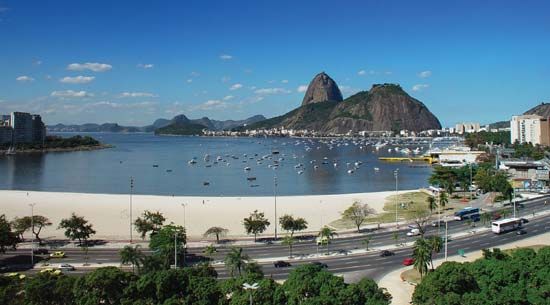
Sugar Loaf Mountain serves as a vital landmark and a defining feature of the entrance to Guanabara Bay in southeastern Brazil. Rising 1,296 feet (395 meters) as a conical, granitic peak, it acts as a prominent geographical marker for the bay’s mile-wide opening from the Atlantic Ocean.714
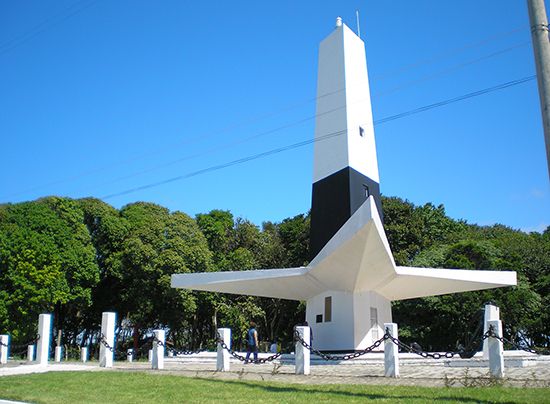
Beyond its role as a natural landmark, the mountain has significant strategic importance. The fortress of São João is situated at its base, which, alongside the Santa Cruz fortress on the eastern side of the entrance, historically provided defensive control over the bay’s access point. Today, Sugar Loaf is widely recognized as a calling card of Rio de Janeiro, symbolizing the city’s unique landscape where coastal mountains meet the sea.714
Sources
- Guanabara Bay — Encyclopædia Britannica
- Rio de Janeiro - Suburbs — Encyclopædia Britannica
- Governador Island — Encyclopædia Britannica
- Guanabara Bay — Merriam-Webster
- Rio de Janeiro - The colonial period — Encyclopædia Britannica
- Rio de Janeiro - City site — Encyclopædia Britannica
- Sugar Loaf — Encyclopædia Britannica
Published on · 3 min read