Galveston Bay
Galveston Bay is an inlet of the Gulf of Mexico located on the southeastern coast of Texas, United States.
What is the geographical location and size of Galveston Bay?
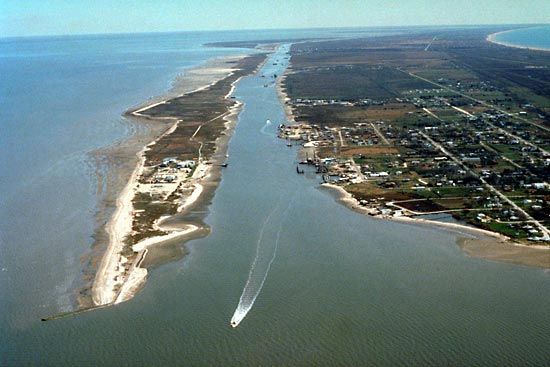
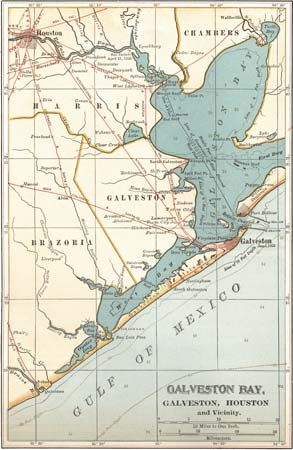
Galveston Bay is an inlet of the Gulf of Mexico located on the southeastern coast of Texas, United States.1
It is the largest estuary in Texas and the seventh largest in the United States. The bay measures approximately 35 miles (56 km) in length and reaches a width of up to 19 miles (31 km). It is a relatively shallow body of water, with an average depth of about 7 feet (2.1 meters). The area is protected from the open waters of the Gulf of Mexico by Galveston Island and the Bolivar Peninsula.1
What role did Galveston Bay play in the early settlement and development of Texas?
Galveston Bay played a pivotal role in the early settlement and development of Texas by serving as a strategic maritime gateway. Its protected waters provided essential anchorage for explorers and settlers, beginning with early Spanish and French interest in the region. In 1785, the bay was named by Spanish pilot José de Evía in honor of Bernardo de Gálvez, the governor of Louisiana.1
The bay’s geography was central to the Texas struggle for independence. During the revolt against Mexico (1835–36), the Texas Navy utilized the bay as a base of operations. Furthermore, the city of Galveston served briefly as the capital of the Republic of Texas during the conflict.2
Beyond its political history, the bay facilitated the region’s economic growth by offering deepwater access to the interior. This connectivity supported the development of major ports, including Houston, and established the area as a critical hub for maritime trade, military supply, and industrial activity.12
How does the Houston Ship Channel relate to Galveston Bay?
The Houston Ship Channel serves as a vital maritime artery that connects the city of Houston to the Gulf of Mexico by passing directly through Galveston Bay.31
The relationship between the two is defined by the following key functions:
- Deepwater Access: The channel provides the necessary deepwater route for large vessels to navigate from the Gulf of Mexico through the bay and inland to the Port of Houston via the San Jacinto River.1
- Industrial Connectivity: By traversing the bay, the channel facilitates the shipping of petroleum and chemical products, supporting the heavy industrialization of the Houston-Galveston region.1
- Historical Development: Following the destruction of Galveston’s port facilities in the 1900 hurricane, the channel—which involved the widening and deepening of the former Buffalo Bayou—allowed Houston to emerge as the state’s leading port.45
Together, they form a critical infrastructure system that balances maritime commerce with the ecological environment of the bay, which remains the largest estuary in Texas.31
What is an estuary and why is it important?
An estuary is a partly enclosed coastal body of water where river water mixes with seawater. These environments are defined by their salinity gradients rather than fixed geographic boundaries, occurring where fresh water is measurably diluted by salt water.6
Why Estuaries Are Important
Estuaries are vital to both ecological health and human society for several reasons:
- High Biological Productivity: Estuaries are among the most productive ecosystems on Earth. Their unique water circulation traps plant nutrients, which stimulates primary production and supports abundant populations of fish and invertebrates, such as crabs, shrimp, and oysters.67
- Nursery Grounds: Many species rely on estuaries as protected nursery grounds. Juveniles find abundant food and shelter from predators in mangrove forests, salt marshes, and sea grass beds before migrating to the open ocean.7
- Commercial Hubs: Historically, estuaries have served as essential harbour sites. Many of the world’s major cities and oldest civilizations flourished in these environments due to their accessibility for trade and commerce.8
- Aquaculture: Estuaries are significant sites for aquaculture, providing space for the cultivation of various seafood species, including salmon, mussels, and shrimp.8
However, because they are located near urban centers, estuaries are highly vulnerable to pollution from sewage and industrial runoff, which can lead to the formation of “dead zones” where oxygen depletion harms marine life.89
Sources
- Galveston Bay — Encyclopædia Britannica
- Galveston — Encyclopædia Britannica
- Houston Ship Channel — Encyclopædia Britannica
- Houston - History — Encyclopædia Britannica
- Houston: Top Questions — Encyclopædia Britannica
- estuary — Encyclopædia Britannica
- estuary - Commercial importance — Encyclopædia Britannica
- estuary - Primary productivity — Encyclopædia Britannica
- river - Origin and classification — Encyclopædia Britannica
- conservation - Pollution — Encyclopædia Britannica
Published on · 3 min read