Hentiyn Mountains
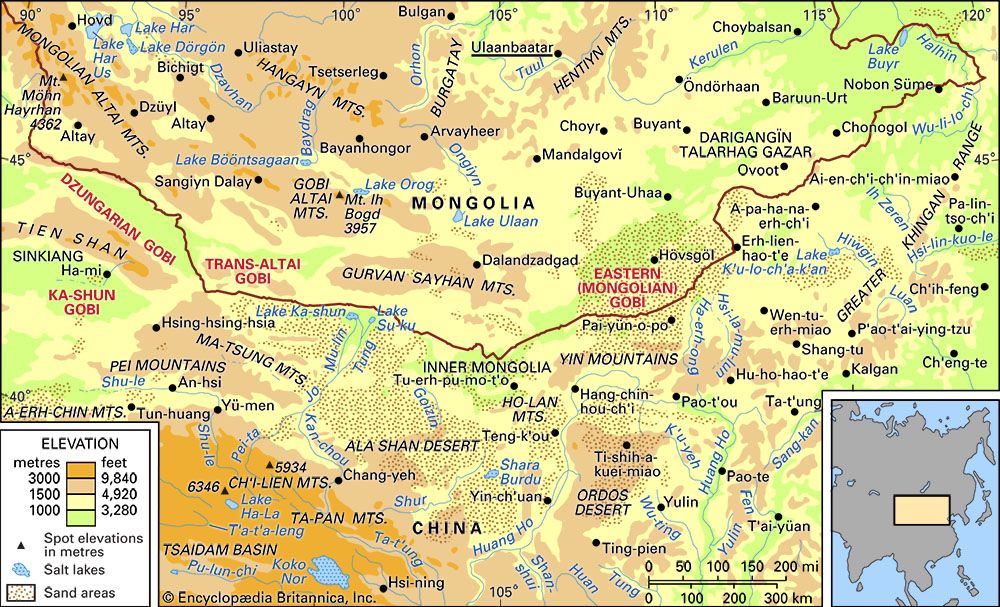
The Hentiyn Mountains (also known as the Khentii Mountains or Khentiin Nuruu) are a major mountain range located in north-central and northeastern Mongolia.
What is Hentiyn Mountains?
The Hentiyn Mountains (also known as the Khentii Mountains or Khentiin Nuruu) are a major mountain range located in north-central and northeastern Mongolia.12
The range extends from the southwestern edge near the national capital, Ulaanbaatar, northeastward to the border with Russia, where it continues into Siberia. Structurally, the Hentiyn Mountains are related to the Yablonovy Range on the Russian side of the frontier, separated by a river valley that forms part of the international boundary.12
While the highest peak, Asraltkhairkhan, reaches approximately 9,200 feet (2,800 metres), the general maximum elevations of the range are around 7,000 feet (2,130 metres). Along with the Altai Mountains and the Khangai Mountains, the Hentiyn range is one of the three primary mountain chains in Mongolia.2
What are the other major mountain ranges in Mongolia?
In addition to the Hentiyn Mountains, Mongolia is defined by two other primary mountain chains that dominate its landscape:
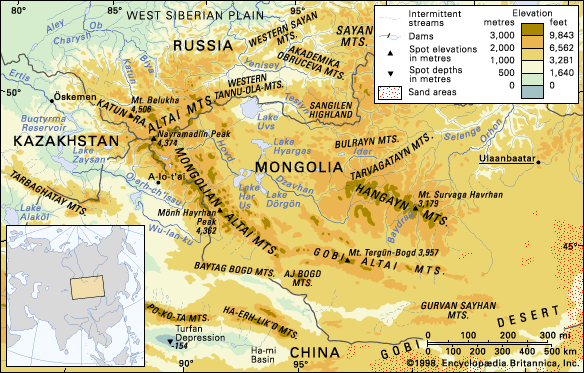
- Altai Mountains: These are the highest and longest mountains in the country, located in the west and southwest. The Mongolian Altai include the nation’s highest point, Khüiten Peak, which reaches 14,350 feet (4,374 metres). This is the only range in Mongolia with contemporary glaciers. Extending from this system are the Gobi Altai Mountains, a lower, more denuded range that transitions into the Gobi desert.23
- Khangai Mountains: Situated in the center of the country, this solid mountain mass features gentle slopes and extensive pastureland. Its highest peak, Otgontenger, rises to approximately 13,200 feet (4,025 metres).2
Additionally, the Sayan Mountains of Siberia run along the northern border with Russia, and the Da Hinggan (Greater Khingan) Range rises along the eastern frontier with China.2
Why is the Khentii region historically significant to Genghis Khan?
The Khentii region is historically significant as the heartland of the tribal league known as “All the Mongols” (Khamag Mongol Uls), which was centered in the valleys of the Onon and Kherlen rivers in the eastern half of northern Mongolia.4
This area served as the ancestral base for Genghis Khan (born Temüujin). As the great-grandson of Khabul Khan—a former ruler of the Mongols—Temüujin emerged from this tribal environment to navigate complex feuds against rival clans and neighboring powers, such as the Tatars and the Juchen-Jin dynasty. The region provided the foundational social and military structure for his rise; by 1206, his success in unifying the various nomadic tribes of the region led to his proclamation as the supreme khan of all the Mongols.56
While the provided search results highlight the importance of the Onon and Kherlen valleys to the Mongol tribal confederation, they do not explicitly detail specific cultural or religious sites within the Khentii Mountains themselves.
What kind of wildlife lives in the Mongolian mountains?
The mountains of Mongolia host a diverse array of wildlife, with species distribution largely determined by elevation and vegetation zones.
High-Altitude and Alpine Zones
The rugged, high-altitude regions—particularly the Altai Mountains—are home to iconic species such as the snow leopard and wild mountain sheep, known as argal or mountain ram. Other inhabitants of these alpine environments include mountain goats and various birds of prey, such as golden eagles, hawks, and kestrels.789
Forested and Steppe Zones
The moist coniferous forests that cloak the lower mountain slopes support a mix of Siberian and Central Asian fauna. Common mammals in these areas include:
- Lynx and brown bears
- Musk deer and roe deer
- Squirrels, badgers, and wild boars
- Small mammals like marmots, jerboas, and members of the Ochotonidae family (pikas)789
Birdlife in these zones is equally varied, featuring species such as the hazel grouse, woodpeckers, and various mountain partridges.89
Sources
- Hentiyn Mountains — Encyclopædia Britannica
- Mongolia - The mountains — Encyclopædia Britannica
- Altai Mountains - Physiography — Encyclopædia Britannica
- history of Mongolia - Ethnography and early tribal history of Mongolia — Encyclopædia Britannica
- Mongolia - The rise of Genghis Khan — Encyclopædia Britannica
- history of Mongolia - The rise of Genghis Khan — Encyclopædia Britannica
- Mongolia - Animal life — Encyclopædia Britannica
- Altai Mountains - Animal life — Encyclopædia Britannica
- Tien Shan - Animal life — Encyclopædia Britannica
Published on · 3 min read