Hangayn Mountains
The Hangayn Mountains (also known as the Khangai Mountains) are a major mountain range located in central Mongolia. The range stretches approximately 500…
What is Hangayn Mountains?
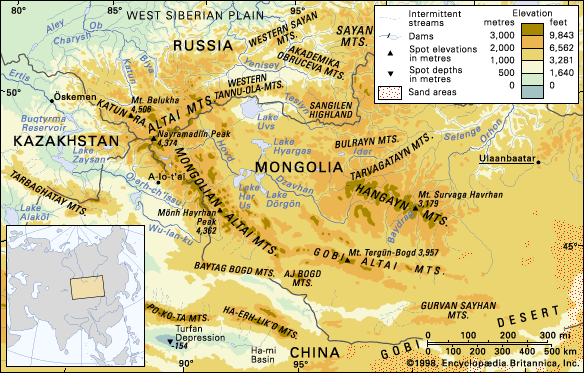
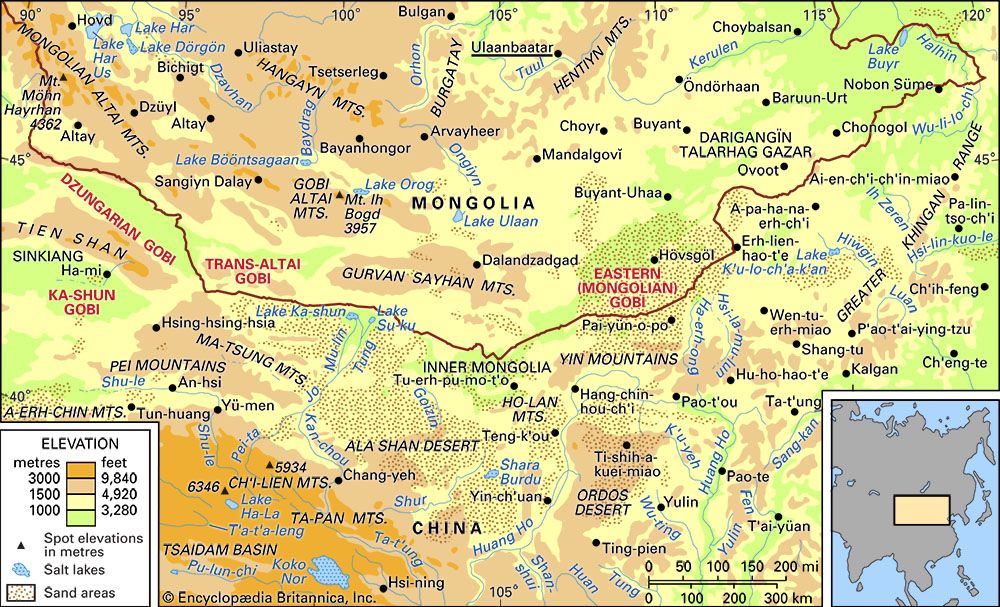
The Hangayn Mountains (also known as the Khangai Mountains) are a major mountain range located in central Mongolia. The range stretches approximately 500 miles (805 km) in a northwest-southeast direction, running parallel to the Altai Mountains to the south Altai Mountains to the south. Its highest point is Otgon Tenger Peak, which reaches an elevation of 12,812 feet (3,905 meters).1
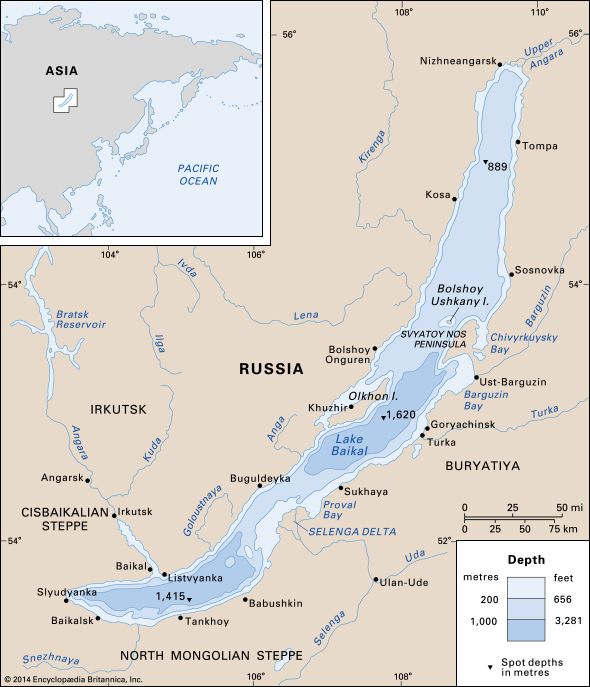
The range features distinct drainage patterns: rivers on the northern slopes generally flow into the Selenge River and its tributary, the Orhon, eventually reaching Lake Baikal in Siberia. Conversely, the rivers originating from the steeper southern slopes terminate in salt lakes or dissipate into the Gobi Desert.1
What is the significance of the Gobi Desert in Mongolia?
The Gobi Desert is a vast, climatically extreme region that plays a significant role in the geography, economy, and history of Mongolia.
Geographic and Climatic Significance
The Gobi is a “cold desert” characterized by extreme seasonal temperature fluctuations, ranging from bitter winters below −40 °C (−40 °F) to hot summers exceeding 40 °C (104 °F). Its high elevation and location in the rain shadow of the Himalayas create an arid environment that supports a unique ecosystem of hardy flora and fauna, such as the Bactrian camel.2
Economic and Cultural Impact
- Nomadic Pastoralism: The Gobi is central to the traditional Mongolian way of life. Nomadic livestock raising—primarily of sheep, goats, and camels—is the primary economic activity, relying on underground water supplies.3
- Resources and Infrastructure: The region contains valuable mineral deposits, including coal, copper, and petroleum. It is also a vital transit corridor, connected by highways and railroads that link Mongolia to international trade routes.3
- Scientific and Historical Value: The Gobi is a site of immense paleontological importance, known for its exceptionally preserved dinosaur fossils. Additionally, its arid climate has preserved significant archaeological sites, including ancient caravan tracks and Paleolithic remains.4
How does the climate of the Hangayn Mountains affect local wildlife?
The provided search results do not contain information regarding how the climate of the Hangayn Mountains specifically affects local wildlife. While the sources describe the geography and relief of the Hangayn Mountains, they do not provide details on the region’s fauna or the ecological impact of its climate.81
Information regarding wildlife in high-mountain environments is available for other ranges, such as the Karakoram Range, but this cannot be applied to the Hangayn Mountains.9
What are the main characteristics of the Altai Mountains?
The Altai Mountains are a complex, jagged mountain system in Central Asia, spanning 1,200 miles (2,000 km) across Russia, Mongolia, China, and Kazakhstan. Their name is derived from the Turkic-Mongolian word altan, meaning “golden.”10
Physiography and Geology
The system is divided into the Altai proper, the Mongolian Altai, and the Gobi Altai. Geologically, the range was formed by ancient mountain-building upthrusts and later reshaped by Quaternary glaciation, which carved rugged, U-shaped valleys. The region remains tectonically active, with frequent earthquakes and rich mineral deposits, including gold, mercury, and tungsten.11
Climate and Vegetation
The climate is severely continental, characterized by long, bitter winters and short, cool summers. Precipitation varies significantly, being highest in the west and decreasing toward the east. Four distinct vegetation zones exist:12
Sources
- Hangayn Mountains — Encyclopædia Britannica
- Why is the Gobi Desert called a cold desert? — Encyclopædia Britannica
- Gobi - People and economy — Encyclopædia Britannica
- Gobi — Encyclopædia Britannica
- Mongolia - Climate and soils — Encyclopædia Britannica
- Gobi - Animal life — Encyclopædia Britannica
- Gobi - Study and exploration — Encyclopædia Britannica
- Karakoram Range - Plant and animal life — Encyclopædia Britannica
- Mongolia - The mountains — Encyclopædia Britannica
- Altai Mountains — Encyclopædia Britannica
- Altai Mountains - Physiography — Encyclopædia Britannica
- Altaisky Nature Reserve — Encyclopædia Britannica
- Altai Mountains - Climate — Encyclopædia Britannica
- Altai Mountains - Geology — Encyclopædia Britannica
- Altai Mountains - Plant life — Encyclopædia Britannica
Published on · 3 min read