Hog
The term hog primarily refers to a domesticated pig that has reached a certain maturity or weight. In the United States, the term is commonly used to…
What is Hog?
The term hog primarily refers to a domesticated pig that has reached a certain maturity or weight. In the United States, the term is commonly used to distinguish larger swine—typically those weighing more than 120 pounds (54 kg)—from younger, smaller pigs. Historically, the term was associated with heavy, fat-producing animals, though modern breeding has shifted toward producing leaner meat.123
Beyond its agricultural definition, the word has several other meanings:
- Animal husbandry: In Britain, the term (often spelled hogg) can refer to a young, unshorn sheep or the wool from such an animal.2
- Figurative usage: It is frequently used to describe a person who is gluttonous, selfish, or someone who consumes resources to excess.2
- Verb usage: As a verb, “to hog” means to take more than one’s fair share, or in specific technical contexts, to cut a horse’s mane short or to cause an object to arch or curve upward.4
What are the main differences between wild boars and domestic pigs?
There is very little biological difference between wild boars and domestic pigs, as both belong to the same species, Sus scrofa. Domestic pigs are descendants of wild stocks, and the primary distinctions are largely related to their physical development and human-influenced traits.67
The main differences include:
- Tusks: The most notable physical difference is in their teeth. Wild boars possess well-developed, sharp tusks used for foraging and defense, whereas the tusklike teeth of domestic pigs are significantly less developed.7
- Selective Breeding: Domestic pigs have been shaped by centuries of selective breeding to meet human needs. This has resulted in various types categorized by their purpose, such as lard, bacon, or pork production, with modern efforts focusing on producing leaner meat.72
- Behavior and Lifestyle: Wild boars are swift, nocturnal, and generally live in groups (except for older, solitary males). In contrast, domestic pigs are managed in agricultural settings, where their growth, diet, and reproduction are controlled by farmers.872
How has selective breeding changed the way pigs are raised for food?
Selective breeding has fundamentally transformed pig production by shifting the focus from traditional, multi-purpose farming to highly specialized, efficient systems designed to meet specific market demands.
Evolution of Breeding Goals
Historically, pigs were often bred as heavy, fat-producing animals to meet the demand for lard. However, as vegetable oils became more affordable in the 1920s, the industry shifted its focus toward producing leaner meat. Breeders utilized crossbreeding to combine desirable traits from different lines—such as selecting boars for rapid weight gain and sows for their ability to produce large litters.109
Modern Production Techniques
The way pigs are raised has been revolutionized by several key advancements:
- Genetic Specialization: Producers now use purebred lines to concentrate specific genes, such as maternal characteristics (litter size) or paternal traits (meat quality and growth rate).10
- Artificial Insemination: This technology allows for the widespread use of boars with the highest genetic merit. By diluting semen, a single ejaculate can facilitate dozens of inseminations, significantly accelerating the genetic improvement of entire herds.10
- Systematized Operations: Breeding is now often integrated into specialized production cycles, such as farrow-to-finish or farrow-to-feeder operations, which optimize labor and resources.11
What are some of the most popular breeds of pigs used in agriculture today?
Today, the global pork industry relies on several key breeds, often utilized in crossbreeding programs to combine maternal traits like large litter sizes with paternal traits like rapid growth and high meat quality.14
Some of the most prominent commercial breeds include:
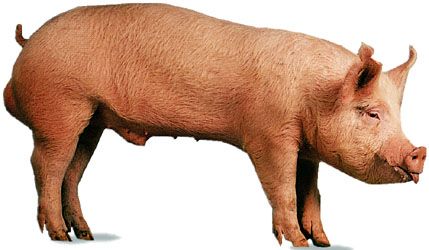
- Yorkshire: Often considered the most widely distributed breed in the world, this white, erect-eared pig is highly valued for its lean meat and prolific sows.129
- Landrace: A white, lop-eared breed found throughout Europe and the United States. It gained global prominence due to its development in Denmark for the export of high-quality bacon.9
- Duroc: Recognized for its golden-red to mahogany-red coat, this breed is prized for its meat quality and is extensively used in North and South America.129
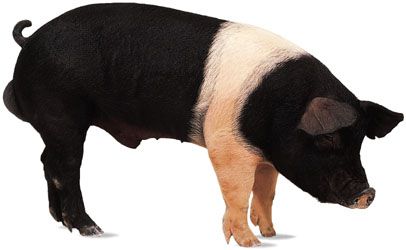
- Hampshire: A distinctive black breed with a white belt encircling its shoulders and front legs. It is known for being an active, alert grazer.129
- Berkshire: Noted for the quality of its meat, this breed is used for fresh pork production in markets such as Japan and England.9
Sources
- Hog — Encyclopædia Britannica
- Pig — Encyclopædia Britannica
- hog — Merriam-Webster
- hog — Merriam-Webster
- Hog house — Encyclopædia Britannica
- wild boar — Encyclopædia Britannica
- List of pigs — Encyclopædia Britannica
- boar — Encyclopædia Britannica
- Origins of agriculture - Hogs — Encyclopædia Britannica
- Livestock farming - Breeding and growth — Encyclopædia Britannica
- Livestock farming - Production systems — Encyclopædia Britannica
- Livestock farming - Breeds — Encyclopædia Britannica
- Animal breeding - Accuracy of selection — Encyclopædia Britannica
- Yorkshire — Encyclopædia Britannica
Published on · 3 min read