Hydrostachyaceae
Hydrostachyaceae is a plant family within the order Cornales, consisting of a single genus, Hydrostachys, which includes approximately 20 species.
What is Hydrostachyaceae?
Hydrostachyaceae is a plant family within the order Cornales, consisting of a single genus, Hydrostachys, which includes approximately 20 species.1
These plants are primarily aquatic herbs native to Madagascar and regions of central and southern Africa. Their leaves typically grow in rosettes and are often highly divided, featuring small fringed or scaly appendages.1
The family is characterized by its unique reproductive structures:
- Flowers: The flowers are unisexual, very small, and densely packed along a spike inflorescence. Male flowers contain a single stamen, while female flowers possess two elongate styles.1
- Fruit: The fruit develops as a capsule containing numerous tiny seeds tiny seeds.1
What are some other examples of aquatic plants?
Aquatic plants are diverse organisms that have adapted to life in water, whether rooted in substrate or floating freely. While they are often confused with seaweed—which are actually algae and not true plants—aquatic plants possess specialized tissues like true roots, stems, and leaves.23
Here are several examples of aquatic plants categorized by their characteristics:
Freshwater Flowering Plants
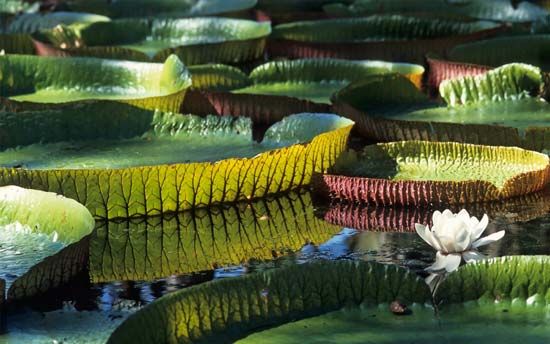
- Water Lilies: Members of the order Nymphaeales, these are well-known for their showy flowers and floating leaves.4
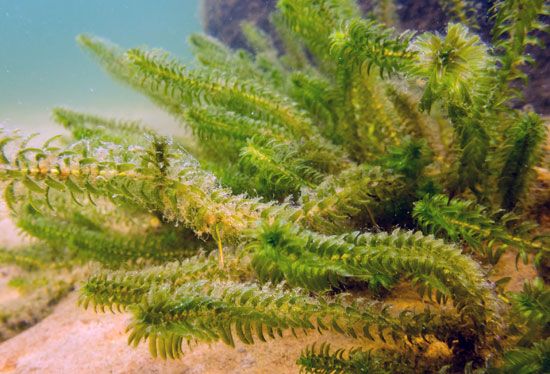
- Elodea: A common submerged plant often used in aquariums and scientific experiments.5
- Vallisneria: Also known as eelgrass, these plants are frequently used in aquatic gardens.5
- Hydrilla: A genus known for being a highly invasive aquatic weed in many regions.5
- Water Shield: A member of the Cabombaceae family, often found in quiet freshwater habitats.4
Other Notable Aquatic Plants
- Water Hyacinth: A well-known example of a plant that floats without anchorage.2
- Lotus: A classic example of an aquatic plant rooted in mud.2
- Mangroves: Trees and shrubs that thrive in saline or brackish coastal environments.6
- Seagrasses: Flowering plants that have adapted to life in marine environments, forming extensive underwater meadows.3
How do plants adapt to living in fast-flowing water?
Plants living in fast-flowing water face the constant threat of being dislodged and washed away by currents. To survive in these environments, they have evolved specialized mechanisms to anchor themselves firmly to the substratum, such as the development of holdfasts.
While aquatic plants generally benefit from the well-oxygenated, nutrient-rich conditions provided by flowing water, they must overcome the physical stress of the current. Unlike terrestrial plants, which require significant structural support to stand against gravity, aquatic plants often rely on the surrounding water for buoyancy. Consequently, their internal anatomy is frequently simplified; for example, they may possess reduced vascular tissue because the water provides the mechanical support that would otherwise be supplied by woody xylem.910
These adaptations allow plants to exploit the advantages of flowing habitats—such as continuous access to nutrients and protection from certain predators—while minimizing the risk of being swept away.9
What are the defining characteristics of the order Cornales?
The order Cornales is recognized as the basalmost order of the core asterid clade of flowering plants. Comprising six families and over 590 species, these plants exhibit several consistent morphological traits.13
Defining Characteristics
- Growth Habit: Most members of the order are woody plants.13
- Floral Structure: The flowers typically feature parts in multiples of four and possess unjoined (free) petals.13
- Ovaries and Fruit: A primary characteristic is the presence of inferior ovaries containing several carpels. The resulting fruits are generally fleshy and contain stony seeds.13
- Phylogenetic Position: As the basalmost order of the core asterids, Cornales represents an early lineage within this significant group of flowering plants.13
Major Families
The order is dominated by three primary families, each with distinct features:
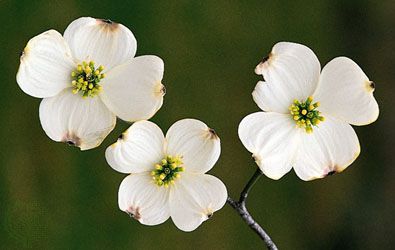
- Cornaceae: The largest family, including the well-known Cornus (dogwood) genus, often noted for showy bracts that surround small flowers.13
- Hydrangeaceae: Typically robust herbs or shrubs with opposite leaves and flowers that often feature enlarged, petal-like sepals.13
- Loasaceae: Often characterized as coarse herbs or shrubs, frequently possessing stinging hairs and flowers with numerous radiating stamens.13
Sources
- Hydrostachyaceae — Encyclopædia Britannica
- aquatic plant — Merriam-Webster
- Hydrocharitaceae — Encyclopædia Britannica
- seed dispersal - Hydrochory: dispersal by water — Encyclopædia Britannica
- Nymphaeales — Encyclopædia Britannica
- Is seaweed a plant? — Encyclopædia Britannica
- Seaweed — Encyclopædia Britannica
- Inland water ecosystem - Biota of inland waters — Encyclopædia Britannica
- Biosphere - Water currents — Encyclopædia Britannica
- angiosperm - Leaves — Encyclopædia Britannica
- tree - Tree structure and growth — Encyclopædia Britannica
- angiosperm - Structural basis of transport — Encyclopædia Britannica
- Cornales — Encyclopædia Britannica
- angiosperm - Eudicots — Encyclopædia Britannica
Published on · 3 min read