Jimsonweed
Jimsonweed (Datura stramonium) has a long history of use by various Indigenous peoples across the Americas, including the Algonquin Indians, for its potent…
How has jimsonweed been used historically in medicine and rituals?
Jimsonweed (Datura stramonium) has a long history of use by various Indigenous peoples across the Americas, including the Algonquin Indians, for its potent properties.12
Ritual and Medicinal Use
Historically, the plant has been utilized in religious and folk ceremonies for its ability to act as a hallucinogen and deliriant, often to induce spiritual visions. Beyond ritualistic applications, the plant serves as a source of medicinal alkaloids, such as atropine, scopolamine, and hyoscyamine.123
Safety Warning
It is critical to emphasize that all parts of the jimsonweed plant are highly poisonous. The same alkaloids that provide its medicinal and hallucinogenic effects can easily result in fatalities if ingested. Users often experience terrifying hallucinations, paranoid delusions, and prolonged side effects, making the plant extremely dangerous for any use.213
How did jimsonweed get its common name?
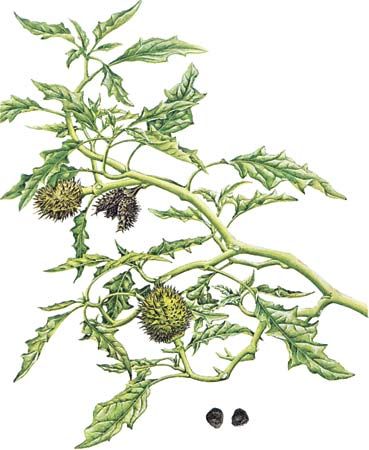
The common name “jimsonweed” is a linguistic derivation of Jamestown, Virginia. The name originated from the town where the plant was notably observed by early European settlers. It is also frequently referred to as thorn apple due to its distinctive, prickly seed pods.156
What is the scientific name of jimsonweed and what family does it belong to?
The scientific name of jimsonweed is Datura stramonium. It belongs to the nightshade family, known botanically as Solanaceae.715
What is jimsonweed and where does it naturally grow?
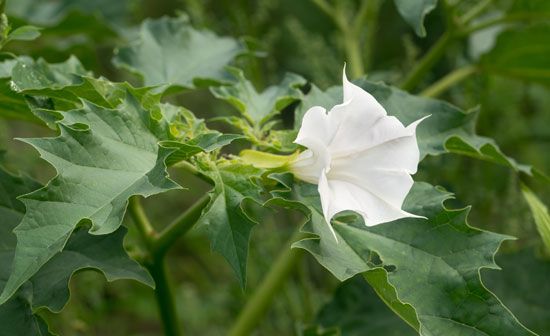
Jimsonweed (Datura stramonium) is a poisonous annual herbaceous plant belonging to the nightshade family. It is characterized by its large, trumpet-shaped flowers and spiky, capsule-like fruit. The plant contains potent alkaloids, such as hyoscyamine and scopolamine, which act as powerful hallucinogens and are highly dangerous; ingestion of any part of the plant can be fatal.124
Regarding its distribution, jimsonweed is believed to be native to Central America but now grows throughout much of North and South America. It is considered an invasive species across much of the Northern Hemisphere, where it thrives as a weed in disturbed habitats, such as along roadsides2.14
Sources
- 9 Mind-Altering Plants - Jimsonweed ( Datura stramonium ) — Encyclopædia Britannica
- Datura — Encyclopædia Britannica
- datura — Merriam-Webster
- Jimsonweed — Encyclopædia Britannica
- jimsonweed — Merriam-Webster
- jamestown lily — Merriam-Webster
- Solanales - Family characteristics — Encyclopædia Britannica
Published on · 2 min read