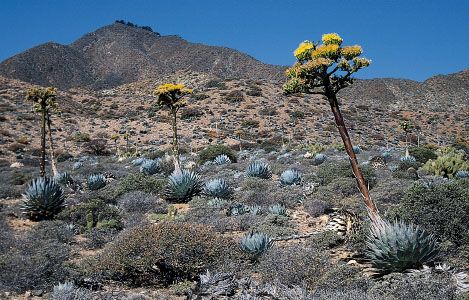
Kaukauveld
The Kalahari is often described as a "thirstland" rather than a true desert, supporting a diverse range of life adapted to its sandy, arid environment.
What are some of the unique plant and animal species that have adapted to life in the Kalahari?
The Kalahari is often described as a “thirstland” rather than a true desert, supporting a diverse range of life adapted to its sandy, arid environment.
Plant Life
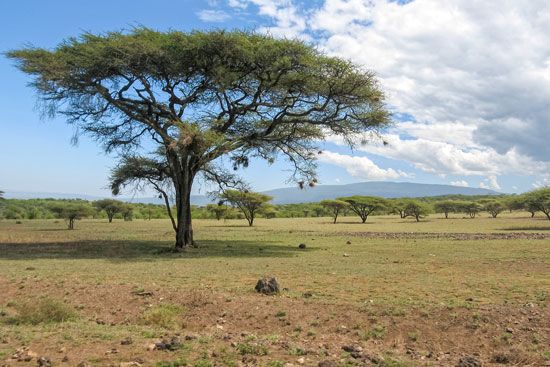
Vegetation is heavily influenced by the deep sand cover. In the drier southwest, plants are primarily drought-tolerant xerophytic shrubs and grasses. As rainfall increases toward the north and east, the landscape transitions into savanna featuring:1
- Acacia: Various species of these trees are common in the central and southwestern regions.12
- Mopane: Also known as the African ironwood, this tree dominates much of the northern and eastern woodlands.23
- Baobab: One of the most iconic and unusual trees of the northern Kalahari, capable of growing to significant heights.13
- Water-loving plants: Areas like the Okavango support reeds, papyrus, and pond lilies.1
Animal Life
The region hosts a wide variety of mammals, birds, and reptiles that have adapted to survive with limited surface water.42
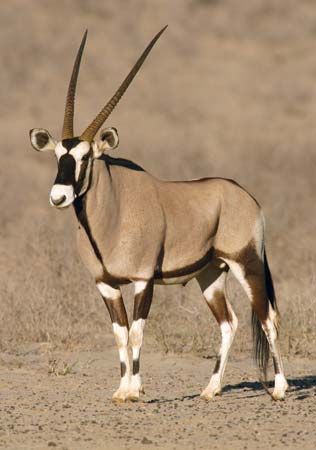
- Large Mammals: The north supports elephants, giraffes, zebras, and buffalo. The southern regions are home to herds of springbok, gnu (wildebeest), hartebeest, and gemsbok.4
- Predators: Lions, leopards, cheetahs, and wild hunting dogs are found in the northern areas.42
- Smaller Species: The desert is home to numerous kudu, duiker, steenbok, and various rodents, reptiles, and birds.42
What is the Kalahari Desert and where is it located in Africa?
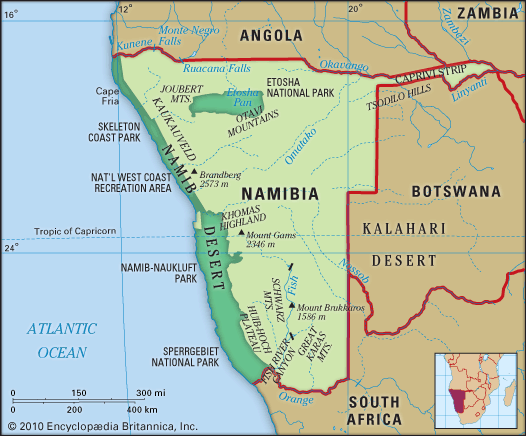
The Kalahari Desert is a vast, basin-like plain situated on the interior plateau of Southern Africa. Spanning approximately 360,000 square miles (930,000 square kilometres), it covers nearly all of Botswana, the eastern third of Namibia, and the northernmost portion of the Northern Cape province in South Africa.6
While often classified as a desert, the region is climatically diverse. The southwestern half meets traditional desert criteria due to low rainfall and high evaporation rates. Conversely, the northeastern portion receives significantly more precipitation but lacks surface water because rain drains rapidly through the deep, sandy soil, resulting in edaphic drought. The landscape is characterized by reddish, alkaline, and nutrient-poor sandy soils, with saline or calcareous conditions near the pans.78
How does the Kalahari Desert compare to other major deserts in Africa, such as the Sahara?
The Kalahari Desert and the Sahara are both classified as hot deserts in Africa, yet they differ significantly in scale and environmental characteristics.7
Scale and Geography
The Sahara is the world’s largest hot desert, covering approximately 8,600,000 square kilometres (3,320,000 square miles) across northern Africa. In contrast, the Kalahari is a smaller basin-like plain in Southern Africa, spanning about 930,000 square kilometres (360,000 square miles).92
Climatic and Physical Differences
- Definition of “Desert”: While the Sahara is a true desert, the Kalahari is often described as a “thirstland.” Only its southwestern portion meets the strict criteria of a desert (where potential evaporation is twice the precipitation). The northeastern Kalahari receives significantly more rainfall but lacks surface water because the moisture drains instantly through deep, sandy soil, creating an “edaphic drought”.6
- Vegetation: Due to these moisture conditions, the northern Kalahari supports open woodlands, palm trees, and forests, whereas the Sahara is characterized by much sparser vegetation.10
- Temperature: Both regions experience high diurnal temperature ranges, but the Kalahari’s relatively high altitude contributes to its specific temperature fluctuations, with winter nights occasionally dropping well below freezing.67
How has tourism impacted the Kalahari Desert and its inhabitants?
Tourism has emerged as an economically significant sector for the Kalahari Desert, alongside mining and the sale of handicrafts. By the mid-1970s, advancements in vehicle mobility opened the entire region to tourist expeditions, study, and hunting, a trend that has persisted into the 21st century.412
The impact of this industry is closely tied to the region’s natural heritage. Namibia, for instance, has established various parks and reserves, such as the Etosha National Park, to celebrate and protect its diverse plant and animal life, which serves as a major draw for visitors. While tourism provides economic opportunities, it operates within a landscape where local inhabitants—such as the Tswana, Kgalagadi, and Herero peoples—primarily rely on cattle pastoralism and subsistence farming. Balancing the growth of the tourism industry with the preservation of the fragile desert ecology and the traditional livelihoods of local communities remains a critical challenge for the region.134
We could dive deeper into how specific conservation efforts, such as transfrontier parks, aim to protect the Kalahari’s biodiversity while managing human impact.
Sources
- Kalahari Desert - Animal life — Encyclopædia Britannica
- Kalahari Desert - Plant life — Encyclopædia Britannica
- Botswana - Plant and animal life — Encyclopædia Britannica
- Kalahari Desert - Bantu-speaking peoples — Encyclopædia Britannica
- Kaukauveld — Encyclopædia Britannica
- Kalahari Desert — Encyclopædia Britannica
- Kalahari Desert - Climate of the Kalahari Desert — Encyclopædia Britannica
- Kalahari Desert - Soils — Encyclopædia Britannica
- world’s largest deserts — Encyclopædia Britannica
- Africa - Climatic regions — Encyclopædia Britannica
- list of deserts — Encyclopædia Britannica
- Kalahari Desert - Study and exploration — Encyclopædia Britannica
- Namibia - Plant and animal life — Encyclopædia Britannica
Published on · 3 min read