Kalahari Desert
Tourism has emerged as an economically significant sector for the Kalahari Desert region, alongside the sale of handicrafts. While the desert was once…
How has tourism impacted the Kalahari Desert region and its inhabitants?
Tourism has emerged as an economically significant sector for the Kalahari Desert region, alongside the sale of handicrafts. While the desert was once largely inaccessible to outsiders due to its harsh environment and lack of surface water, the introduction of motor vehicles in the 20th century transformed the area. By the mid-1970s, improved vehicle mobility opened the entire region to tourist expeditions, hunting, and scientific study.12
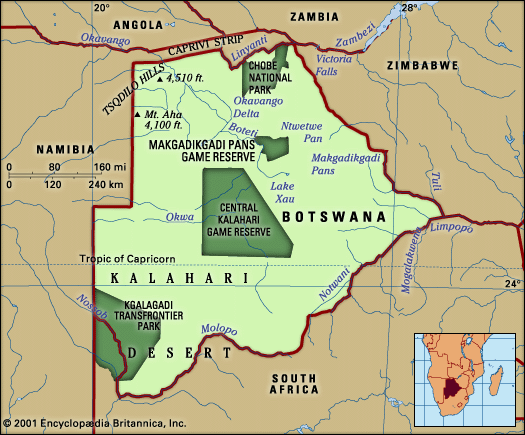
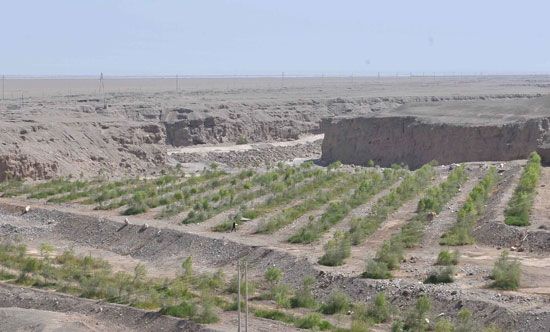
Conservation efforts have also shaped the landscape, most notably through the establishment of the Kgalagadi Transfrontier Park. Formed by the merger of parks in South Africa and Botswana, this protected area serves to safeguard migratory animal populations, including gemsbok, gnu, and various predators. While tourism provides economic opportunities, the region continues to face ecological challenges, such as desertification driven by intensive cattle grazing, which remains a primary economic activity for local inhabitants.31
How does the Kalahari Desert compare to other famous deserts around the world?
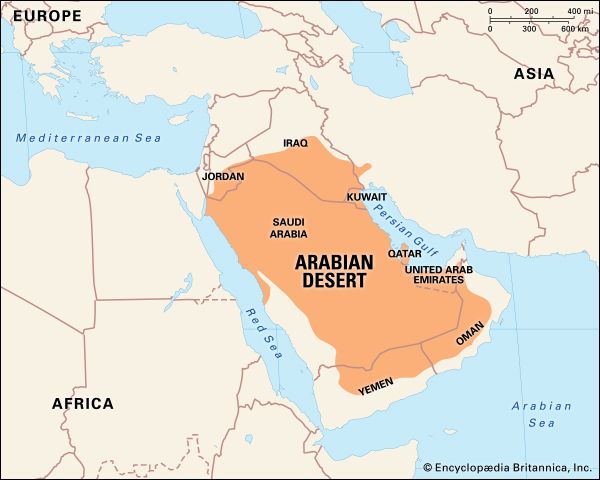
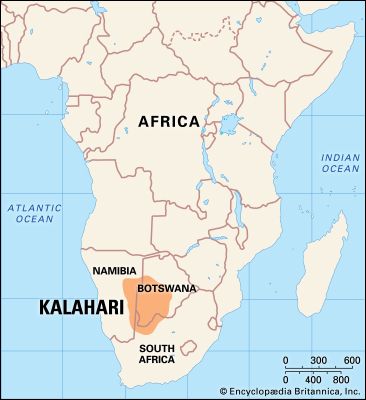
The Kalahari Desert is the world’s sixth-largest desert, covering approximately 930,000 square kilometers (360,000 square miles) in southwestern Africa. Unlike many of the world’s most famous deserts, such as the Sahara or the Arabian Desert, the Kalahari is often characterized by its unique “edaphic drought”—a condition where the region lacks surface water despite receiving more rainfall in its northeastern portions than a traditional desert definition would allow.45
Key comparisons include:
- Size and Classification: While the Antarctic Ice Sheet and the Arctic are the world’s largest deserts due to their low precipitation, the Kalahari is a significant subtropical desert. It is larger than the Patagonian and Great Basin deserts but smaller than the Gobi.4
- Landscape: Much of the Kalahari is a high-altitude, sand-covered plain, featuring sand sheets and longitudinal dunes that differ from the rocky or gravelly surfaces found in other arid regions.6
- Biodiversity: Unlike the most extreme arid zones, the Kalahari supports a surprisingly rich variety of animal life, including large mammals like giraffes and lions in the north, and herds of antelope in the south, which adapt to the absence of surface water.7
What are some of the most notable wildlife species found in the Kalahari Desert?
The Kalahari Desert supports a remarkably diverse range of wildlife, with species distribution often varying between the arid south and the more temperate north.
Large Mammals and Antelopes
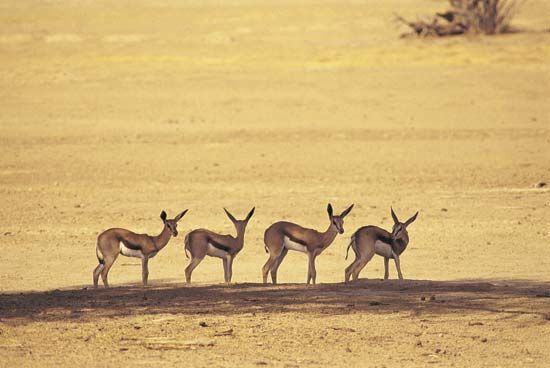
The region is home to numerous antelope species, which are well-adapted to the desert environment. In the arid south, herds of springbok, gnu (wildebeest), and hartebeest are common, alongside gemsbok and eland. The northern Kalahari supports a wider variety of large mammals, including:118
- Giraffes and zebras11
- Elephants and buffalo11
- Additional antelope species such as roan, sable, tsessebe, and impala11
Predators and Other Mammals
The desert’s predator population is significant, featuring lions, cheetahs, leopards, and wild hunting dogs. Smaller carnivores and mammals include:118
- Black-backed jackals, foxes, and hyenas7118
- Caracals and servals8
- Warthogs, baboons, badgers, anteaters, ant bears, hares, and porcupines11
Birds and Reptiles
The Kalahari is home to a prolific array of birdlife, including the ostrich. Additionally, the region hosts a wide variety of reptiles and amphibians, including numerous types of snakes and lizards.7118
How did the Kalahari Desert form, and how old is it?
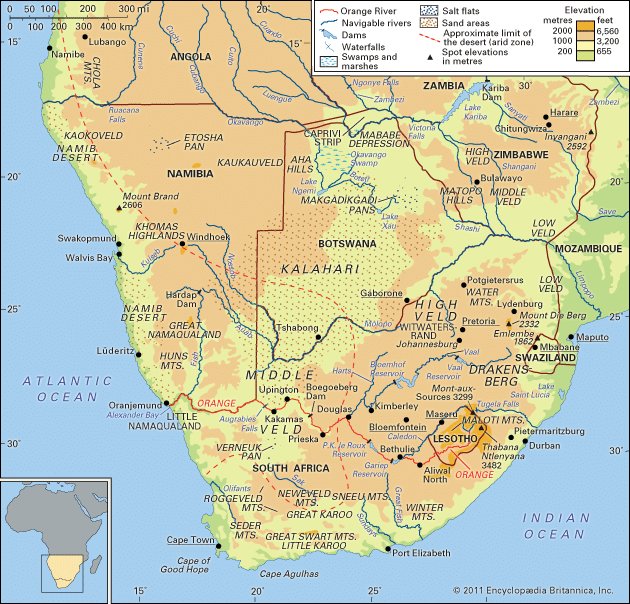
The formation of the Kalahari Desert is a complex process linked to the geological and climatic shifts of the Pleistocene Epoch, which occurred approximately 2,588,000 to 11,700 years ago.6
Geological Formation
The desert is primarily a vast, sand-covered basin. Its physical features were shaped by several key processes:
- Sand Accumulation: Much of the region’s sand was deposited during the Pleistocene. While some deposits originated from ancient fluvial (river) activity during periods of higher rainfall, the majority were wind-formed into the extensive sand sheets and longitudinal dunes seen today.6
- Drainage and Pans: The desert lacks traditional drainage to the sea. Instead, ephemeral streams historically ended in depressions, depositing silt and minerals as they evaporated. This created pans—flat, dry lake beds that serve as terminal features of the desert’s drainage system.6
Climatic History
The Kalahari has not always been a desert. Throughout the Quaternary Period, the region alternated between humid phases and dry, arid phases. The modern desertification of the Kalahari is a relatively recent development, with the current arid cycle beginning approximately 3,000 BCE.13
Sources
- Kalahari Desert - Bantu-speaking peoples — Encyclopædia Britannica
- Kalahari Desert - Study and exploration — Encyclopædia Britannica
- Kgalagadi Transfrontier Park — Encyclopædia Britannica
- Kalahari Desert - Climate of the Kalahari Desert — Encyclopædia Britannica
- world’s largest deserts — Encyclopædia Britannica
- Kalahari Desert - Physiography and geology — Encyclopædia Britannica
- Kalahari Desert - Plant life — Encyclopædia Britannica
- Kalahari Desert - Animal life — Encyclopædia Britannica
- Kaukauveld — Encyclopædia Britannica
- Namibia - Plant and animal life — Encyclopædia Britannica
- Botswana - Plant and animal life — Encyclopædia Britannica
- antelope — Encyclopædia Britannica
- Kalahari Desert — Encyclopædia Britannica
- Africa - Pleistocene and Holocene developments — Encyclopædia Britannica
- Makgadikgadi — Encyclopædia Britannica
Published on · 3 min read