Kudu
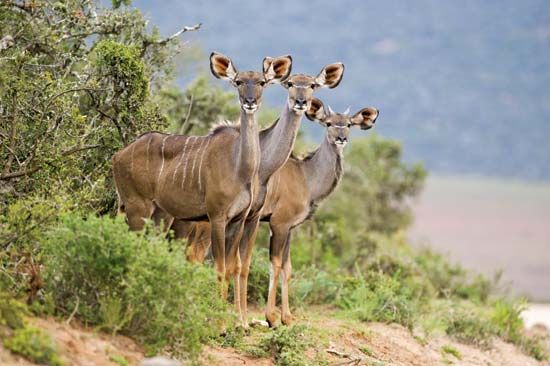
Kudus are social animals that typically form small, stable herds, usually consisting of two to three females and their offspring. These groups exhibit strong…
How do kudus interact socially, and what is their mating behavior like?
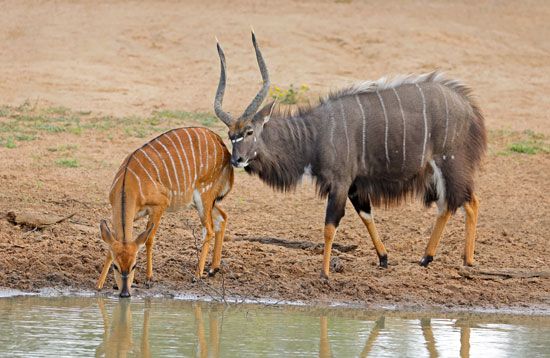
Kudus are social animals that typically form small, stable herds, usually consisting of two to three females and their offspring. These groups exhibit strong social bonds, which are considered more pronounced than those found in other tragelaphine antelopes. The sexes generally remain segregated, except during the mating season. Young males leave the female herds at approximately 1.5 years of age, as their developing horns begin to advertise their gender, and they subsequently join loose bachelor herds. As males age, they tend to become increasingly solitary.1
Regarding mating behavior, kudus follow specific courtship rituals characteristic of tragelaphine antelopes courtship rituals characteristic of tragelaphine antelopes. During these ceremonies, the male follows the female and nuzzles her neck repeatedly. When the male mounts the female, he rests his neck along hers so that their heads make contact. Males may also utilize flehmen behavior—sniffing or licking the female’s urine and curling their lips—to determine if she is in heat.2
What are the different species of kudu, and how do they differ?
There are two distinct species of kudu, both of which are spiral-horned antelopes belonging to the tribe Tragelaphini.1
Greater Kudu (Tragelaphus strepsiceros)
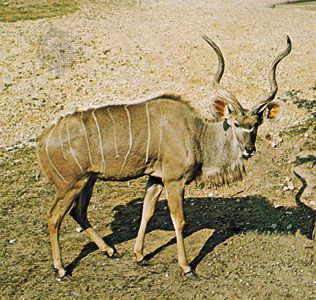
The greater kudu is the second-largest antelope in Africa. Males are significantly larger than females, standing 130–150 cm tall and weighing up to 315 kg. They are characterized by:51
- Horns: Possess the longest horns of any antelope (120–180 cm), which take six years to complete two full turns.1
- Appearance: Their coat ranges from reddish brown to blue-gray with 6–10 vertical white stripes, a nose chevron, and a beard in males.1
- Habitat: Widely distributed in the southern African Bushveld, though they are restricted to mountainous woodlands in East Africa.1
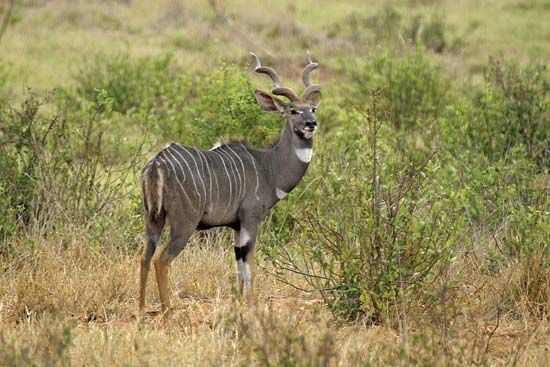
Lesser Kudu (T. imberbis)
The lesser kudu is a smaller, more elusive species found in arid thornbush regions of East Africa.1
- Horns: Mature males have shorter horns (60–90 cm) that make two and a half turns.1
- Appearance: They are more vividly marked with 11–15 vertical white stripes and lack the beard found on greater kudu males.1
- Size: They stand about 100 cm tall and weigh between 92–108 kg.1
What is the typical diet and feeding behavior of kudus?
Kudus are cover-dependent browsers that maintain a diverse diet, consuming more than 100 different types of vegetation. Their nutritional intake includes trees, shrubs, vines, herbs, seedpods, and fruits, supplemented by small amounts of new grass.1
Their feeding behavior is closely tied to their environment and the changing seasons. During the dry season, both species rely on the green growth found along watercourses. When the rains arrive, they disperse throughout deciduous woodlands to forage.1
The ability to consume green vegetation allows these antelopes to inhabit waterless regions, as they obtain much of their necessary moisture from their food. However, greater kudus still regularly visit water holes to drink. Because they are cover-dependent, they rely on dense vegetation not only for their food supply but also for concealment, which is essential to their survival strategy.1
What are the distinctive physical features of a kudu?
Kudus are characterized by their striking, camouflaged coats and distinctive spiral horns, which are found only on males. While both the greater kudu and lesser kudu share these traits, they possess unique physical differences.1
Shared Features
- Horns: Both species feature corkscrew-shaped horns that serve as an indicator of a male’s dominance status.1
- Concealment Markings: Both have vertical white torso stripes, nose chevrons, and cheek patches, which help them blend into thickets.1
- Dorsal Crest: Both species possess a short, erectile crest along their spine.1
Species-Specific Differences
- Size: The greater kudu is significantly larger, with males standing up to 150 cm tall, whereas the lesser kudu is more svelte, standing about 100 cm tall.1
- Striping: The greater kudu typically has 6–10 vertical stripes, while the lesser kudu is more vividly marked with 11–15 stripes.1
- Facial and Neck Features: Greater kudu males have a beard that darkens with age, a feature absent in the lesser kudu. Conversely, the lesser kudu features broad white patches on the chest and throat.1
Sources
- kudu — Encyclopædia Britannica
- artiodactyl - Reproduction — Encyclopædia Britannica
- Animal social behavior - Social interactions involving sex — Encyclopædia Britannica
- Sperm competition — Encyclopædia Britannica
- greater kudu — Merriam-Webster
Published on · 3 min read