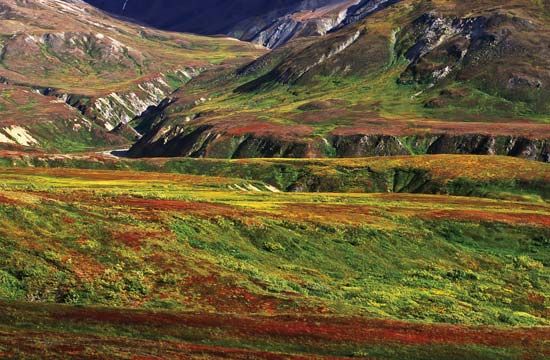
Kolyma Upland
The Kolyma Upland is a mountain tract located in northeastern Siberia, Russia. It consists of a complex mass of ranges and uplands characterized by deep…
What is Kolyma Upland?
The Kolyma Upland is a mountain tract located in northeastern Siberia, Russia. It consists of a complex mass of ranges and uplands characterized by deep river valleys and gorges, with several peaks exceeding 5,000 feet (1,500 m) in elevation.1
Geographically, the upland lies along the northeastern shores of the Sea of Okhotsk, serving as a divide between that sea and the Kolyma Lowland, which drains northward into the East Siberian Sea. The region is sparsely populated and primarily covered by desolate tundra. While the area is rugged, gold mining is a significant economic activity in the valley of the upper Kolyma River. Historically, this region is also noted for the brutal forced-labour camp system established during the rule of Joseph Stalin, where more than one million prisoners perished between 1932 and 1954.12
What is the significance of the Kolyma River in Siberian geography?
The Kolyma River is a vital geographical feature of northeastern Siberia, stretching 1,323 miles (2,129 km) from its source in the Kolyma Upland to the East Siberian Sea.21
Its significance is defined by several key characteristics:
- Hydrology: The river acts as a primary drainage system for a 250,000-square-mile basin. Its course transitions from narrow, rapid-filled mountain gorges to a wide, meandering floodplain in the Kolyma Lowland.2
- Climate Impact: The river experiences extreme seasonal fluctuations. Because the upper reaches thaw before the lower course, the region faces severe ice jams and widespread flooding during the spring.2
- Economic and Historical Context: The upper basin is notable for its gold deposits, which have been the region’s primary economic driver. Tragically, this area was also the site of a brutal forced-labour camp system under Joseph Stalin, where over one million people perished.21
How does the tundra climate affect life in northeastern Siberia?
The tundra climate in northeastern Siberia profoundly shapes life by creating an environment defined by extreme cold, permafrost, and a very short growing season.45
Environmental Constraints
- Permafrost and Soil: The presence of permanently frozen subsoil prevents deep drainage, leading to marshy, acidic, and poorly drained landscapes. This frozen ground makes agriculture difficult and presents significant engineering challenges for infrastructure, such as roads and buildings, which are prone to subsidence and frost heaving.675
- Vegetation: The climate supports only cold-tolerant, low-lying vegetation like lichens, mosses, sedges, and dwarf trees. While summer daylight hours are long, the extreme temperature fluctuations—with frosts possible even in summer—limit plant growth and biodiversity.45
Human Adaptation
- Traditional Livelihoods: Indigenous groups have historically adapted to these conditions through reindeer herding, fishing, and hunting. These practices often involve nomadic movements to follow seasonal resources, reflecting a deep integration with the environment.8910
- Modern Settlement: In the 20th century, industrial development—including mining and energy exploration—led to the establishment of new urban centers. Today, the population is largely divided between non-Indigenous groups living in these industrial towns and Indigenous populations who continue to maintain traditional rural lifestyles.11
What was the historical impact of the Kolyma labor camps?
The Kolyma labor camps, which operated in the upper Kolyma River valley between 1932 and 1954, represent a profound humanitarian catastrophe under the rule of Joseph Stalin. These camps were established primarily to exploit the region’s gold deposits, serving as a brutal instrument of the Soviet state’s forced-labour system.2
The historical impact of this complex was devastating:
- Human Cost: The camps were characterized by extreme conditions that led to the deaths of more than one million prisoners. This loss of life was a direct consequence of the inhumane treatment and environmental severity inherent in the Soviet penal system of that era.2
- Economic Exploitation: The camps were integral to the Soviet effort to extract resources from the inhospitable Arctic and sub-Arctic regions. By utilizing forced labor, the state sought to drive economic production in remote areas where traditional labor was unavailable or prohibitively expensive.2
- Systemic Terror: The Kolyma camps were part of a broader pattern of state-sponsored repression, which included the mass deportation of millions of citizens and the use of famine as a tool of political control.15
Sources
- Kolyma Upland — Encyclopædia Britannica
- Kolyma River — Encyclopædia Britannica
- Caucasus - Climate — Encyclopædia Britannica
- Taiga - Climate — Encyclopædia Britannica
- Asia - North and Central Asia — Encyclopædia Britannica
- permafrost - Highways and railroads — Encyclopædia Britannica
- permafrost - General issues — Encyclopædia Britannica
- Russia - Tundra — Encyclopædia Britannica
- Taiga - Other plants — Encyclopædia Britannica
- Siberia — Encyclopædia Britannica
- Arctic - Adaptations to local environments — Encyclopædia Britannica
- Arctic - History of settlement — Encyclopædia Britannica
- Siberian peoples — Encyclopædia Britannica
- Arctic - Biological resources — Encyclopædia Britannica
- Soviet Union - The Party versus the peasants — Encyclopædia Britannica
Published on · 3 min read