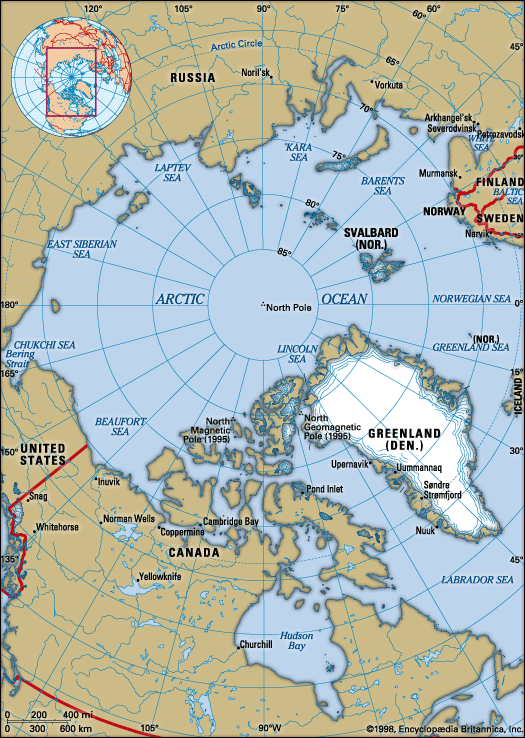
East Siberian Sea
The East Siberian Sea is a marginal sea of the Arctic Ocean located between the New Siberian Islands to the west and Wrangel Island to the east.
What is East Siberian Sea?
The East Siberian Sea is a marginal sea of the Arctic Ocean located between the New Siberian Islands to the west and Wrangel Island to the east.1
Spanning approximately 361,000 square miles (936,000 square km), the sea is characterized by its shallow nature, with depths ranging from 30 to 65 feet (9 to 20 meters) in its central and western regions, reaching a maximum depth of 510 feet (155 meters). It is connected to the Laptev Sea via the Dmitrya Lapteva, Eterikan, and Sannikov straits, and to the Chukchi Sea through the Long Strait.1
Due to its harsh climate, the sea is covered by ice for much of the year, limiting navigation to the months of August and September. Key ports serving the region include Pevek and Ambarchik.1
What is the Northern Sea Route?
The Northern Sea Route is a maritime shipping lane that traverses the Arctic along the northern coast of Eurasia, primarily off the coast of northern Siberia in Russia. Historically known as the Northeast Passage, it serves as a vital connection between the Atlantic and Pacific oceans.34
The route spans approximately 3,500 miles (5,600 km) and passes through the Kara, Laptev, East Siberian, and Chukchi seas3. Because the region remains icebound for much of the year, the route is challenging to navigate and requires the support of specialized icebreakers to maintain a navigable channel.34
While the route was historically sought as a trade passage, it is currently used primarily for domestic Russian cargo, such as transporting fuel, ore, and timber to and from northern ports. Interest in the route has grown in recent years due to improvements in icebreaker technology and a general trend toward longer ice-free periods, which are linked to global warming.345
How does sea ice affect navigation in the Arctic?
Sea ice is a primary obstacle to navigation in the Arctic, as it creates physically impenetrable barriers that remain for most of the year in many regions. The presence of extensive ice fields, which can reach thicknesses of several feet and feature massive hummocks, necessitates the use of specialized icebreakers—ships with reinforced bows designed to break and maintain navigable channels.368
The impact of sea ice on shipping includes:
- Seasonal Constraints: Navigation is often limited to short periods during the summer months when ice cover is reduced.36
- Operational Hazards: Beyond solid ice sheets, ships face dangers from drift ice and icebergs. Decaying icebergs, in particular, shed smaller fragments known as “growlers” and “bergy bits,” which are difficult to detect via radar but possess enough mass to severely damage or sink vessels.9
- Navigational Complexity: In areas like the Bering Sea, ice is compounded by severe winter storms, fog, and powerful currents, making it one of the most challenging environments for maritime transit.6
While global warming has led to a reduction in Arctic sea ice extent and longer ice-free seasons, which may facilitate easier navigation, the region remains a high-risk environment requiring sophisticated tracking and ice-management protocols.3109
What kind of wildlife lives in the Arctic Ocean?
The Arctic Ocean supports a specialized ecosystem dominated by warm-blooded mammals, as well as various fish and bird species that have adapted to the extreme cold and seasonal light cycles.11
Marine Mammals
Mammals are the dominant macrofauna in the Arctic. Key species include:
- Whales: The beluga and narwhal are true Arctic residents, while the bowhead whale is found in regions like the Beaufort Sea and Baffin Bay.11
- Seals: The ringed seal and bearded seal are typical Arctic species, alongside migratory harp seals and hooded seals.11
- Polar Bears: These are essentially aquatic animals that rely on sea ice to hunt seals.1112
Fish and Invertebrates
Fish diversity is relatively low in the Arctic zone, with approximately 25 species. Abundant species include the arctic char and small gadids like the polar cod and arctic cod. These fish are supported by a unique food web based on algae (diatoms) that grow within the sea ice, which in turn supports zooplankton and amphipod crustaceans.1113
Marine Birds
While most Arctic birds are migratory, they are abundant during the summer. Common groups include:
- Auk family: Murres, guillemots, and little auks.11
- Gulls and Terns: Including the arctic tern, which performs a massive migration to subantarctic waters.11
- Others: Sea ducks (eider, scoter), jaegers, and the fulmar.11
Sources
- East Siberian Sea — Encyclopædia Britannica
- Laptev Sea — Encyclopædia Britannica
- Northeast Passage — Encyclopædia Britannica
- North Sea — Encyclopædia Britannica
- Arctic - Environmental concerns — Encyclopædia Britannica
- sea ice - The emerging impacts of recent changes to sea ice — Encyclopædia Britannica
- Arctic - Water transport — Encyclopædia Britannica
- Bering Sea and Strait - Navigation — Encyclopædia Britannica
- iceberg - Iceberg detection, tracking, and management — Encyclopædia Britannica
- icebreaker — Merriam-Webster
- Arctic - Marine fauna — Encyclopædia Britannica
- sea ice - Ice salinity , temperature, and ecological interactions — Encyclopædia Britannica
- Polar ecosystem - Biota of the Arctic — Encyclopædia Britannica
- Arctic - Animals of the land and fresh water — Encyclopædia Britannica
- Arctic - Climate of the Arctic — Encyclopædia Britannica
- Ectotherm — Encyclopædia Britannica
- Arctic National Wildlife Refuge — Encyclopædia Britannica
- fish processing - Cold storage — Encyclopædia Britannica
Published on · 3 min read