Krimmler Waterfall
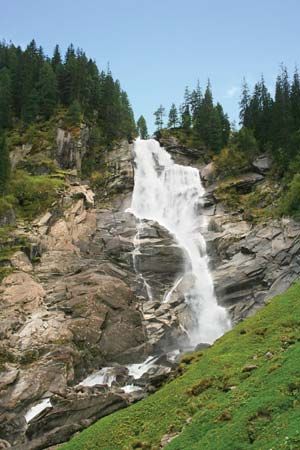
The Krimmler Waterfall is a prominent waterfall located on the Krimmler River in the federal state of Salzburg, Austria.
What is Krimmler Waterfall?
The Krimmler Waterfall is a prominent waterfall located on the Krimmler River in the federal state of Salzburg, Austria.1
As the highest cataract in the Austrian Alps, it features a total drop of 1,247 feet (380 meters) and descends in three distinct stages: upper, middle, and lower. The upper stage is particularly notable, characterized by a dramatic 460-foot (140-meter) drop. Visitors can access the falls via a foot trail or bridle path starting from the village of Krimml.1
How are waterfalls formed by glaciers?
Waterfalls formed by glaciation typically result from the dramatic reshaping of landscapes by ice. The primary mechanisms include:
- Hanging Valleys: Large trunk glaciers erode their main valleys much more deeply than smaller tributary glaciers. Once the ice retreats, these tributary valleys are left at a higher elevation than the main valley floor. Streams flowing from these “hanging” valleys must drop over the steep walls of the main U-shaped trough to join the drainage below, creating waterfalls like those found in Yosemite National Park.234
- Glacial Stairways: As ice moves over bedrock, it can create a series of giant “treads and risers” due to variations in rock resistance. After the ice melts, the resulting steps in the landscape often become the sites of waterfalls or cascades.3
- Glacial Potholes: Plastic flow at the base of a glacier can gouge semicylindrical holes into the bedrock. These depressions are later deepened by meltwater runoff carrying gravel, often forming modern cascades.3
- Ice Damming: Glaciers can block or divert rivers, creating temporary lakes. The subsequent breaching of these ice dams can release massive torrents of water, which erode deep channels and create features like the “fossil” Dry Falls in Washington.5
What other famous natural landmarks are in the Austrian Alps?
The Austrian Alps are home to numerous spectacular natural landmarks shaped by millions of years of tectonic activity and glacial erosion. Notable sites include:
- Grossglockner: As the highest peak in Austria (12,460 feet), this mountain is a centerpiece of the Hohe Tauern range. It is famous for the Pasterze Glacier, one of the most significant ice masses in the Eastern Alps.78
- Salzkammergut: Often referred to as the Austrian “Lake District,” this region is renowned for its stunning mountain and lake scenery. It contains more than 30 lakes, including Hallstätter and Wolfgang, and is framed by limestone massifs like the Dachstein.9
- Kitzbühel Alps: This range offers extensive alpine terrain that serves as a major hub for summer and winter sports, characterized by its rolling peaks and deep valleys.10
- Glacial Landscapes: The region features numerous ice-scoured valleys and deep, elongated lakes that were carved during the Quaternary Period.11
Many of these areas, such as the Hallstatt-Dachstein/Salzkammergut region, are recognized for their unique cultural and natural heritage.12
Why is the Krimmler River important to the local ecosystem?
The Krimmler River is a vital component of the local ecosystem primarily due to its role as a glacial stream, which helps regulate the regional water supply. As a tributary of the upper Salzach, the river benefits from the natural “buffering effect” of glaciers, which store precipitation and release it as meltwater. This process ensures a more stable and consistent streamflow throughout the year, even during varying weather conditions.1
Furthermore, the river carries significant amounts of sediment, including fine-grained rock flour. This material is essential to the character of the region, as it contributes to the distinct green coloration of many Alpine lakes downstream. The river is also famous for the Krimmler Waterfall, the highest cataract in the Austrian Alps, which serves as a prominent natural landmark within this dynamic hydrological system.114
Sources
- Krimmler Waterfall — Encyclopædia Britannica
- glacial landform - Hanging valleys — Encyclopædia Britannica
- river - Falls attributable to constructional processes — Encyclopædia Britannica
- river - Falls attributable to discordance of river profile — Encyclopædia Britannica
- river - Types of waterfalls — Encyclopædia Britannica
- waterfall — Encyclopædia Britannica
- Grossglockner — Encyclopædia Britannica
- Alps - Geology — Encyclopædia Britannica
- Kitzbühel Alps — Encyclopædia Britannica
- list of World Heritage sites - Austria — Encyclopædia Britannica
- Hohe Tauern — Encyclopædia Britannica
- Salzkammergut — Encyclopædia Britannica
- Exploring 7 of Earth’s Great Mountain Ranges - Alps — Encyclopædia Britannica
- glacier - Glacier hydrology — Encyclopædia Britannica
Published on · 3 min read