Mangrove Snake
Mangrove snakes (genus Boiga) are characterized by a broad, triangular head and a body that ranges from long and slender to moderately stout. A defining…
What are the defining physical characteristics of a mangrove snake?
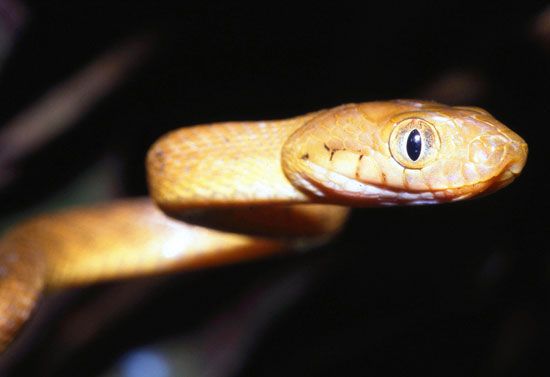
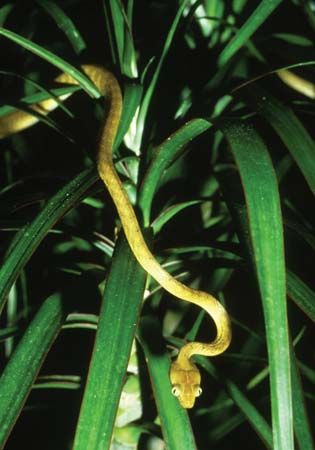
Mangrove snakes (genus Boiga) are characterized by a broad, triangular head and a body that ranges from long and slender to moderately stout. A defining feature of the genus is their elliptical pupils, which have earned them the nickname “cat-eyed snakes”. These snakes are rear-fanged, possessing a Duvernoy’s gland that delivers venom through grooved, backward-curving teeth at the back of the upper jaw.12
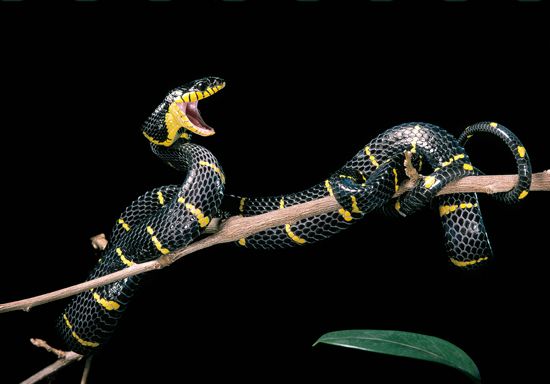
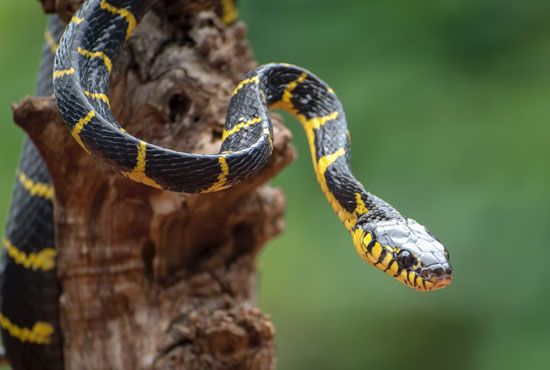
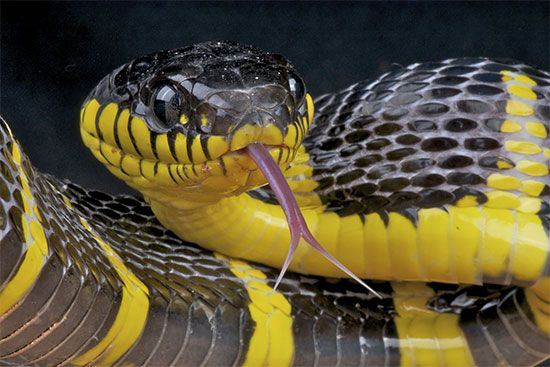
The well-known black-and-yellow mangrove snake (B. dendrophila) typically reaches lengths of 2 to 2.5 meters (6.6 to 8.2 feet). Its body is uniformly black or black above and bluish below, marked by transverse yellow bands that circle its length. Additionally, the species features yellow lips and a yellow throat with black edges. As arboreal animals, they are highly mobile in trees and on the ground, often coiling into an S-shape to lunge at prey or defend themselves.12
Where are mangrove snakes typically found, and what type of habitat do they prefer?
Mangrove snakes (genus Boiga) are widely distributed across South Asia and Australia. Specifically, the black-and-yellow mangrove snake (Boiga dendrophila) is native to Southeast Asia, with a range extending from the Malay Peninsula through Indonesia, Thailand, Vietnam, and the Philippines.23
Regarding their preferred environment, these snakes are strongly arboreal, meaning they spend much of their time in trees. They are typically found in mangrove swamps and tropical lowland forests. While they are highly mobile on the ground, they are often observed coiled around tree branches, sometimes at heights exceeding 30 meters (100 feet). Their natural habitat is currently threatened by human activities, including the conversion of wetlands and forests into farmlands, as well as infrastructure development and aquaculture as well as infrastructure development and aquaculture.231
How venomous are mangrove snakes, and what is their typical behavior towards humans?
Mangrove snakes (genus Boiga) are considered weakly venomous. They possess a Duvernoy’s gland that delivers venom through grooved, backward-curving teeth located at the back of the upper jaw.13
The venom of the black-and-yellow mangrove snake (Boiga dendrophila) contains a specific neurotoxin called denmotoxin. This toxin is highly lethal to birds, as it binds to their neuromuscular receptors to cause paralysis, but it is only mildly toxic to mammals. For humans, a bite from this species typically results in localized swelling and skin discoloration rather than systemic danger.23
Regarding their behavior toward humans, these snakes are generally known to be defensive when threatened. When faced with a potential predator, they may coil their bodies into an S-shape to lunge. While they are sometimes kept as pets, they are wild animals that can be reactive if provoked. It is important to note that other members of the Boiga genus, such as the brown tree snake, are recognized for being significantly more aggressive.31
What do mangrove snakes primarily eat, and how do they hunt their prey?
Mangrove snakes (genus Boiga) are nocturnal hunters that consume a varied diet depending on their life stage and species. Juveniles typically prey on lizards, while adults regularly consume rodents, birds, frogs, and other reptiles, as well as the eggs of these animals.23
These snakes are highly adept at hunting both from tree branches and on the forest floor. They often coil their bodies into an S-shape before lunging at their prey. As rear-fanged snakes, they utilize a specialized venom gland called the Duvernoy’s gland, which delivers a neurotoxin through grooved teeth at the back of the upper jaw. This venom, such as the denmotoxin found in the black-and-yellow mangrove snake, paralyzes prey by blocking neuromuscular transmission.4
Once the prey is subdued, the snake swallows it whole. This process is facilitated by a feeding mechanism known as the pterygoid walk, where the snake uses alternating jaw movements to effectively “walk” its head over the prey, pulling it down the throat using its flexible skull and unfused lower jaws.4
Sources
- Black-and-yellow mangrove snake: Top Questions — Encyclopædia Britannica
- mangrove snake — Encyclopædia Britannica
- Black-and-yellow mangrove snake — Encyclopædia Britannica
- cat snake — Encyclopædia Britannica
Published on · 3 min read