Marlin
Marlins are large, carnivorous marine fishes belonging to the family Istiophoridae, recognized by several distinct physical features.
What are the distinguishing physical characteristics of marlins?
Marlins are large, carnivorous marine fishes belonging to the family Istiophoridae, recognized by several distinct physical features.1
Key characteristics include:
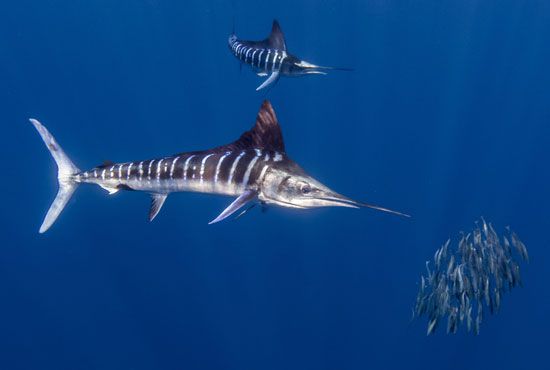
- Body Shape: They possess an elongated body and a long dorsal fin.1
- Snout: A defining feature is the rounded, spear-like projection extending from the snout, which classifies them as billfish.12
- Size and Coloration: While specific traits vary by species, they generally exhibit blue, blue-gray, or blue-green upper bodies with lighter, often silvery or white, bellies. Many species are marked with pale vertical stripes along their sides.1
- Species-Specific Traits: The black marlin is notable for its stiff pectoral fins, which cannot be flattened against the body without force. Sizes vary significantly, with the blue and black marlins reaching weights of 450 kg to over 700 kg, while the white marlin is much smaller, typically maxing out around 45 kg.1
What are the largest species of marlin, and how big can they grow?
The largest species of marlin are the black marlin and the blue marlin, both of which are among the largest perciform fishes.14
- Black Marlin (Istiompax indica): This Indo-Pacific species is widely considered the largest of the marlins. It is known to reach weights exceeding 700 kg (1,500 pounds). Some records indicate they can grow to a length of approximately 4.6 meters (15 feet) and reach weights as high as 748 kg (1,650 pounds).145
- Blue Marlin (Makaira nigricans): Found worldwide, the blue marlin is also a massive fish, often attaining weights of 450 kg (1,000 pounds) or more.1
In comparison, other species such as the striped marlin and the white marlin are significantly smaller, typically maxing out at 125 kg (275 pounds) and 45 kg (100 pounds), respectively.1
How fast can marlins swim, and why are they considered one of the fastest fish in the ocean?
Marlins, particularly the black marlin (Istiompax indica), are widely recognized as the fastest swimmers in the ocean, capable of reaching burst speeds of up to 129 km (80 miles) per hour.1
They are considered among the fastest fish due to their highly specialized hydrodynamics. Because water is a significantly denser medium than air, swimming animals must overcome substantial resistance to move quickly. Marlins have evolved an elongated, streamlined body shape that minimizes drag, allowing them to efficiently propel themselves through the water. Their ability to achieve such high speeds is a result of this specialized body structure, which enables them to navigate the thick fluid medium of the ocean with minimal friction.61
How do marlins use their long snouts for hunting?
Marlins are characterized by a rounded spear extending from the snout, which is a defining feature of these large carnivorous marine fishes. While they are often associated with this spear-like structure, the provided information does not detail the specific mechanics of how they utilize this snout for hunting prey. We know that they are active predators that feed largely on other fishes, but the precise behavioral application of the snout remains outside the scope of the current Britannica knowledge base.1
Sources
- marlin — Encyclopædia Britannica
- billfish — Encyclopædia Britannica
- billfish — Merriam-Webster
- black marlin — Merriam-Webster
- perciform - Size range — Encyclopædia Britannica
- What Is the Most Aerodynamic Animal? — Encyclopædia Britannica
- Ciconiiform - Bill shape — Encyclopædia Britannica
Published on · 2 min read