Middle America Trench
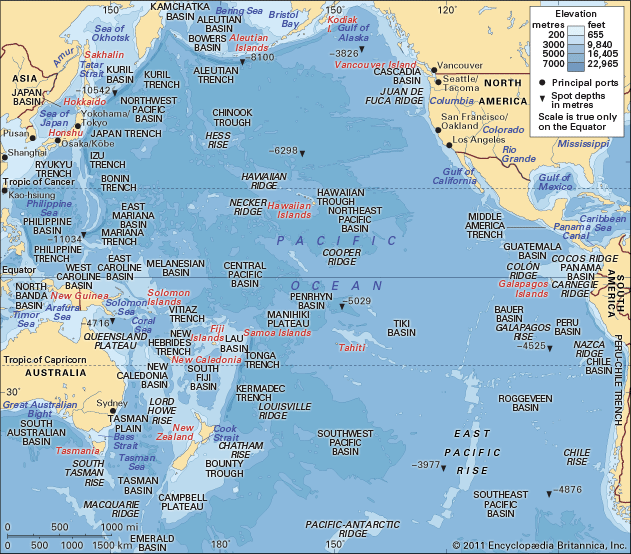
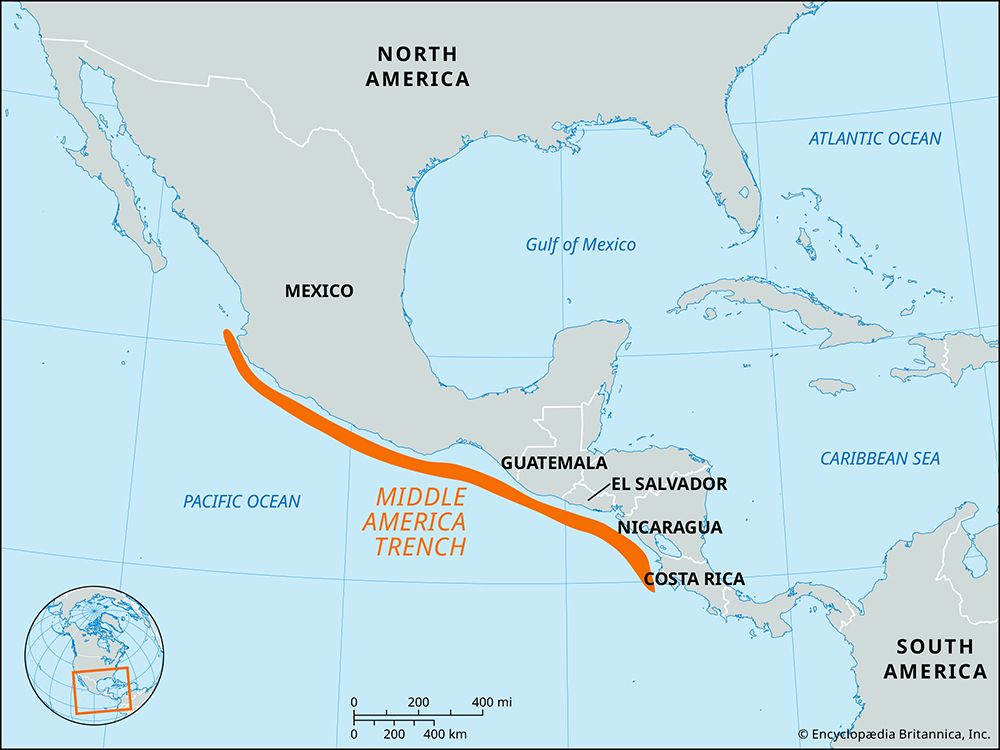
The Middle America Trench is a significant submarine depression located in the Pacific Ocean off the western coast of Central America.
What is Middle America Trench?
The Middle America Trench is a significant submarine depression located in the Pacific Ocean off the western coast of Central America.1
Spanning over 1,700 miles (2,750 km) from central Mexico to Costa Rica, this trench reaches a maximum depth of 21,880 feet (6,669 meters) and encompasses an area of 37,000 square miles (96,000 square km). Its structure varies geographically: the northern section is shallower and curves along the Mexican coast, paralleling the continental shelf, while the deeper southern section follows a more linear path. The southern portion is notably associated with active volcanism on the adjacent land, resulting in an irregular trench floor.1
What is the process of subduction?
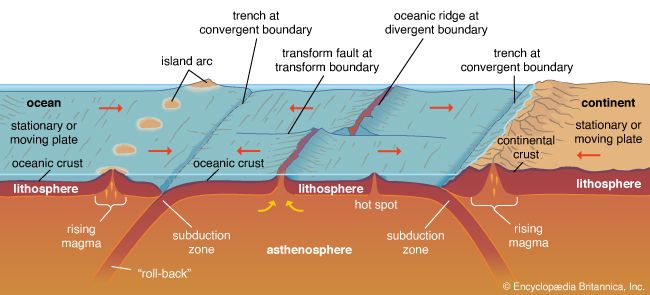
Subduction is a geological process occurring at convergent margins where older, denser oceanic lithosphere underthrusts a continental mass or a younger, less-dense oceanic plate, dragging it downward into the Earth’s upper mantle.2
The Mechanics of Subduction
As the cold, dense oceanic slab descends—typically at an angle between 30° and 60° along the Wadati-Benioff zone—it creates a deep oceanic trench due to frictional drag. During this descent:3
- Accretion: The overriding plate scrapes sediments and crustal fragments off the descending slab, forming an accretionary wedge of deformed rock.3
- Metamorphism: High-pressure, low-temperature conditions transform rocks into blueschists and, at greater depths, eclogites, which increases density and further facilitates the sinking process.3
- Magmatism: At depths of approximately 100 km, the slab releases volatile components that trigger partial melting in the overlying mantle. This generates magma, which rises to form a volcanic arc parallel to the trench.4
How do deep-sea trenches influence volcanic activity?
Deep-sea trenches are fundamental to volcanic activity because they mark the locations of subduction zones, where one tectonic plate is forced beneath another. This process influences volcanism through several key mechanisms:6
- Magma Generation: As an oceanic plate descends, it carries water and carbon dioxide trapped in seafloor sediments into the Earth’s mantle. These volatiles act as fluxes, lowering the melting temperature of mantle rocks and triggering the formation of magma at depths of 100 to 200 km.7
- Volcanic Arcs: This magma is buoyant and rises through the overriding plate, creating a line of volcanoes typically located about 100 km inland from the trench. Depending on the setting, these form either volcanic island arcs, such as the Mariana Islands, or mountain chains like the Andes.876
- Explosive Nature: Subduction-zone volcanoes are often highly explosive. The high gas content—derived from subducted sediments and crustal assimilation—combined with high-viscosity, silica-rich magma, leads to the rapid expansion of gases that drives violent eruptions.7
What are tectonic plates and how do they move?
Tectonic plates are the rigid, rocky segments that make up the lithosphere, Earth’s outermost shell. Typically 50 to 100 km thick, these plates consist of both continental and oceanic crust and rest upon the asthenosphere, a weaker, partially molten layer that allows the plates to slide across the planet’s surface.101112
How Plates Move
While the exact mechanisms are still being studied, scientists generally attribute plate movement—which occurs at rates of 5 to 10 cm per year—to a combination of three primary forces:131112
- Mantle Convection: Heat from the decay of radioactive elements in the Earth’s interior creates convection currents in the mantle. This circular movement of material is believed to propel the plates above.131412
- Slab Pull: At subduction zones, dense, old oceanic crust sinks into the mantle. The weight of this descending slab pulls the rest of the plate along with it.131412
- Ridge Push: At mid-ocean ridges, the elevated ridge position creates a gravitational force that pushes the cooling, denser rock away from the ridge, allowing new magma to rise.131412
As these plates move, they interact at their boundaries by diverging, converging, or sliding past one another along transform faults, processes that drive earthquakes, volcanism, and mountain building.101115
Sources
- Middle America Trench — Encyclopædia Britannica
- subduction zone — Encyclopædia Britannica
- plate tectonics - Subduction zones — Encyclopædia Britannica
- plate tectonics - Island arcs — Encyclopædia Britannica
- North America - Mesozoic and Cenozoic orogenic belts — Encyclopædia Britannica
- How was the Mariana Trench formed? — Encyclopædia Britannica
- deep-sea trench - Structure — Encyclopædia Britannica
- volcano - Subduction volcanoes — Encyclopædia Britannica
- igneous rock - Effects of water and other volatiles — Encyclopædia Britannica
- How do tectonic plates move? — Encyclopædia Britannica
- plate tectonics - Principles of plate tectonics — Encyclopædia Britannica
- plate tectonics - Mantle convection — Encyclopædia Britannica
- plate tectonics — Encyclopædia Britannica
- lithosphere — Encyclopædia Britannica
- plate tectonics - Plate boundaries — Encyclopædia Britannica
- plate tectonics - Transform faults — Encyclopædia Britannica
Published on · 3 min read