Middle Atlas
The Middle Atlas (or Moyen Atlas) is a mountain range located in central Morocco, Africa. It is one of the three distinct chains that make up the Atlas…
What is Middle Atlas?
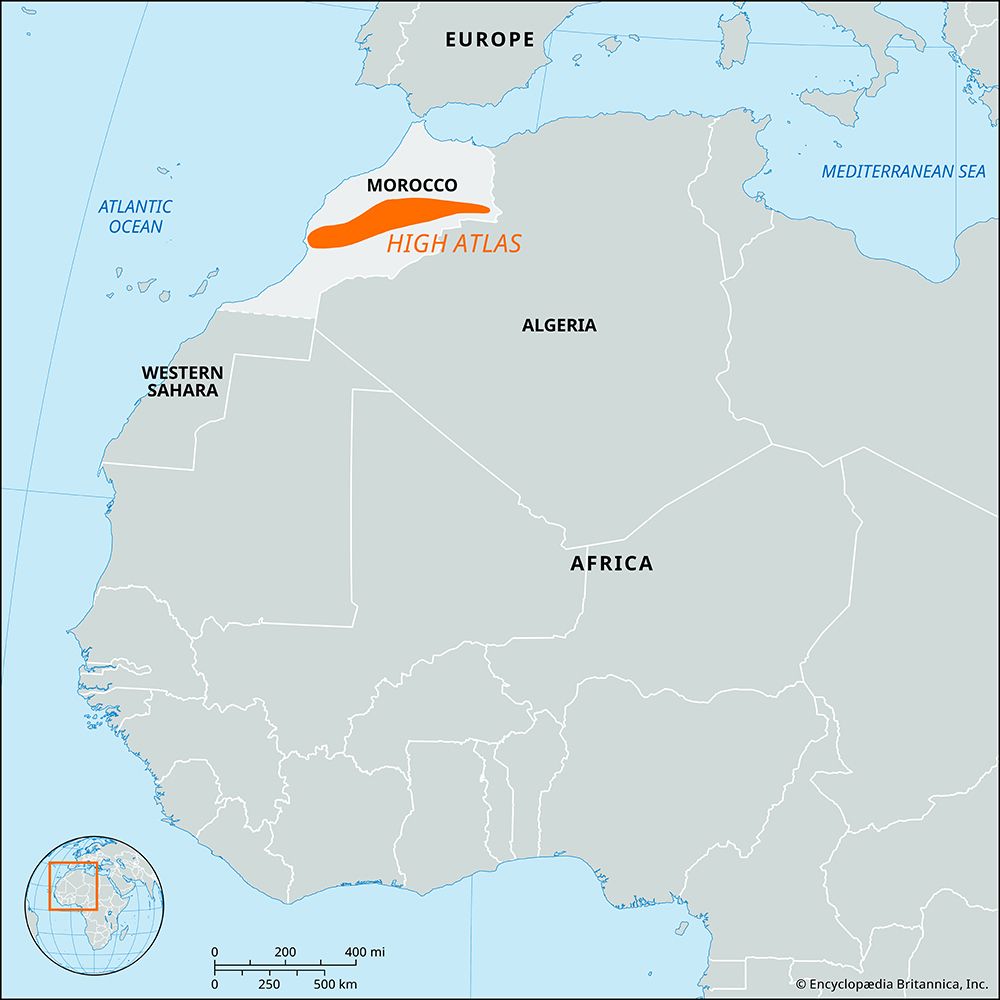
The Middle Atlas (or Moyen Atlas) is a mountain range located in central Morocco, Africa. It is one of the three distinct chains that make up the Atlas Mountains, trending in a northerly direction away from the High Atlas.12
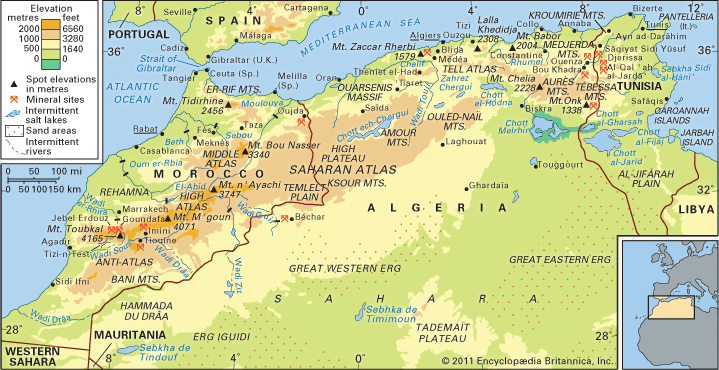
Geographically, the range lies between a region of plateaus and plains to the northwest and the main body of the Atlas Mountains to the southeast. The mountains reach significant elevations, with many peaks exceeding 8,000 feet (2,400 metres) and the highest point, Mount Bou Nasser, reaching 10,958 feet (3,340 metres).12
Characterized by extensive cedar forests, the Middle Atlas serves as a popular area for skiing, hunting, and fishing. The range is also notable for its role in regional connectivity; for instance, the Taza Pass serves as a critical break in the mountain system, facilitating movement between the Rif region and the Middle Atlas.13
How do the High Atlas and Anti-Atlas differ from the Middle Atlas?
The Middle Atlas, High Atlas, and Anti-Atlas are distinct chains within the Atlas Mountains of Morocco, differing primarily in their geography, elevation, and environmental characteristics.
- High Atlas: This is the most prominent chain, extending 460 miles and containing the highest point in the system, Mount Toubkal (13,665 feet). It acts as a major barrier across central Morocco and is characterized by significant mineral deposits, including phosphate.15
- Middle Atlas: Trending northward from the High Atlas, this range is distinguished by its extensive cedar forests and serves as a hub for winter sports, hunting, and fishing. While it reaches impressive heights—up to 10,958 feet at Mount Bou Nasser—it is geographically situated between the northern plains and the main body of the Atlas.215
- Anti-Atlas: Located south of the High Atlas and running toward the Atlantic coast, this is a rugged, arid region with a lower mean elevation of about 5,000 feet. It is significantly drier than the other ranges, receiving less than 17 inches of rainfall annually.36
What types of wildlife and plants are found in the cedar forests of the Middle Atlas?
The cedar forests of the Middle Atlas are characterized by a distinct vertical distribution of plant life and serve as a vital habitat for specific wildlife.
Vegetation
At higher elevations in the Middle Atlas, the landscape is dominated by stands of the Atlas cedar (Cedrus atlantica). These evergreen conifers are well-adapted to the mountainous environment, often growing alongside other species depending on moisture levels. In the broader mountainous regions of Morocco, lower slopes typically feature various oaks, including:69
- Cork oak
- Evergreen oak
- Deciduous oak6
In drier areas or at different altitudes, the vegetation transitions to open forests of thuja, juniper, Aleppo pine, and maritime pine.6
Wildlife
The forests provide a sanctuary for several animal species, most notably the Barbary macaque. These tailless, ground-dwelling monkeys flourish in the Middle Atlas forests under government protection. Other wildlife found within the broader Atlas mountain system—often inhabiting the oak woods or higher elevations—include:36
How does the Taza Gap connect different regions of Morocco?
The Taza Gap, also known as the Taza Pass, serves as a vital strategic corridor that breaks the continuity of the mountain system between the Rif Mountains and the Middle Atlas.134
By providing a natural conduit through these mountainous barriers, the gap connects eastern regions with the Atlantic coastal plains of northwestern Africa. Historically, this passage has been a primary route for movement, allowing successive waves of invaders to travel westward into Morocco. Today, the Taza Gap remains a critical transportation artery, facilitating modern travel as both road and rail links between Algeria and Morocco pass through this corridor.134
Sources
- Middle Atlas — Encyclopædia Britannica
- Morocco - Relief of Morocco — Encyclopædia Britannica
- Atlas Mountains - Climate of the Atlas Mountains — Encyclopædia Britannica
- Atlas Mountains - Transportation — Encyclopædia Britannica
- Anti-Atlas — Encyclopædia Britannica
- Exploring 7 of Earth’s Great Mountain Ranges - Atlas Mountains — Encyclopædia Britannica
- Atlas Mountains - Geology — Encyclopædia Britannica
- Atlas Mountains - Resources — Encyclopædia Britannica
- Cedar — Encyclopædia Britannica
- Barbary macaque — Encyclopædia Britannica
- Morocco - Plant and animal life — Encyclopædia Britannica
- Atlas Mountains - Plant and animal life — Encyclopædia Britannica
- Taza — Encyclopædia Britannica
Published on · 3 min read