Oceanic Plateau
Standard oceanic crust is relatively thin, typically measuring about 6 km (4 miles) in thickness. It is characterized by its density and composition…
What is the typical thickness of an oceanic plateau compared to regular oceanic crust?
Standard oceanic crust is relatively thin, typically measuring about 6 km (4 miles) in thickness. It is characterized by its density and composition, primarily consisting of basaltic layers and gabbros formed at spreading centers.1
In contrast, the term “oceanic plateau” refers to large submarine elevations that rise sharply above the surrounding deep-sea floor. These features are diverse in nature:2
- Marginal Plateaus: These are often downwarped or downfaulted blocks of former continental shelves. While they are located in oceanic regions, the crust underlying them is continental in character, meaning it is thicker than standard oceanic crust.2
- Mid-Ocean Plateaus: These are believed to be isolated fragments of continental rock cores that were separated during processes like continental drift.2
Because these plateaus are generally composed of continental material rather than the dense, thin crust typical of the ocean basins, they possess a significantly greater thickness than the 6 km average of standard oceanic crust.21
How are oceanic plateaus formed, and what geological processes are involved?
Oceanic plateaus are large submarine elevations that rise at least 200 meters above the surrounding deep-sea floor. Their formation is generally attributed to two distinct geological processes depending on their location and composition:
Marginal Plateaus
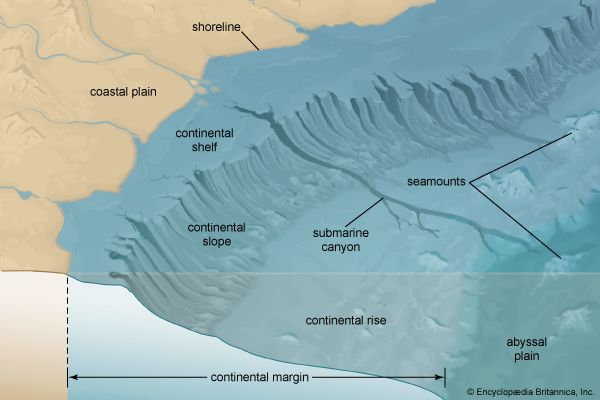
These features are typically formed through tectonic processes that affect continental margins. They are often identified as downwarped or downfaulted blocks of former continental shelves. Although they are located in oceanic regions, the crust underlying these plateaus is continental in character, often covered by a veneer of marine sediments. A prominent example is the Blake Plateau off the southeastern United States.1
Mid-Ocean Plateaus
Plateaus located well beyond continental margins are believed to be isolated fragments of continental rock cores. These are thought to have been separated from larger landmasses during continental drift and seafloor spreading. Over time, these fragments have been overlain by marine sediments, creating isolated topographic highs within the ocean basins.1
It is important to note that some features historically labeled as oceanic plateaus have been reclassified by modern bathymetric data as portions of oceanic ridges, which are formed by the upwelling of magma at divergent plate boundaries.14
What is an oceanic plateau and how does it differ from other underwater features?
An oceanic plateau is a large submarine elevation that rises at least 200 meters (660 feet) above the surrounding deep-sea floor, characterized by an extensive, relatively flat or gently tilted summit.1
These features differ from other underwater formations in their origin and composition:
- Marginal Plateaus: These are often downwarped or downfaulted blocks of former continental shelves. Although located in the ocean, their underlying crust is continental in character, distinguishing them from the thin, dense oceanic crust that typically forms the deep-sea floor.111
- Mid-Ocean Plateaus: Found far from continental margins, these are believed to be isolated fragments of continental rock cores separated during continental drift and seafloor spreading.1
- Comparison to Other Features: Unlike guyots, which are isolated volcanic mountains with flat summits formed by wave erosion, oceanic plateaus are much larger and often continental in origin. Additionally, modern bathymetric data has revealed that some features once classified as plateaus are actually portions of oceanic ridges, which are volcanic mountain ranges formed at divergent plate boundaries.1212
What are some examples of well-known oceanic plateaus around the world?
Several well-known oceanic plateaus illustrate the diverse ways these submarine features form across the globe:
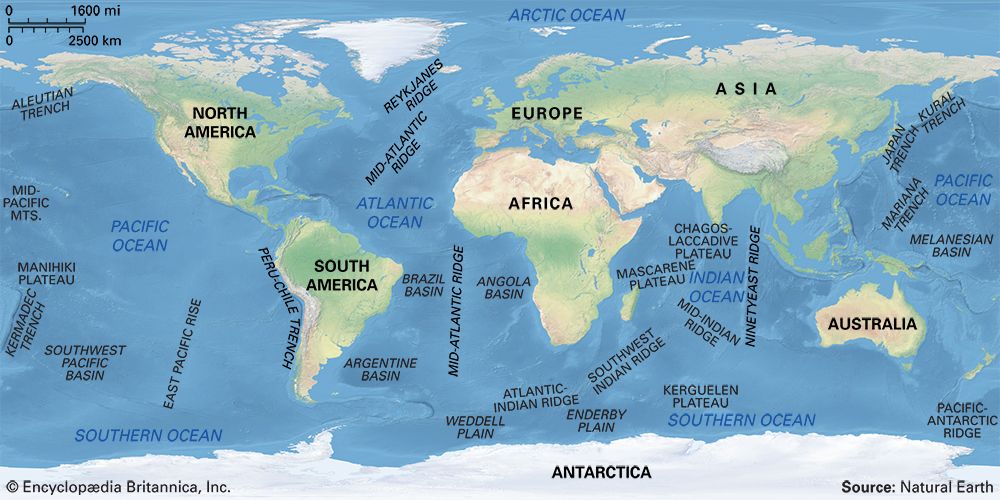
- Blake Plateau: Located off the southeastern United States, this is a classic example of a marginal plateau. It is a vast, flat-topped feature covering approximately 130,000 square kilometers (50,000 square miles). It is considered a downwarped or downfaulted block of the former continental shelf, possessing a crust that is continental in character despite being submerged 700 to 1,000 meters below sea level.1
- South China Sea Plateaus: These are categorized as mid-ocean plateaus. Unlike marginal plateaus, they are found well beyond continental margins as isolated topographic highs. They are believed to be fragments of continent that were isolated during continental drift and seafloor spreading, and they are often capped with coral.1
It is important to note that some features previously identified as plateaus, such as the Albatross Plateau in the eastern equatorial Pacific, have been reclassified by modern bathymetric data as parts of oceanic ridges.1
Sources
- oceanic plateau — Encyclopædia Britannica
- ocean basin - General features — Encyclopædia Britannica
- oceanic crust — Encyclopædia Britannica
- plate tectonics - Hotspots — Encyclopædia Britannica
- hotspot — Encyclopædia Britannica
- plate tectonics - Seafloor spreading — Encyclopædia Britannica
- plate tectonics - Discovery of ocean basin features — Encyclopædia Britannica
- oceanic ridge - Principal characteristics — Encyclopædia Britannica
- plate tectonics - Island arcs — Encyclopædia Britannica
- Europe - Cenozoic igneous provinces — Encyclopædia Britannica
- guyot — Encyclopædia Britannica
- continental shelf - Structure — Encyclopædia Britannica
- ocean basin - Exploration of the ocean basins — Encyclopædia Britannica
- Kerguelen Islands — Encyclopædia Britannica
Published on · 3 min read