Ogre-faced Spider
The ogre-faced spider (family Deinopidae) is a group of approximately 60 tropical spider species named for their distinct appearance, which features one pair…
What is ogre-faced spider?
The ogre-faced spider (family Deinopidae) is a group of approximately 60 tropical spider species named for their distinct appearance, which features one pair of eyes that are unusually large, resembling an ogre.12
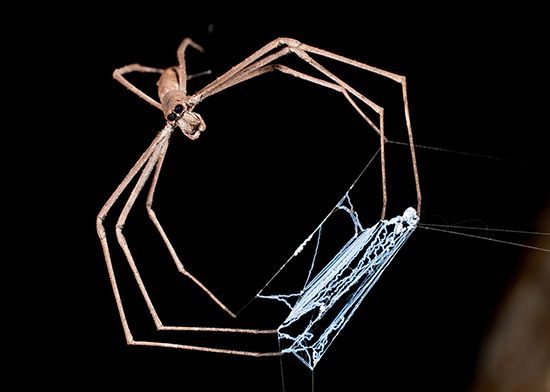
These spiders are also known as net-casting spiders because of their unique hunting method. During the evening, they construct a small, flat web, which they then detach and hold between their four long front legs. When an insect passes by during the night, the spider throws the web over its prey to capture it. By morning, the spider typically abandons or consumes the web and spends the day resting on a branch before repeating the process the following evening.3
Common genera within the family include Deinopis, Menneus (humpbacked spiders), and Asianopis.1
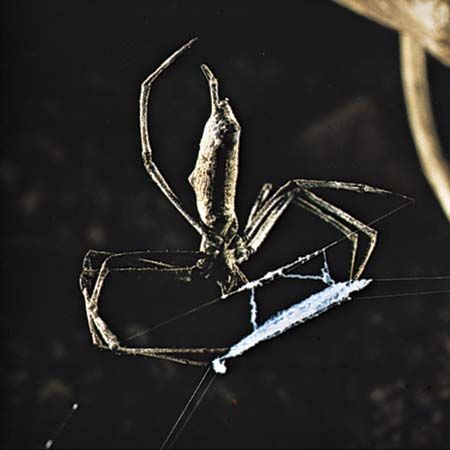
How do net-casting spiders use their legs to throw their webs?
Net-casting spiders, which belong to the family Deinopidae, utilize a specialized hunting technique that involves their four long front legs.
During the evening, these spiders construct a small, flat web. Once the web is complete, the spider detaches it from its initial anchor points and holds the structure spread between its four front legs. The spider then waits in this position throughout the night. When an insect passes within range, the spider actively throws the web over the prey to capture it. By the following morning, the spider typically consumes or abandons the web, spending the day resting on a branch before repeating the process the next evening.24
What are some other unique ways spiders hunt for prey?
Spiders have evolved a remarkable variety of hunting strategies beyond traditional web-building. Here are some of the most unique methods used to capture prey:
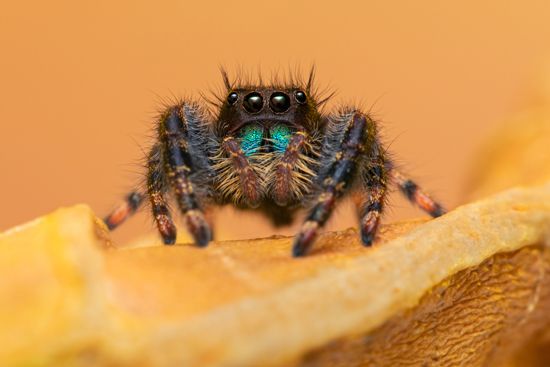
- Active Hunting and Pouncing: Wolf spiders are named for their habit of chasing down prey, while jumping spiders use their keen eyesight to stalk victims before pouncing from a distance of up to 10 cm (4 inches).
- Chemical and Mechanical Mimicry: Bolas spiders use aggressive chemical mimicry by releasing pheromones that attract male moths. They then swing or throw a single sticky silk thread—a “bola”—to capture the moth in mid-air. Similarly, the jumping ant spider mimics the appearance and movement of ants to avoid predators and approach prey undetected.
- Spitting: Spitting spiders employ a unique “spitting” technique, shooting a zigzag stream of sticky, venomous material from their fangs to immobilize prey from a distance.
- Ambush Tactics: Trap-door spiders construct silk-lined burrows with hinged doors, darting out to grab passing insects. Other ambush predators, such as crab spiders, wait on flowers that match their own coloration, using their legs to grasp unsuspecting insects.
Why do some spiders build new webs every single day?
Spiders that build new webs daily, such as many orb weavers, do so primarily because the effectiveness of their traps diminishes over time. The primary reasons for this daily reconstruction include:
- Loss of Stickiness: The spirals of many orb webs are coated with a specialized glue-like substance designed to ensnare prey. This material dries out after several days, significantly reducing the web’s ability to capture insects.213
- Structural Damage: Webs are frequently damaged during the capture of prey or by environmental factors. While spiders often repair small tears, a web that has sustained significant wear must be replaced to remain a functional trap.213
- Efficiency: For species like the net-casting spider, the web is a temporary tool used for a specific hunting period. These spiders consume or abandon their webs each morning, resting during the day before constructing a fresh, high-quality trap for the following night.2
By rebuilding, spiders ensure their webs remain highly efficient “air filters” capable of trapping insects that might otherwise avoid or escape damaged or non-sticky silk.213
Sources
- ogre-faced spider — Encyclopædia Britannica
- spider - Spiderwebs — Encyclopædia Britannica
- spider - Annotated classification — Encyclopædia Britannica
- spider - External features — Encyclopædia Britannica
- arachnid - External features — Encyclopædia Britannica
- spider - Stalking prey — Encyclopædia Britannica
- bolas spider — Encyclopædia Britannica
- trapdoor spider — Encyclopædia Britannica
- jumping spider — Encyclopædia Britannica
- jumping ant spider — Encyclopædia Britannica
- 9 of the World’s Deadliest Spiders - Wolf spider (family Lycosidae) — Encyclopædia Britannica
- hunting spider — Merriam-Webster
- spider - Silk — Encyclopædia Britannica
- How do spiders make circular webs? — Encyclopædia Britannica
Published on · 3 min read