Jumping Spider
Jumping spiders are agile, daytime ambush predators that do not rely on webs to snare their prey. Instead, they utilize their exceptional eyesight—which…
How do jumping spiders hunt and capture their prey?
Jumping spiders are agile, daytime ambush predators that do not rely on webs to snare their prey. Instead, they utilize their exceptional eyesight—which features forward-facing eyes with telescopic capabilities—to locate and track potential targets.12
Once a target is identified, these spiders stalk their prey, closing the distance to within 5 to 10 cm (2 to 4 inches). When the prey moves, the spider pounces, using a specialized internal hydraulic system that increases the pressure of its hemolymph to explosively straighten its legs, allowing it to leap many times its own body length. Upon reaching the target, the spider uses its chelicerae (jaws) to deliver a lethal bite via fangs connected to venom glands.21
While most jumping spiders are carnivorous, they exhibit a sophisticated combination of instinctual and learned hunting behaviors. Some species, such as those in the genus Portia, are noted for their high intelligence when hunting other web-building spiders. Conversely, the species Bagheera kiplingi is primarily herbivorous, though it may occasionally supplement its diet with small insects.13
What role do jumping spiders play in their ecosystems?
Jumping spiders (family Salticidae) serve as significant predators within their ecosystems. As agile, daytime ambush hunters, they play a key role in controlling populations of other small arthropods, such as moths, and they may also consume the eggs of other spiders.145
Because they are the largest and most diverse of all spider families, with over 6,000 species inhabiting nearly every terrestrial habitat on Earth, their impact as predators is widespread. While most are carnivorous, the family exhibits diverse ecological roles; for instance, some species utilize mimicry to avoid predation, while others, such as Bagheera kiplingi, are primarily herbivorous, demonstrating that these spiders occupy varied niches beyond simple predation.15
What unique features do jumping spider eyes have, and how do they contribute to their hunting abilities?
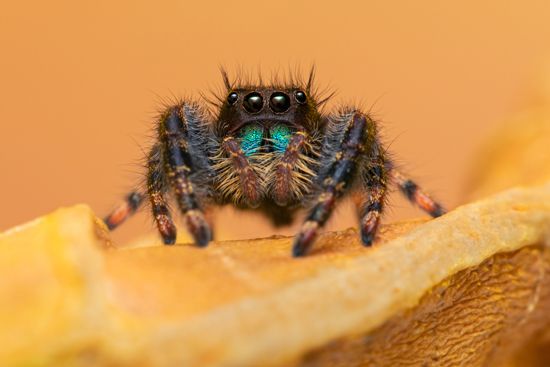
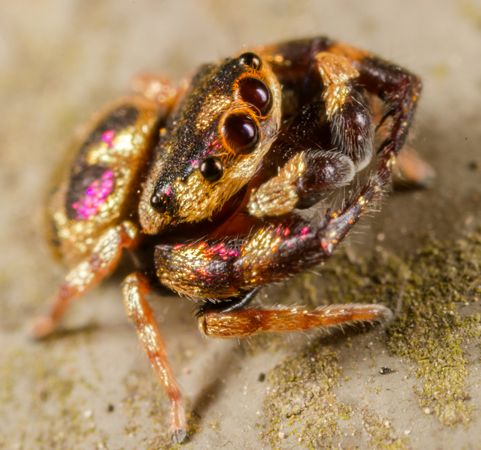
Jumping spiders (family Salticidae) possess some of the most sophisticated vision in the animal kingdom, which is central to their success as active, daytime ambush predators. They typically have eight eyes, each serving a specialized function to aid in hunting and navigation.617
The Principal Eyes
The two large, forward-facing eyes are the primary tools for hunting. These eyes feature:
- Telescopic Design: They are equipped with spherical lenses and internal focusing mechanisms that allow the spider to make distant objects appear closer.1
- High Resolution: These eyes contain four-tiered retinas, enabling the spider to perceive the full spectrum of color and discern fine details. Their vision is so acute that they can resolve a few minutes of arc, significantly outperforming the eyes of the insects they hunt.617
- Active Scanning: Unlike the fixed eyes of many other arthropods, the retinas of a jumping spider’s principal eyes can scan to and fro across an image, allowing the spider to actively identify and assess the nature of its target.7
Secondary Eyes
The remaining six eyes are positioned around the crest of the head and beside the main eyes. These serve primarily as motion detectors, providing the spider with a wide field of view to sense movement in its surroundings before focusing its principal eyes on a specific target.617
What are some unique species of jumping spiders and their special traits?
The family Salticidae is the largest and most diverse group of spiders, containing over 6,000 species that exhibit a wide array of specialized traits and behaviors. Here are a few notable examples:3
- Bagheera kiplingi: This species is unique for its largely herbivorous diet. While almost all other spiders are carnivorous, B. kiplingi primarily consumes protein-rich “Beltian bodies” and nectar from acacia trees. It has developed clever strategies to forage on these trees while avoiding the aggressive ants that protect them.89
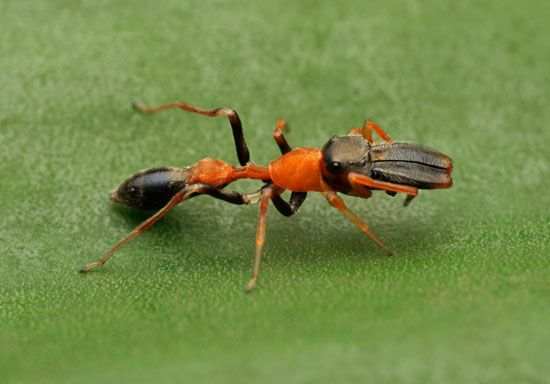
- Jumping ant spider (Myrmarachne formicaria): A master of mimicry, this spider physically resembles a redwood ant to avoid predators. It features an elongated body that mimics the three-segmented appearance of an ant and often holds its front legs over its head to simulate antennae.10
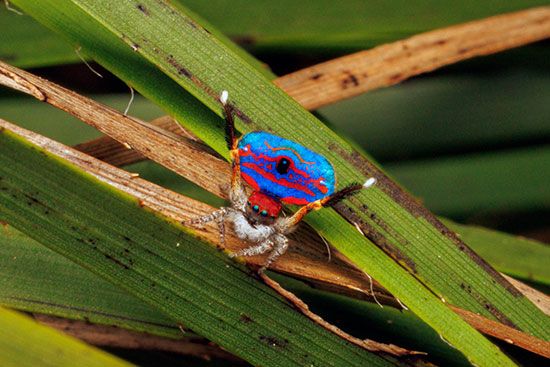
- Peacock spiders (genus Maratus): These spiders are famous for their elaborate mating rituals. Males possess colorful, iridescent abdominal flaps that they unfold and display while performing complex dances, often accompanied by vibrations and rhythmic drumming of their pedipalps.13
- Portia: Members of this genus are considered among the most intelligent arthropods on Earth1. They are known for their sophisticated problem-solving abilities and complex hunting behaviors, particularly when preying on other web-building spiders.3
Sources
- jumping spider — Encyclopædia Britannica
- spider - Stalking prey — Encyclopædia Britannica
- Bagheera kiplingi — Encyclopædia Britannica
- jumping ant spider: Top Questions — Encyclopædia Britannica
- Nine Incredible Jumping Spiders — Encyclopædia Britannica
- How many eyes does a spider have? — Encyclopædia Britannica
- Photoreception - Corneal eyes — Encyclopædia Britannica
- Nine Incredible Jumping Spiders - Bagheera kiplingi : The vegetarian — Encyclopædia Britannica
- Nine Incredible Jumping Spiders - Jumping ant spider: A masterful mimic — Encyclopædia Britannica
- peacock spider — Encyclopædia Britannica
- jumping spider: Top Questions — Encyclopædia Britannica
Published on · 4 min read