Jumping Ant Spider
The jumping ant spider (Myrmarachne formicaria) is a species of jumping spider that has evolved remarkable mimicry to resemble a redwood ant in both…
What is jumping ant spider?
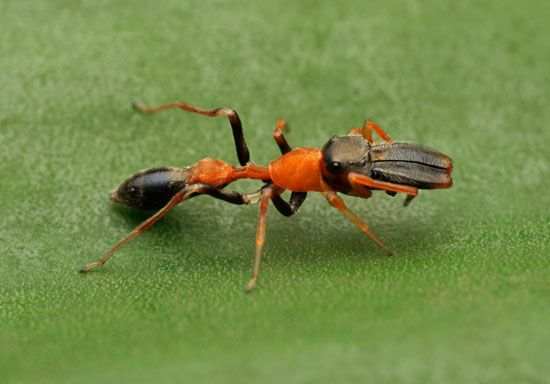
The jumping ant spider (Myrmarachne formicaria) is a species of jumping spider that has evolved remarkable mimicry to resemble a redwood ant in both appearance and behavior. This adaptation serves as a highly effective defense mechanism, as predators—such as birds, wasps, and other spiders—often avoid ants due to their aggressive group defense and the production of formic acid.12
To achieve this disguise, the spider’s cephalothorax is modified to mimic the three-segmented body structure and narrow waist of an ant. Because spiders possess eight legs rather than an insect’s six, the jumping ant spider frequently raises its front two legs above its head to mimic an ant’s antennae. Furthermore, it adopts a winding, ambling gait similar to an ant following a pheromone trail. Unlike many other jumping spiders, this species does not use webs to hunt and typically attacks its prey from close range rather than leaping.12
How do other animals use mimicry to survive?
Animals utilize mimicry as a survival strategy by evolving superficial resemblances to other organisms, effectively deceiving a third party—such as a predator, prey, or host—to gain a selective advantage. This phenomenon relies on the behavioral responses of the signal receiver, which mistakes the mimic for a model.34
Primary Forms of Mimicry
- Batesian Mimicry: A harmless or edible species evolves to resemble a noxious or dangerous one. Predators, having learned to avoid the dangerous model, subsequently avoid the mimic as well.54
- Müllerian Mimicry: Multiple inedible or dangerous species evolve to share the same warning coloration. This spreads the “cost” of educating predators across several species, as a single negative experience with any of the models or mimics teaches the predator to avoid the entire group.54
- Aggressive Mimicry: A predator or parasite adopts the appearance or behavior of a non-threatening species or even the prey itself to launch surprise attacks or infiltrate a host. For example, anglerfish use a lure resembling prey to attract smaller fish, while cuckoos lay eggs that mimic those of host birds to ensure their young are reared by others.6
Mimicry is not limited to appearance; it can involve sound, smell, and behavior. It is a fascinating evolutionary adaptation that highlights the complex interactions between species.3
What are the main differences between spiders and insects?
Although spiders and insects are both arthropods, they belong to distinct taxonomic groups with significant anatomical differences.8
Key Differences
- Body Structure: Insects have three main body sections (head, thorax, and abdomen), whereas spiders are arachnids with two main sections: the cephalothorax and the abdomen.89
- Appendages: Insects possess six legs, while spiders have eight. Additionally, spiders lack antennae, which are common in insects.8
- Respiratory Systems: Insects primarily use a system of branching tubes called tracheae that open through spiracles. Spiders typically possess unique “book lungs”—leaflike plates for gas exchange—though some also have tracheae.10
- Specialized Organs: Spiders are distinguished by their silk-producing organs known as spinnerets, which are absent in insects. Furthermore, spiders use specialized appendages called chelicerae (jaws) that often contain venom glands to subdue prey.8911
How do jumping spiders hunt without using webs?
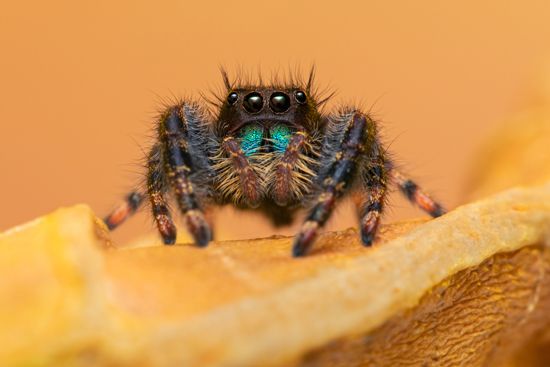
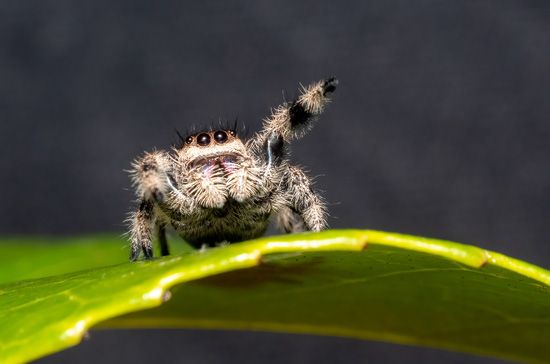
Jumping spiders (family Salticidae) are agile, daytime ambush predators that do not build webs to snare their prey. Instead, they rely on their remarkable intelligence and keen eyesight to hunt.1213
These spiders possess eight eyes, including two large, forward-facing eyes with internal focusing mechanisms that provide high-resolution vision, allowing them to perceive fine details and the full spectrum of color. When hunting, a jumping spider stalks its prey until it is within a range of approximately 5 to 10 cm (2 to 4 inches). Once in position, the spider uses an internal hydraulic system to explosively increase the pressure of its hemolymph, which propels it to pounce upon the target. Upon reaching the prey, the spider delivers a lethal bite using its chelicerae, which contain venom glands.121415
Some species, such as those in the genus Portia, exhibit sophisticated problem-solving skills and learned behaviors, making them some of the most intelligent arthropods on Earth.12
Sources
- jumping ant spider — Encyclopædia Britannica
- Nine Incredible Jumping Spiders - Jumping ant spider: A masterful mimic — Encyclopædia Britannica
- mimicry - Müllerian mimicry — Encyclopædia Britannica
- aggressive mimicry — Encyclopædia Britannica
- mimicry - Mimicry within species — Encyclopædia Britannica
- mimicry — Encyclopædia Britannica
- mimicry - The importance of the signal receiver — Encyclopædia Britannica
- spider: Top Questions — Encyclopædia Britannica
- arachnid - Body and appendages — Encyclopædia Britannica
- Respiratory system - Trachea — Encyclopædia Britannica
- spider - External features — Encyclopædia Britannica
- jumping spider — Encyclopædia Britannica
- spider - Stalking prey — Encyclopædia Britannica
- Types of Spiderwebs — Encyclopædia Britannica
- peacock spider: Top Questions — Encyclopædia Britannica
- Salticidae — Merriam-Webster
Published on · 3 min read