Ooze
Oozes are pelagic sediments that form on the deep-ocean floor when the skeletal remains of microscopic organisms accumulate to constitute at least 30 percent…
How do oozes form on the ocean floor, and what factors influence their composition?
Oozes are pelagic sediments that form on the deep-ocean floor when the skeletal remains of microscopic organisms accumulate to constitute at least 30 percent of the deposit. These sediments typically develop in areas far enough from land that the steady rain of biological debris is not obscured by terrestrial runoff.123
The composition and distribution of these oozes are influenced by several key factors:
- Primary Productivity: The supply of skeletal material is largely controlled by the fertility of surface waters. High productivity zones, such as the Equator and coastal upwelling areas, provide the necessary biological input for ooze formation.2
- Dissolution Rates: The chemical environment of the deep sea determines whether skeletons survive. Calcareous oozes are limited by the calcite compensation depth (CCD), below which carbonate dissolves rapidly. Siliceous oozes require high surface productivity because silica dissolves quickly in seawater.42
- Dilution: The presence of other materials, such as clays or turbidites, can dilute biogenic content, preventing the formation of true ooze.23
What is ooze in geological terms, and how does it differ from other sediments?
In geological terms, ooze is a type of pelagic sediment found on the deep-ocean floor that consists of at least 30 percent skeletal remains of microscopic organisms. These deposits are essentially soft muds that accumulate in areas far enough from land that the steady rain of biological debris is not obscured by terrestrial runoff.134
Ooze differs from other marine sediments primarily in its composition and origin:
- Biogenic vs. Terrigenous: While many marine sediments are terrigenous—composed of rock and soil particles transported from land by wind, ice, or rivers—oozes are biogenic, meaning they are formed from the hard parts of marine life.45
- Threshold Requirement: If a deep-sea deposit contains less than 30 percent biogenic material, it is typically classified as deep-sea clay or brown mud rather than ooze.14
- Formation Process: Unlike turbidites, which are deposited rapidly by density currents originating from continental slopes, oozes accumulate very slowly as particles settle through the water column.45
Oozes are categorized as either calcareous (calcium carbonate) or siliceous (silica), depending on the chemical makeup of the organisms’ skeletons.13
What is the significance of the carbonate compensation depth (CCD) in relation to ooze formation?
The calcite compensation depth (CCD) is a critical threshold in oceanography that dictates the distribution and preservation of calcareous oozes on the seafloor. It is defined as the specific depth at which the rate of calcium carbonate accumulation is exactly balanced by the rate of carbonate dissolution.23
The significance of the CCD in relation to ooze formation includes:
- Preservation Limit: Carbonate oozes are primarily found at depths shallower than approximately 4,500 meters (about 14,800 feet). Below this depth, the chemical environment causes carbonate skeletal remains to dissolve rapidly, preventing the formation of calcareous ooze.23
- Geographic Variation: The CCD is not uniform across the globe. For instance, the CCD in the Atlantic basin is about 500 meters (1,600 feet) deeper than in the Pacific basin, a difference attributed to higher rates of carbonate supply and lower dissolution rates in the Atlantic.23
- Topographic Influence: Because the CCD often intersects the flanks of oceanic ridges, these elevated seafloor features are frequently blanketed by carbonate oozes, even when surrounding deeper basins are not.23
- Historical Fluctuations: Changes in ocean chemistry, biological productivity, and carbonate input over geologic time have caused the CCD to shift by as much as 2,000 meters (6,600 feet), significantly altering the historical distribution of these sediments.23
How does the distribution of oozes vary across different ocean basins?
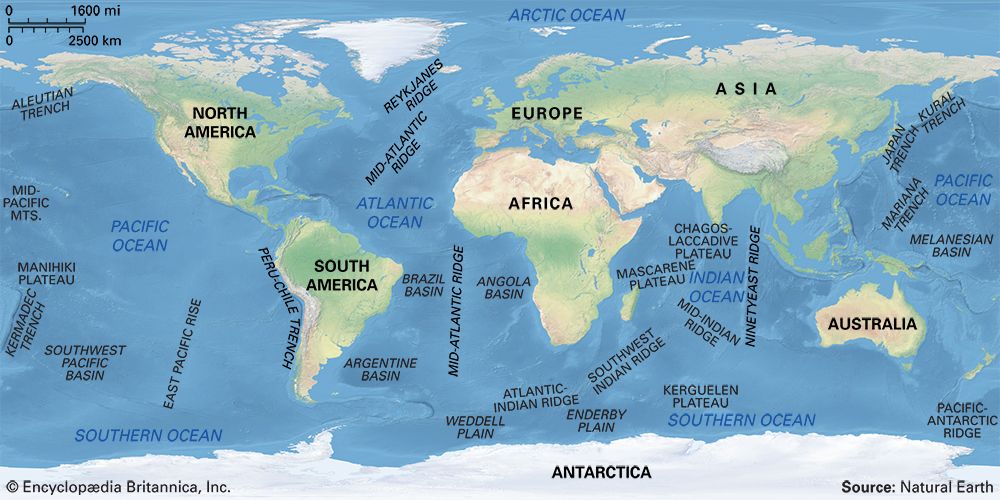
The distribution of biogenic ooze across the world’s ocean basins is primarily governed by surface water productivity, the depth of the seafloor relative to the calcite compensation depth (CCD), and the rate of dilution by other sediments.3
Basin-Specific Patterns
- Atlantic Ocean: This basin is dominated by carbonate oozes. Because the CCD in the Atlantic is approximately 500 meters deeper than in the Pacific, carbonate remains are better preserved, allowing these sediments to cover vast areas of the deep seafloor. Pteropod ooze is also uniquely found in the mid-Atlantic.312
- Pacific Ocean: Siliceous oozes are most common here. Due to a shallower CCD and higher rates of carbonate dissolution, carbonate deposits are less prevalent than in the Atlantic. Radiolarian ooze is specifically found under the eastern part of the North Pacific, while diatom ooze occurs in northern belts.32
- Indian Ocean: The seafloor here features a combination of both carbonate and siliceous oozes, reflecting a mix of the conditions found in the other two major basins.3
Global Distribution Factors
- Productivity Zones: Oozes accumulate most heavily where primary productivity is high, such as near the Equator and in zones of coastal upwelling. Siliceous oozes are particularly concentrated around Antarctica, where 75 percent of the ocean’s silica supply is deposited.3
- Topography: The CCD intersects the flanks of oceanic ridges, causing these elevated features to be blanketed by carbonate oozes even in basins where the deeper plains are dominated by clays.31
Sources
- ooze — Encyclopædia Britannica
- calcite compensation depth — Encyclopædia Britannica
- biogenic ooze — Encyclopædia Britannica
- marine sediment — Encyclopædia Britannica
- ocean basin - Sediment types — Encyclopædia Britannica
- seawater - Dissolved inorganic substances — Encyclopædia Britannica
- seawater - Dissolved organic substances — Encyclopædia Britannica
- ocean basin - Sedimentation patterns — Encyclopædia Britannica
- plankton - Plankton and biological productivity — Encyclopædia Britannica
- plate tectonics - Past plate movements — Encyclopædia Britannica
- Marine ecosystem - Links between the pelagic environments and the benthos — Encyclopædia Britannica
Published on · 4 min read