Öræfajökull
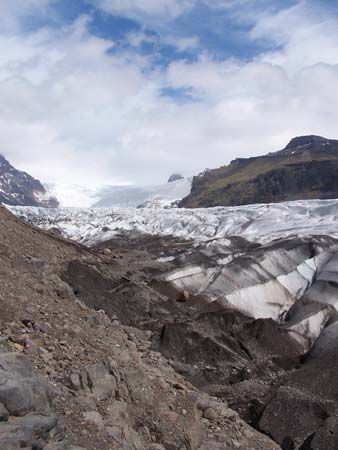
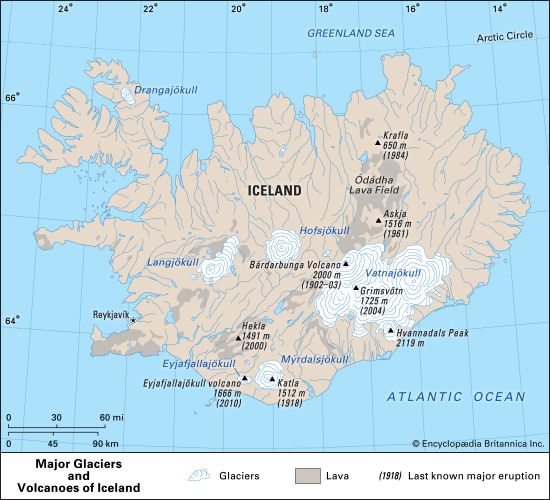
Öræfajökull is an ice-covered volcanic massif located in southeastern Iceland. It is situated at the southern extremity of the Vatnajökull ice field.
What is Öræfajökull?
Öræfajökull is an ice-covered volcanic massif located in southeastern Iceland. It is situated at the southern extremity of the Vatnajökull ice field.1
The massif is home to Hvannadals Peak, which stands at an elevation of 6,952 feet (2,119 metres) above sea level. This summit holds the distinction of being the highest peak in all of Iceland.12
What is a jökulhlaup?
A jökulhlaup (Icelandic for “glacier run”) is a sudden and often catastrophic glacier outburst flood. These events occur when water stored within or behind a glacier is released abruptly.3
The process typically begins when internal drainage is blocked by the glacier’s plastic flow. As water accumulates, it eventually finds a narrow path to escape. The heat from the flowing water enlarges this conduit, leading to a rapid increase in discharge until the stored volume is released. In regions like Iceland, these floods are frequently triggered by volcanic activity, such as eruptions of Grímsvötn, which melt surrounding ice to create lakes that eventually breach their ice walls.32
These floods can be highly destructive, historically hindering infrastructure development, such as the completion of coastal roads near Vatnajökull.2 While some occur with predictable regularity, others are completely irregular and difficult to forecast.3
How do volcanoes form under glaciers?
Volcanoes that form beneath glaciers, known as subglacial volcanoes, create distinct landforms due to the unique environment of ice and meltwater. The specific shape of these volcanoes is determined by the nature of the volcanic vent and the interaction between the erupting magma and the surrounding ice.4
- Fissure Eruptions: When eruptions occur along long fissures beneath the ice, they typically build steep ridges composed of broken lava fragments rather than the expansive lava plateaus seen in subaerial environments.4
- Point-Source Eruptions: When eruptions occur repeatedly from a single vent, they form “table mountains.” These structures feature steep sides made of pillow lavas—sacklike formations created when basaltic lava is extruded into water-filled caverns within the ice. These pillow structures are often capped by layers of broken lava fragments from explosive shallow-water eruptions, which are then topped by shield-building lava flows that form once the eruption reaches the glacial surface.4
This process is particularly well-documented in Iceland, where volcanic activity frequently interacts with extensive ice caps like Vatnajökull.45
What are some other famous volcanoes in Iceland?
Iceland is home to approximately 200 volcanoes of various types, owing to its location atop the Mid-Atlantic Ridge. Beyond the well-known Hekla—often called Iceland’s most active and famous volcano—several others have shaped the country’s landscape and history:57
- Askja: Located in the central highlands, this volcano features three large calderas dotted with active fissures and cones.8
- Eyjafjallajökull: Situated beneath an extension of the Mýrdalsjökull glacier, it gained international attention in 2010 when its eruption sent ash plumes into the atmosphere, disrupting air traffic across Europe.5
- Surtsey: This volcanic island emerged from the Atlantic Ocean off the southwestern coast following a submarine eruption that lasted from 1963 to 1967. It is now recognized as a World Heritage site.59
- Heimaey (Heima Island): A major eruption here in 1973 forced the evacuation of the town of Vestmannaeyjar and destroyed a significant portion of the community.5
- Krafla: Located in the northeast, this area experienced continuous volcanic activity between 1975 and 1984, which impacted local geothermal energy projects.5
Sources
- Öræfajökull — Encyclopædia Britannica
- Vatnajökull — Encyclopædia Britannica
- glacier - Glacier floods — Encyclopædia Britannica
- volcano - Determinants of size and shape — Encyclopædia Britannica
- Iceland - Land — Encyclopædia Britannica
- Cryogenian Period: Top Questions — Encyclopædia Britannica
- world’s major volcanoes — Encyclopædia Britannica
- Hekla — Encyclopædia Britannica
- list of World Heritage sites - Iceland — Encyclopædia Britannica
Published on · 3 min read