Precambrian
Because the Precambrian era lacks the abundant, diverse fossils found in younger strata, scientists cannot rely on traditional biostratigraphy to date these…
What methods do scientists use to date rocks and events from the Precambrian era?
Because the Precambrian era lacks the abundant, diverse fossils found in younger strata, scientists cannot rely on traditional biostratigraphy to date these ancient rocks. Instead, they primarily use chronometric dating, which employs radiometric dating to calculate absolute ages.123
Radiometric Dating Methods
Radiometric dating measures the ratio of radioactive parent isotopes to their stable daughter products within minerals. Because these isotopes decay at a known, constant rate—defined by their half-life—scientists can determine the time elapsed since a rock or mineral formed. Key techniques for the Precambrian include:45
- Uranium-Lead Dating: This is a primary tool for dating very old rocks. By analyzing isotopes such as uranium-238 and uranium-235, geochronologists can date zircon and other refractory minerals with high precision.365
- Other Isotopic Systems: Methods such as potassium-argon, samarium-neodymium, and rubidium-strontium dating are also used to interpret the cooling, crystallization, and metamorphic history of ancient crustal rocks.65
Biostratigraphy
While limited, stromatolites—layered structures formed by microorganisms—provide a form of biostratigraphic correlation for some Precambrian sequences, though their application is less universal than fossil-based dating in the Phanerozoic.1
What role did plate tectonics play in shaping the Earth during the Precambrian?
Plate tectonics played a fundamental role in shaping the Earth during the Precambrian, though the nature of these processes evolved as the planet cooled and matured.
Archean Tectonic Processes
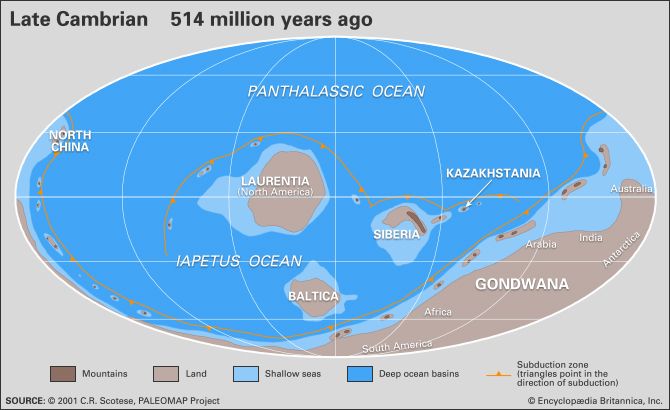
During the early Precambrian (Archean Eon), Earth’s interior produced significantly more heat due to the decay of radioactive isotopes. This high heat flow drove rapid tectonic activity, characterized by primitive forms of plate tectonics rather than the modern, rigid-plate model. During this time, oceanic ridges were more abundant and active, and oceanic plateaus were common. While vast amounts of crust were generated, they were frequently destroyed by rapid subduction processes.8
Transition to Modern Tectonics
By the early Proterozoic, the crust had become cooler and more rigid, allowing for the development of “modern” tectonic processes, including seafloor spreading, ophiolite obduction, and collision-based mountain building. The formation of stable continental blocks enabled the development of long, linear orogenic belts at their margins.89
Environmental and Climatic Impact
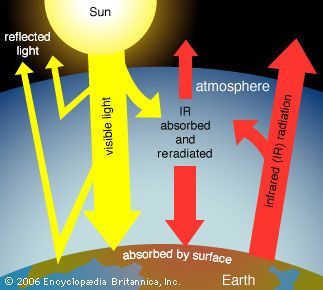
Plate tectonics exerted significant control over the Precambrian climate by regulating the greenhouse effect:
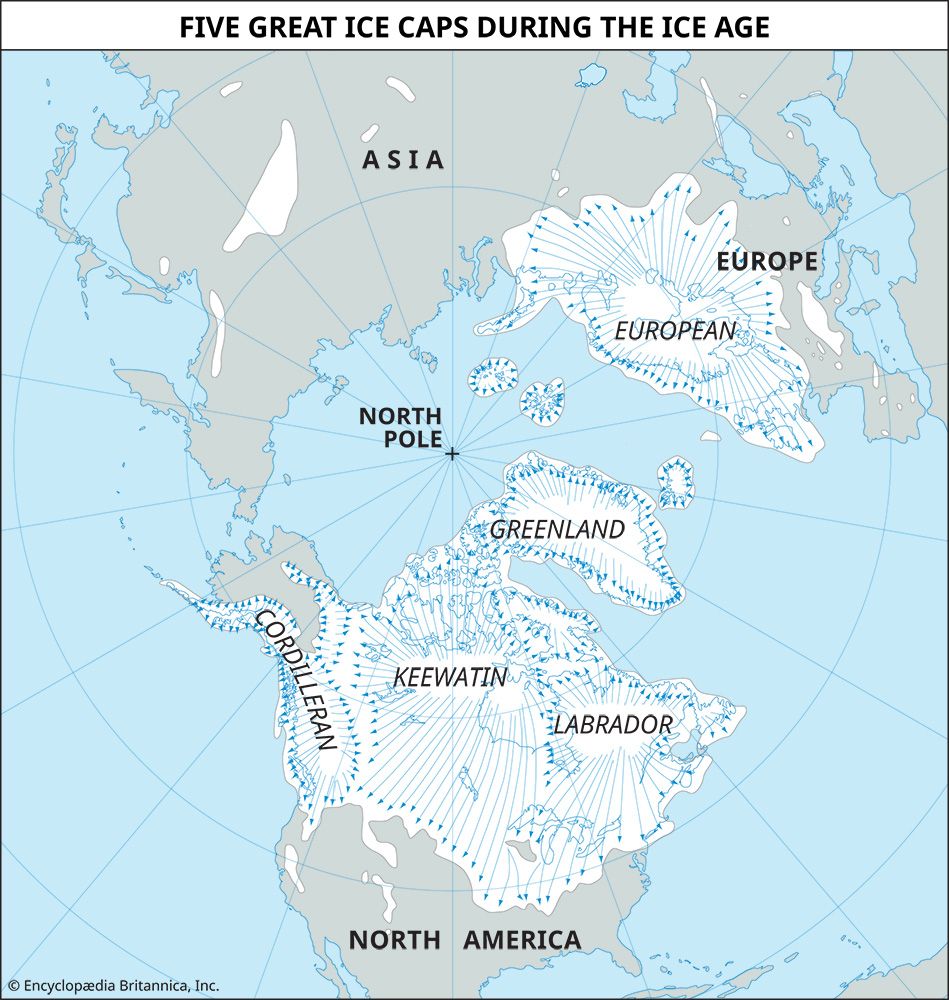
- Supercontinent Formation: During periods of supercontinent assembly, volcanic activity was limited, leading to lower carbon dioxide levels, cooler temperatures, and extensive glaciations.10
- Continental Breakup: Conversely, intervals of continental rifting and breakup were associated with high rates of seafloor spreading and volcanic activity, which increased atmospheric carbon dioxide and warmed the Earth.10
By the end of the Precambrian, these tectonic cycles had amalgamated large continental blocks into a new supercontinent, setting the stage for the geological and biological developments of the Phanerozoic.9
How is the Precambrian divided into different eons, and what are their characteristics?
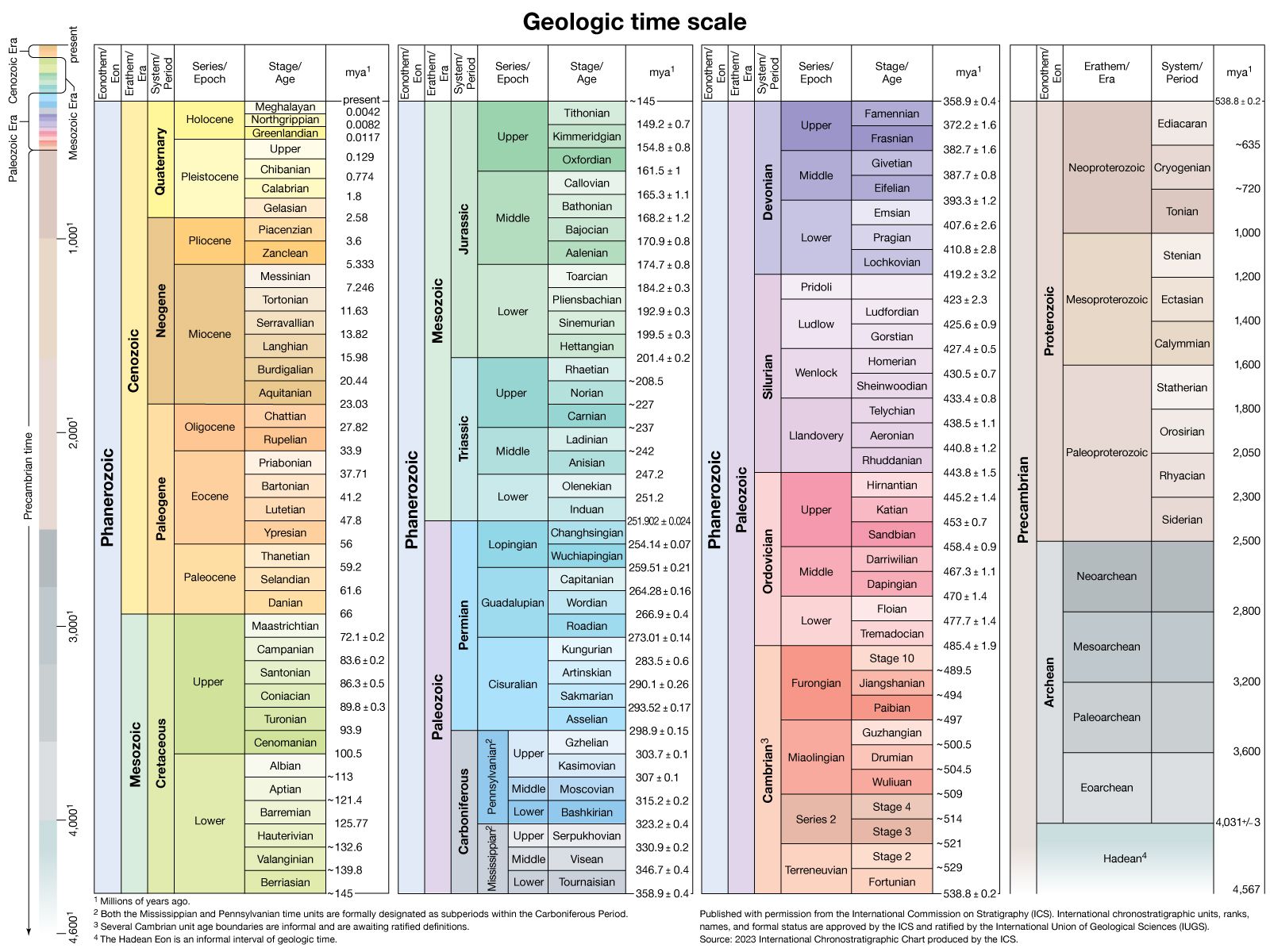
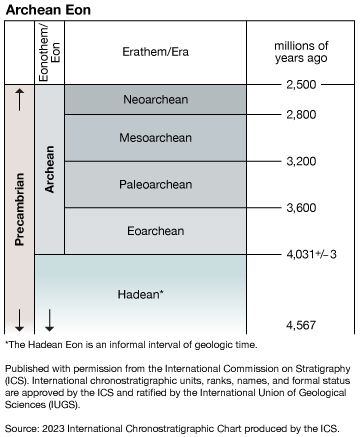
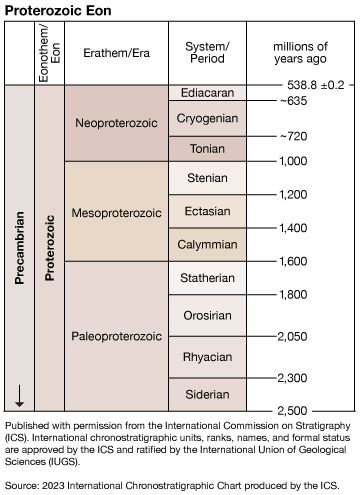
The Precambrian represents more than 80 percent of Earth’s geologic record, spanning from the planet’s formation approximately 4.6 billion years ago to the beginning of the Cambrian Period 541 million years ago. It is divided into three primary eons:15
The Hadean Eon (4.6–4.0 billion years ago)
This informal interval marks Earth’s initial formation through the accretion of dust and gases. It was characterized by extreme instability, frequent collisions with planetesimals, and intense heat that likely prevented surface rock from solidifying. During this time, the core and crust stabilized, and the atmosphere and oceans began to develop.1516
The Archean Eon (4.0–2.5 billion years ago)
The Archean is defined by the emergence of the earliest known life-forms, including prokaryotes and stromatolites. It is subdivided into four eras: the Eoarchean, Paleoarchean, Mesoarchean, and Neoarchean.151718
The Proterozoic Eon (2.5 billion–541 million years ago)
This eon saw the proliferation of bacteria and protists, as well as the evolution of the first multicellular organisms and sexual reproduction. It is divided into the Paleoproterozoic, Mesoproterozoic, and Neoproterozoic eras. Indirect evidence of oxygen-producing life during this time is found in banded-iron formations.151718
What were the major geological and atmospheric changes during the Precambrian?
The Precambrian, spanning from Earth’s formation 4.6 billion years ago to 541 million years ago, was a period of profound transformation. Geological and atmospheric changes during this time laid the foundation for the modern planet.
Atmospheric Evolution
Earth’s early atmosphere was reducing and rich in carbon dioxide, methane, and water vapour, with little to no free oxygen. This atmosphere created a strong greenhouse effect that kept the planet warm despite a less luminous early Sun.131920
The transition to an oxidizing atmosphere was driven by photosynthesis from organisms like cyanobacteria. For over a billion years, this oxygen was largely consumed by the oxidation of ferrous iron in the oceans, resulting in the massive banded-iron formations found in the geological record. As these iron sinks were depleted, atmospheric oxygen levels rose, eventually enabling the evolution of complex eukaryotes and, later, multicellular life.1319
Geological Changes
The Precambrian saw the transition from a chaotic, molten state to a planet with stable continental crust.812
- Crustal Growth: Early Earth lacked large, stable continents. Through the Archean, crustal growth occurred via volcanic activity and the formation of primitive orogenic belts.8
- Tectonic Shifts: The tectonic style evolved from rapid, heat-driven processes to more modern plate-tectonic regimes by the Paleoproterozoic.21
- Climatic Regulation: Tectonic cycles influenced the climate; supercontinent assembly generally led to cooler temperatures and glaciations due to reduced volcanic CO₂ emissions, while continental rifting periods were associated with warmer climates.22
Sources
- dating: Top Questions — Encyclopædia Britannica
- uranium-thorium-lead dating — Encyclopædia Britannica
- Precambrian - Correlation of Precambrian strata — Encyclopædia Britannica
- dating - Distinctions between relative-age and absolute-age measurements — Encyclopædia Britannica
- geology - Historical geology and stratigraphy — Encyclopædia Britannica
- dating - Origin of radioactive elements used — Encyclopædia Britannica
- geology - Isotopic geochemistry — Encyclopædia Britannica
- plate tectonics - Plate tectonics and the geologic past — Encyclopædia Britannica
- Precambrian - Archean crustal growth — Encyclopædia Britannica
- Precambrian - Proterozoic plate movements — Encyclopædia Britannica
- Earth sciences - The theory of plate tectonics — Encyclopædia Britannica
- Precambrian - Climatic conditions — Encyclopædia Britannica
- Precambrian - Oxygenation of the atmosphere — Encyclopædia Britannica
- Earth - Planetary differentiation — Encyclopædia Britannica
- Precambrian — Encyclopædia Britannica
- Precambrian - Major subdivisions of the Precambrian System — Encyclopædia Britannica
- Hadean Eon — Encyclopædia Britannica
- life - Geologic record — Encyclopædia Britannica
- Precambrian - Evolution of the atmosphere and ocean — Encyclopædia Britannica
- Precambrian - Distinctive features — Encyclopædia Britannica
- geologic history of Earth - Formation of the secondary atmosphere — Encyclopædia Britannica
- Climate - The evolution of life and the atmosphere — Encyclopædia Britannica
Published on · 4 min read