Razor-billed Auk
The razor-billed auk (Alca torda) is a black and white seabird native to the North Atlantic, characterized by its sharp, heavy, and compressed beak.…
What is Razor-billed auk?
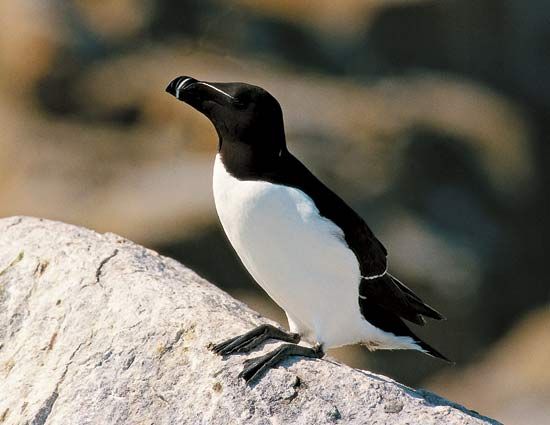
The razor-billed auk (Alca torda) is a black and white seabird native to the North Atlantic, characterized by its sharp, heavy, and compressed beak. Measuring approximately 40 cm (16 inches) in length, it holds the distinction of being the largest living member of the auk family (Alcidae) and is the closest living relative to the extinct great auk.1
These birds are skilled deep divers that primarily feed on fish and shellfish. During their breeding season, they inhabit North Atlantic coasts, though some populations migrate as far south as the Mediterranean Sea.1
What was the great auk and why did it go extinct?
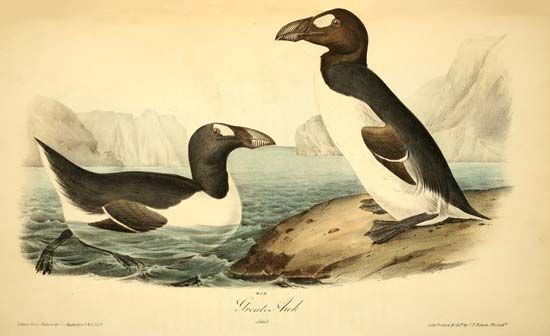
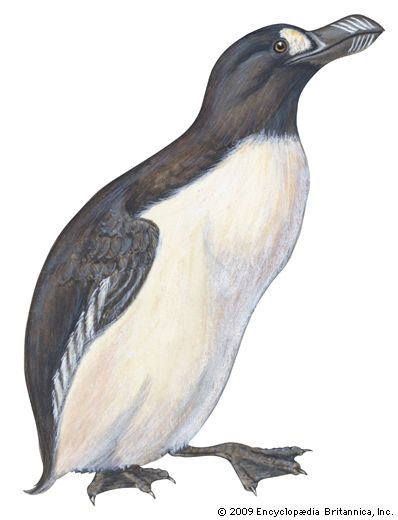
The great auk (Pinguinus impennis) was a flightless seabird belonging to the family Alcidae. Standing about 75 cm (30 inches) tall, it was the largest member of its family, featuring a black back, a white front, and a distinctive large bill with transverse grooves. Unlike its living relatives, such as the razor-billed auk, the great auk was entirely flightless, though it used its short wings to swim efficiently underwater.23
The species went extinct in 1844 due to human exploitation. Because the birds were flightless and lived in dense colonies on rocky islands, they were utterly defenseless against hunters. Throughout the early 1800s, they were slaughtered in massive numbers for food and bait, often being driven onto ships to be killed. The final known specimens were taken in June 1844 on Eldey island, Iceland. The loss of the great auk serves as a sobering reminder of the ethical responsibility humans have to protect vulnerable species from overexploitation and extinction.2
How do deep-diving seabirds adapt to life in the ocean?
Deep-diving seabirds have evolved specialized physical and physiological traits to thrive in marine environments and pursue prey underwater.
Locomotion and Propulsion
Many diving birds, such as auks, utilize both their wings and webbed feet for propulsion while swimming underwater. In contrast, penguins have evolved highly modified wings that function as paddles, allowing them to “fly” through the water, while their feet are primarily used for steering. Other species, like cormorants, are adept at underwater pursuit, often hunting in groups to herd fish.43
Physiological Adaptations
- Salt Excretion: Because marine birds often ingest seawater, they possess specialized lateral nasal glands that excrete concentrated salt solutions, allowing them to maintain osmotic balance.5
- Pressure Management: During deep dives, birds must manage the effects of water pressure on air-filled cavities. While human divers face risks like thoracic squeeze—where lung volume decreases significantly under pressure—diving birds have evolved anatomical structures that allow them to navigate these depths safely.6
- Thermoregulation: Birds nesting in exposed, tropical environments utilize behaviors like throat fluttering and panting to facilitate evaporative cooling, preventing overheating while foraging.5
What other birds belong to the auk family?
The auk family, known as Alcidae, comprises 22 species of diving birds, 21 of which are still living. Beyond the extinct great auk and the razor-billed auk, the family includes several other distinct groups of seabirds.39
These birds are generally categorized into the following types:
- Dovekie: Also known as the little auk.
- Auklet: A group of smaller birds within the family.
- Guillemot: Known for their slender bills and distinct breeding plumage.
- Murre: Large, colonial-nesting birds often found on cliff ledges.
- Murrelet: Smaller relatives of the murres.
- Puffin: Easily recognized by their colorful, triangular bills.
All these alcids share common traits such as short wings, webbed feet, and a heavy reliance on the sea for food, including fish, crustaceans, and plankton.39
Sources
- Razor-billed auk — Encyclopædia Britannica
- Great auk — Encyclopædia Britannica
- Auk — Encyclopædia Britannica
- Pelecaniform - Feeding ecology — Encyclopædia Britannica
- Bird - Swimming and diving — Encyclopædia Britannica
- Pelecaniform - Physiological adaptations — Encyclopædia Britannica
- Cold-bloodedness — Encyclopædia Britannica
- thoracic squeeze — Encyclopædia Britannica
- Alcidae — Encyclopædia Britannica
Published on · 3 min read