Racer
North American racer snakes (Coluber constrictor) are characterized by a slender body shape and a long tail. They possess large eyes and smooth scales…
What are the distinguishing physical characteristics of racer snakes?
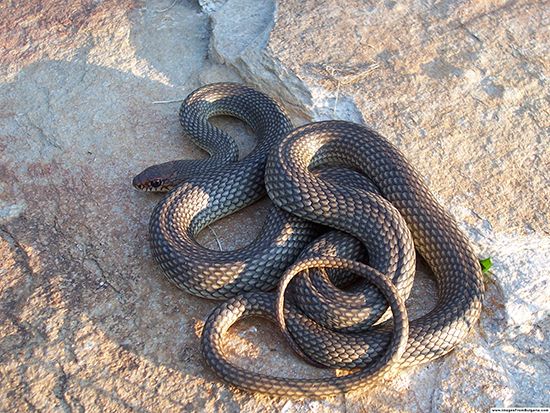
North American racer snakes (Coluber constrictor) are characterized by a slender body shape and a long tail. They possess large eyes and smooth scales, distinguishing them from other species that may have keeled (ridged) scales.1
Physically, these snakes can reach lengths of up to 1.8 meters (approximately 6 feet). Their coloration varies significantly by subspecies and region:
- Blue racers: Typically plain bluish, greenish blue, gray, or brownish, sometimes featuring yellow bellies.1
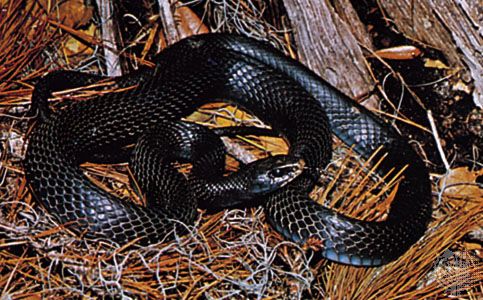
- Eastern racers: Generally all black, with the exception of a white patch located on the chin and throat.1
- Juveniles: Regardless of the subspecies, young racers are notably different from adults, as they are marked with blotches or spots.1
While they are swift and active during the day, they are nonvenomous and do not kill by constriction, despite their scientific name; instead, they subdue prey by holding it down with the weight of their coils.1
How fast can racer snakes move, and why are they called ‘racers’?
North American racer snakes are widely recognized as being among the fastest of all snakes. They are capable of moving at speeds of approximately 5.6 kilometers (3.5 miles) per hour while traveling across the ground or through bushes.1
They are called “racers” primarily due to this exceptional speed and their highly active, diurnal nature. Their slender, long-tailed bodies are physically adapted for rapid movement, allowing them to navigate their environments quickly to hunt or escape predators.1
Are racer snakes venomous, and do they pose any danger to humans?
Racer snakes are nonvenomous and do not pose a significant danger to humans. While they are generally harmless, they are active and defensive if they feel threatened. If a racer is cornered, it may vibrate its tail and strike repeatedly in an attempt to deter a perceived threat.14
It is important to note that while these snakes are not venomous, any wild animal should be treated with respect and observed from a safe distance to avoid unnecessary stress to the animal or accidental injury to yourself. Their primary defense mechanism is their speed, which they use to escape rather than engage with potential predators.1
How many species of racer snakes exist, and what are some common types?
The term “racer” is applied to several large, swift, nonvenomous snakes within the family Colubridae. While there is no single, fixed number of species globally, the classification depends on the region:
- North American Racers: All North American racers belong to a single species, Coluber constrictor. This species is highly diverse, with various subspecies identified by their coloration and geographic range.1
- Southeast Asian Racers: Several species within the genus Elaphe found in Southeast Asia are also commonly referred to as racers.1
Common Types of North American Racers:
- Blue Racer: A subspecies found in central and western North America, typically displaying bluish, greenish-blue, gray, or brownish hues with yellow bellies.1
- Black Racer: Also known as the eastern subspecies or black pilot snake, this snake is primarily black with a distinctive patch of white on its chin and throat.15
- Red Racer and Western Black Racer: These are specific color phases of the coachwhip found in the western United States.1
Sources
- racer — Encyclopædia Britannica
- snake - The skin — Encyclopædia Britannica
- rat snake — Encyclopædia Britannica
- 15 of the world’s rarest snakes - Saint Lucia racer ( Erythrolamprus ornatus ) — Encyclopædia Britannica
- black snake — Encyclopædia Britannica
- black racer — Merriam-Webster
- coluber — Merriam-Webster
Published on · 2 min read