Red Panda
The red panda (Ailurus fulgens) is a unique, raccoon-like mammal characterized by several distinct physical traits:
What are the unique physical characteristics of red pandas?
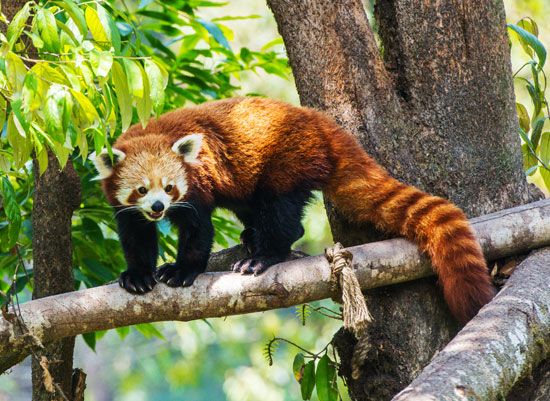
The red panda (Ailurus fulgens) is a unique, raccoon-like mammal characterized by several distinct physical traits:
- Fur and Coloration: They possess soft, thick fur that is a rich reddish-brown on their upper body and black underneath. Their face is white with distinctive red-brown stripes running from each eye to the corners of the mouth.12
- Tail: They have a long, bushy tail that is faintly ringed, measuring between 30 and 50 cm (12–20 inches) in length.12
- Size: Roughly the size of a large domestic cat, their head and body length ranges from 50 to 65 cm (20–26 inches), with a weight of 3 to 6.2 kg (6.5–14 pounds).12
- Feet and Claws: Their feet feature hairy soles, and they possess semi-retractile claws that assist in their agile, arboreal lifestyle.2
Notably, male and female red pandas do not exhibit significant differences in size or coloration.12
Where are red pandas found in the wild, and what is their natural habitat like?
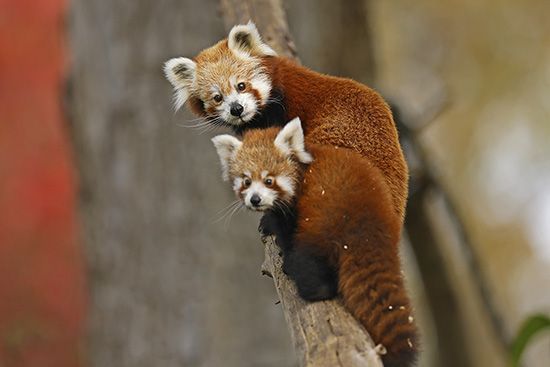
Red pandas are native to high-elevation temperate forests located between 2,500 and 4,800 meters (about 8,200 to 15,750 feet) in the Himalayas and mountainous regions of eastern Asia. Their range includes parts of northern India, the Plateau of Tibet, Bhutan, Myanmar, Nepal, and the Sichuan and Yunnan provinces of China.2
Their natural habitat consists of woodlands characterized by a mix of coniferous and deciduous trees with an understory of bamboo. As arboreal mammals, they spend significant time in trees, often resting on branches during the day, though they typically descend to the ground to feed on bamboo shoots and leaves.2
Unfortunately, this habitat is increasingly threatened by habitat loss and fragmentation due to logging, road construction, and human settlement expansion, as well as the environmental impacts of climate change.21
How are red pandas related to giant pandas and other animals in their taxonomic family?
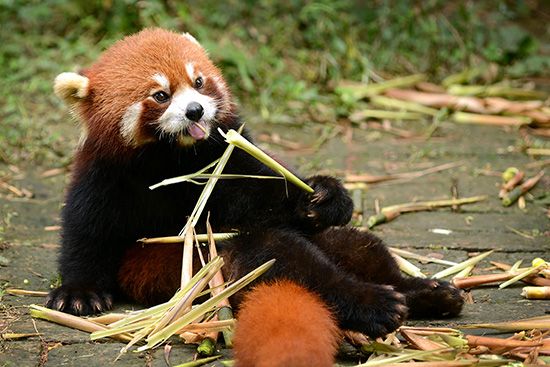
Despite their shared name and diet, red pandas and giant pandas are not closely related. While they were historically grouped together, modern scientific classification distinguishes them significantly.32
Taxonomic Classification
- Red Panda (Ailurus fulgens): The red panda is the sole member of the family Ailuridae. It is now considered more closely related to raccoons, skunks, and weasels than to the giant panda.432
- Giant Panda (Ailuropoda melanoleuca): The giant panda is classified within the family Ursidae, making it a member of the bear family. Molecular analyses have confirmed that bears are the giant panda’s closest relatives, a placement supported by various behavioral and reproductive traits.5
Why the Confusion?
The confusion stems from their similar names and the fact that both species inhabit mountainous regions of China and rely heavily on bamboo as a primary food source. However, these similarities are examples of convergent evolution rather than a close genetic lineage. The red panda is sometimes referred to as the “lesser panda,” a name that reflects this historical, though inaccurate, association with the giant panda.4523
How did the red panda get its name, and what other names is it known by?
The name “red panda” is derived from the animal’s distinctive physical appearance, specifically its rich, reddish-brown fur. While the term “panda” was originally applied to this species in 1834, the name is now more commonly associated with the giant panda. Because of this, the red panda is also frequently referred to as the lesser panda.3627
The etymology of the word “panda” itself is somewhat uncertain, though it is thought to be of French origin, potentially derived from a language spoken in the southeastern Himalayas.2
Taxonomically, the red panda is known as Ailurus fulgens and is the sole member of the family Ailuridae. Although it was historically grouped with the giant panda, it is now understood to be more closely related to raccoons, skunks, and weasels unk), and weasels.63
Sources
- Red panda: Top Questions — Encyclopædia Britannica
- Red panda — Encyclopædia Britannica
- red panda — Merriam-Webster
- giant panda — Encyclopædia Britannica
- 9 Misnomers and Misleading Names | Red Panda — Merriam-Webster
- lesser panda — Merriam-Webster
- panda — Merriam-Webster
Published on · 3 min read