Redfish
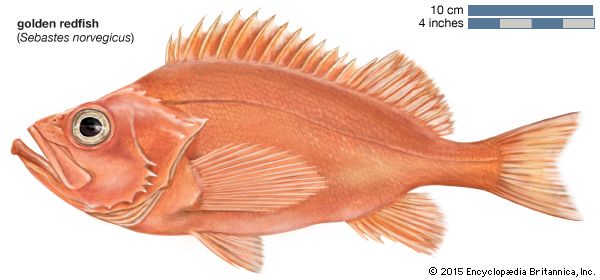
The term "redfish" most commonly refers to Sebastes norvegicus, a commercially important food fish belonging to the scorpionfish family, Scorpaenidae. Found…
What is redfish?
The term “redfish” most commonly refers to Sebastes norvegicus, a commercially important food fish belonging to the scorpionfish family, Scorpaenidae. Found in the North Atlantic along European and North American coasts, this species is also known as ocean perch, rosefish, or Norway haddock. It is characterized by a perchlike form, a large mouth, prominent eyes, and spines on its head and cheeks, reaching lengths of up to 1 meter.12
Additionally, the name “redfish” is sometimes used to refer to the red drum (Sciaenops ocellatus), a large game and food fish found in the Gulf of Mexico and the Atlantic coast of North America, distinguished by a black spot at the base of its tail.23
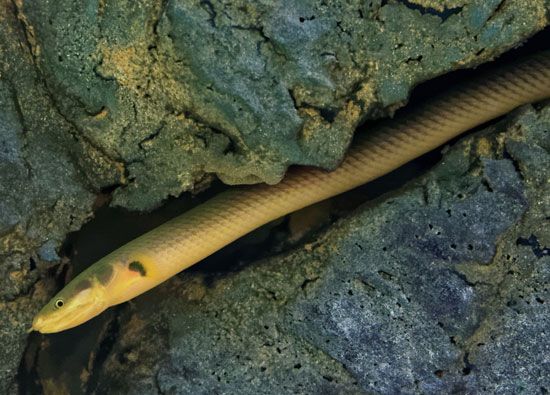
It is important to distinguish these from the reedfish (Erpetoichthys calabaricus), an unrelated, air-breathing, eel-like freshwater fish native to Africa.4
What is the difference between a redfish and a red drum?
There is no difference between a redfish and a red drum; they are two names for the same species of fish, Sciaenops ocellatus4.
The red drum is a large, coppery-colored member of the drum family (Sciaenidae), which is found primarily along the Atlantic coast of North America and in the Gulf of Mexico. It is easily identified by a distinctive black spot located at the base of its tail. Because it is a popular game and food fish, it is frequently referred to by anglers and in culinary contexts as a “redfish,” though it is also known as a channel bass.45
How do scorpionfish use their spines for protection?
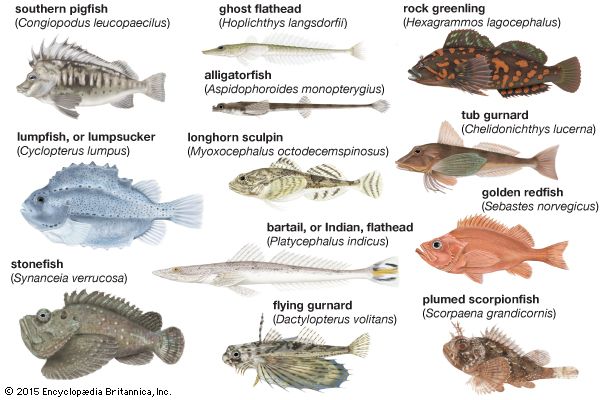
Scorpionfish utilize their physical structure as a primary defense mechanism against predators. These fish possess large, spiny heads and strong fin spines that can inflict deep, painful wounds upon any creature that attempts to attack them.6
In many species, these spines are also equipped with venom, which serves as a potent chemical deterrent. Beyond their physical weaponry, scorpionfish rely on their sedentary nature and remarkable camouflage to avoid detection. By blending into their surroundings through cryptic coloration and various fleshy flaps or projections on their bodies, they often remain invisible against rocky or coral-covered bottoms, effectively avoiding conflict before it begins.67
What are some other types of fish found in the North Atlantic?
The North Atlantic is home to a diverse array of fish species, many of which are vital to commercial fisheries. These species are generally categorized by their habitat as either demersal (deep-dwelling) or pelagic (free-swimming).
Key North Atlantic Fish Species
- Gadidae (Cod) Family: This group includes the Atlantic cod, a cold-water species valued for its flesh and liver oil, as well as haddock.8
- Pelagic Species: These free-swimming fish include mackerel, herring, and menhaden.8
- Other Notable Species:
- Atlantic salmon: An important finfish often raised in aquaculture pens.8
- Fluke: A species of interest for open-ocean cultivation.8
- Eels: The Sargasso Sea serves as a critical spawning ground for American and European freshwater eels of the genus Anguilla.9
- Barn door skate: A species that has been impacted by bycatch in fisheries targeting other fish.8
The region’s rich fish life is supported by large plankton blooms, which thrive in the nutrient-rich, cold waters found near the continental shelf.89
Sources
- redfish — Encyclopædia Britannica
- redfish — Merriam-Webster
- reedfish — Encyclopædia Britannica
- red drum — Merriam-Webster
- drum — Encyclopædia Britannica
- scorpionfish — Encyclopædia Britannica
- scorpaeniform - Camouflage and coloration — Encyclopædia Britannica
- Atlantic Ocean - Fisheries of the Atlantic Ocean — Encyclopædia Britannica
- Atlantic Ocean - Biological resources — Encyclopædia Britannica
- cod — Encyclopædia Britannica
Published on · 2 min read