Reedfish
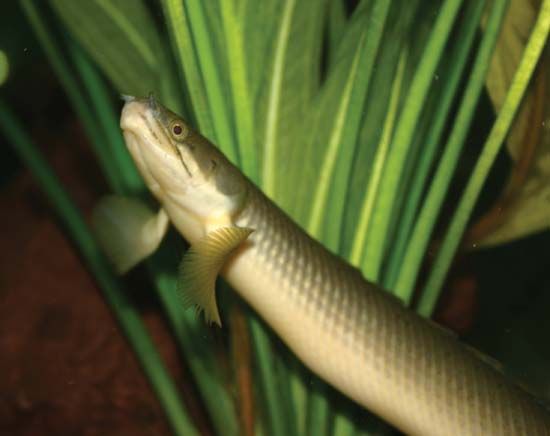
The reedfish (Erpetoichthys calabaricus) is an air-breathing, eel-like freshwater fish native to river systems in Benin, Nigeria, and Cameroon. Classified…
What is reedfish?
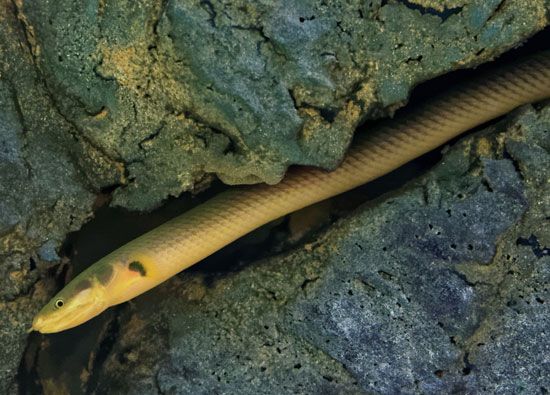
The reedfish (Erpetoichthys calabaricus) is an air-breathing, eel-like freshwater fish native to river systems in Benin, Nigeria, and Cameroon. Classified within the family Polypteridae, it is closely related to the bichir related to the bichir.12
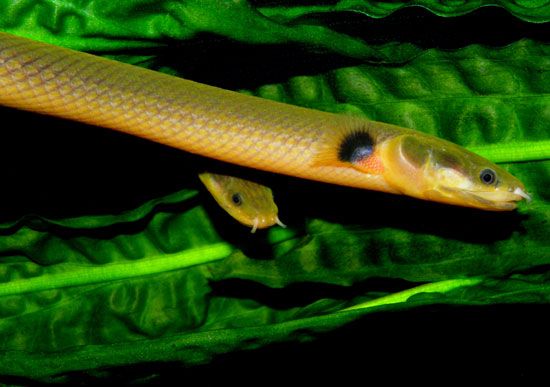
Typically reaching lengths of 30 to 37 cm, the reedfish possesses an elongated body covered in thick, rhomboid scales covered in thick, rhomboid scales. It inhabits the edges of streams and floodplains, where it remains concealed by day and forages at night for worms, crustaceans, and small fishes.1
A notable adaptation is its ability to breathe air by gulping it at the water’s surface, which fills a primitive lung attached to its digestive tract. This lung provides approximately 40 percent of the fish’s oxygen intake, with the remainder supplied by its gills and skin. Due to environmental pressures, the International Union for Conservation of Nature has listed the species as near threatened since 2010.1
How do the lungs of a reedfish differ from the swim bladders found in most other fish?
The lungs of a reedfish and the swim bladders of most other fish share a common historical origin, as both structures developed as diverticula (outpocketings) of the digestive tract. However, they differ significantly in their primary function and specialization.4
- Swim Bladders: In most modern bony fishes, the swim bladder serves as a hydrostatic or ballast organ. By regulating the amount of gas within this organ, fish can control their buoyancy and depth. While some primitive teleosts retain a connection to the digestive tract (physostomous), many advanced species have lost this connection entirely (physoclistic).4
- Reedfish Lungs: The reedfish possesses a primitive lung that is specialized for respiration rather than buoyancy. This organ is highly vascularized and allows the fish to gulp atmospheric air at the water’s surface to supplement its oxygen intake. Unlike a standard hydrostatic swim bladder, the reedfish’s lung is an essential accessory breathing organ; the fish relies on it for approximately 40 percent of its total oxygen uptake.54
In essence, while the swim bladder is primarily a buoyancy control device, the reedfish has adapted this ancestral structure into a functional respiratory organ to thrive in low-oxygen environments.45
What are some of the key physical differences between a reedfish and a typical bichir?
While the reedfish and the bichir are both members of the family Polypteridae and share similar respiratory adaptations, they exhibit distinct physical differences:
- Body Shape: The most notable difference is their overall form. The reedfish is characterized by a distinctly elongated, eel-like body, whereas the bichir has a more robust, cylindrical, and elongated shape that is less serpentine in appearance.31
- Size: Bichirs are generally larger than reedfish. While adult reedfish typically reach lengths of 30 to 37 cm, most bichir species grow between 30 and 60 cm, with some larger species reaching nearly 100 cm in length and weighing several kilograms.31
- Dorsal Fin Structure: The bichir is easily identified by its dorsal fin, which consists of a series of sharp, individual spines, each featuring a flaglike cluster of fin rays. While the reedfish also belongs to the same order, its morphology is more specialized toward its eel-like profile.3
Both species share thick, rhomboid ganoid scales and the ability to breathe air using primitive lungs, an evolutionary trait that distinguishes them from many other bony fishes.31
Why is the reedfish currently classified as a near-threatened species?
The reedfish (Erpetoichthys calabaricus) has been classified as a near-threatened species by the International Union for Conservation of Nature since 2010.1
While the provided information confirms this status, it does not specify the exact environmental pressures or human activities driving this classification. Generally, species inhabiting freshwater river systems, floodplains, and stream edges—the primary habitats for reedfish in Benin, Nigeria, and Cameroon—are often vulnerable to habitat degradation, pollution, and changes in water quality.1
Because the specific data regarding the threats to the reedfish population is not detailed in the available records, I cannot provide a definitive explanation for their current conservation status beyond the official designation.
Sources
- reedfish — Encyclopædia Britannica
- reedfish — Merriam-Webster
- bichir — Encyclopædia Britannica
- fish - The respiratory system — Encyclopædia Britannica
- lungfish - Adaptations for breathing — Encyclopædia Britannica
- osteoglossomorph - Form and function — Encyclopædia Britannica
- Respiratory system - The gills — Encyclopædia Britannica
- Polypteridae — Merriam-Webster
Published on · 3 min read