Osteoglossomorph
The provided search results do not contain specific information regarding the typical diet of osteoglossomorph fish. While it is noted that these fish are…
What is the typical diet of osteoglossomorph fish?
The provided search results do not contain specific information regarding the typical diet of osteoglossomorph fish. While it is noted that these fish are unique because they use their tongues as an opposing surface for their teeth when biting into food, the specific dietary components—such as whether they are primarily carnivorous, herbivorous, or omnivorous—are not detailed in the available documentation.1
Please note that the information provided in your search results regarding feeding habits pertains to the superorder Ostariophysan, which is a different group of fishes.2
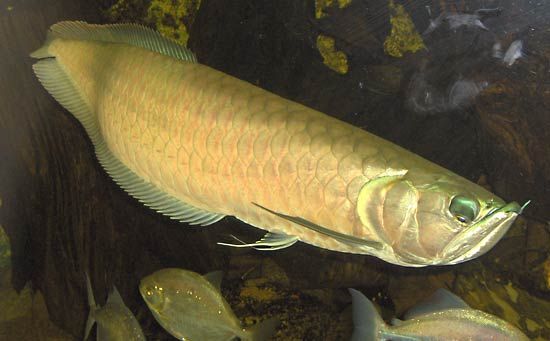
What unique features does the skull of osteoglossomorph fish have?
The skull of an osteoglossomorph fish exhibits several specialized features that distinguish this group of bony fishes:
- Dentition: These fish are unique in that they use their tongue as an opposing surface for teeth when biting into food. Many species possess well-developed teeth on the tongue, the skull base, and the bones of the mouth cavity.15
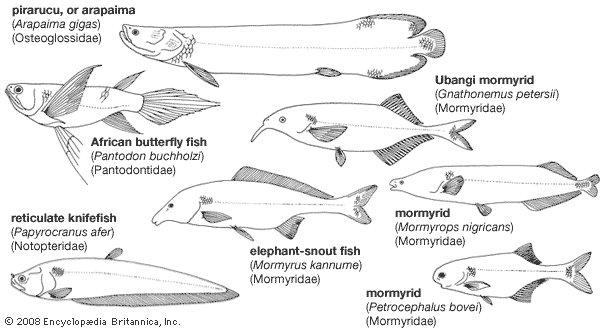
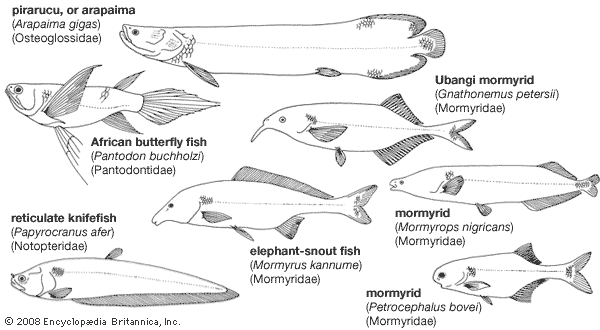
- Jaw Structure: The jaws are not protrusible. While many species have a typical head shape, the Mormyridae display a wide variety of head and mouth forms, including long, curved, tubular snouts used for probing in mud or rocks.6
- Auditory Connections: A notable feature in several groups is the connection between the swim bladder and the skull. In Notopteridae and Hiodontidae, paired extensions connect the swim bladder to the auditory region of the skull. In the African genus Papyrocranus, diverticula of the swim bladder actually penetrate the skull, which is believed to enhance hearing.6
- Internal Vesicles: In Mormyridae and Gymnarchidae, thin tubes extend from the swim bladder into the skull during embryonic development. These eventually atrophy, leaving an isolated vesicle within the skull surrounded by the semicircular canals of the ear.6
How do osteoglossomorph fish reproduce and care for their young?
Reproductive habits among osteoglossomorph fish are remarkably diverse, ranging from species that provide minimal care to those that exhibit complex parental behaviors. While they generally do not undertake extensive breeding migrations, many species move into floodplains or streams during the breeding season.3
Parental Care and Nesting
Parental involvement varies significantly across families:
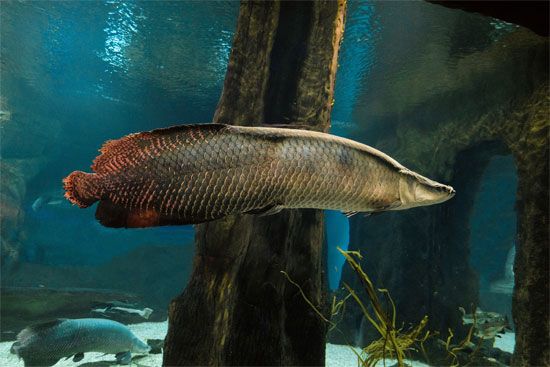
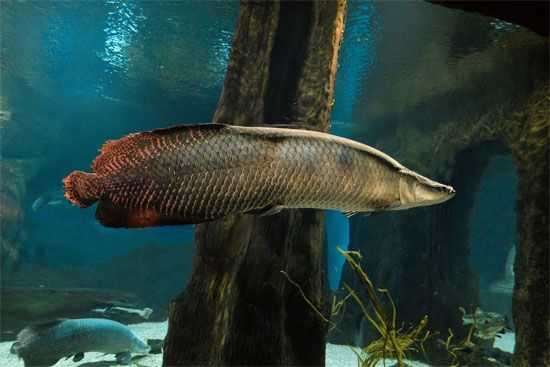
- Osteoglossidae: This family displays a wide range of care. The arawana and its relatives are mouthbrooders, carrying eggs and young in the mouth of one parent. The African arowana (Heterotis niloticus) constructs a crude grass nest in flooded plains, where the male guards the young and leads them on feeding excursions. Similarly, both sexes of the pirarucu (Arapaima gigas) dig a spawning pit; the male subsequently guards the embryos and the hatched young, which congregate around his head for protection.3
- Gymnarchidae: Gymnarchus niloticus builds a large, floating, trough-shaped nest from matted swamp grass stems. One or both parents guard the developing young for approximately 18 days.3
- Notopteridae: These fish do not build nests but establish breeding territories. In Chitala chitala, one parent—likely the male—clears a bottom area near a submerged object to lay eggs in circular bands, which the male then guards.3
- Other Species: Mormyrids are thought to provide little to no parental care, and the African butterfly fish (Pantodon) produces floating eggs with minimal care.3
What are the defining characteristics of osteoglossomorph fish?
Osteoglossomorphs (superorder Osteoglossomorpha) are widely considered the most primitive group of bony fishes. Their defining characteristics include:
- Anatomical Features: They possess a rudimentary caudal skeleton and lack intermuscular bones in the abdominal and anterior caudal regions.1
- Feeding Mechanism: They are unique among fishes for using their tongue as an opposing surface for teeth when biting into food. Their jaws are not protrusible, though they are strongly toothed.15
- Sensory and Internal Anatomy: All members have a well-developed swim bladder, which in several groups connects to the skull to aid in hearing. Some families, such as Mormyridae and Gymnarchidae, possess specialized electrical organs used for navigation, detection, and communication.59
- Diversity: The group is divided into two orders: Osteoglossiformes, which are morphologically diverse and found globally in tropical freshwater, and Hiodontiformes, which are restricted to North America.1
Sources
- osteoglossomorph — Encyclopædia Britannica
- osteoglossomorph - General features — Encyclopædia Britannica
- osteoglossomorph - Life cycle and reproduction — Encyclopædia Britannica
- ostariophysan - Feeding habits — Encyclopædia Britannica
- osteoglossomorph - Annotated classification — Encyclopædia Britannica
- osteoglossomorph - Form and function — Encyclopædia Britannica
- lizard - Skull and jaws — Encyclopædia Britannica
- Reproductive behaviour - Fishes — Encyclopædia Britannica
- osteoglossomorph - Behaviour and ecology — Encyclopædia Britannica
- osteoglossomorph - Critical appraisal — Encyclopædia Britannica
Published on · 3 min read