River Liffey
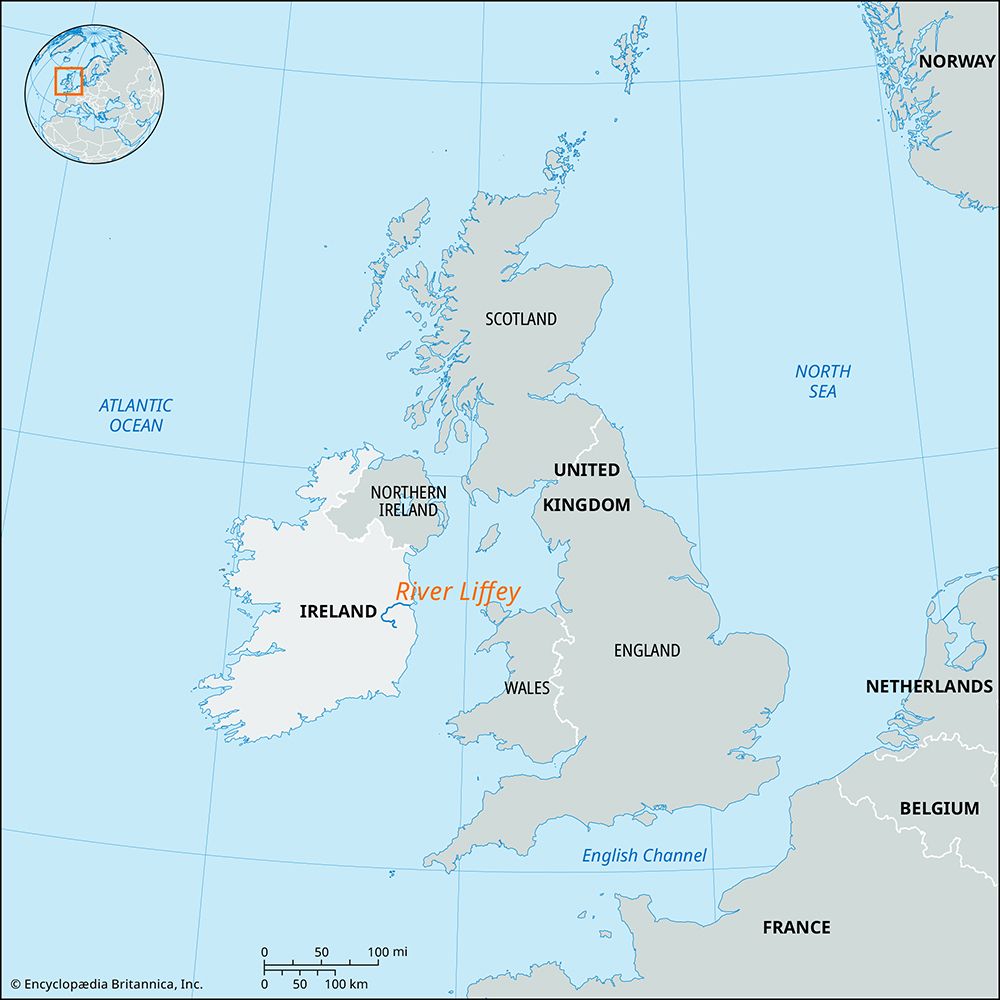
The River Liffey is a 50-mile (80-km) long river located in eastern Ireland. It rises in the Wicklow Mountains, approximately 20 miles southwest of Dublin…
What is River Liffey?
The River Liffey is a 50-mile (80-km) long river located in eastern Ireland. It rises in the Wicklow Mountains, approximately 20 miles southwest of Dublin, and flows through the counties of Wicklow, Kildare, and Dublin.12
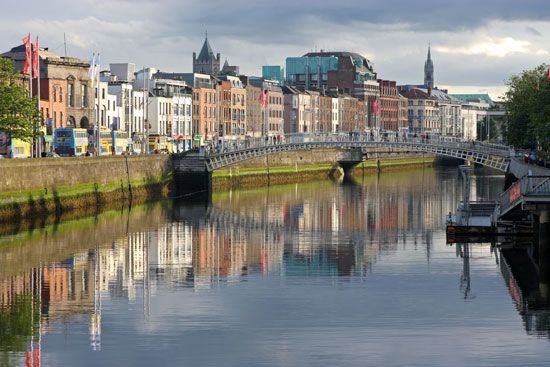
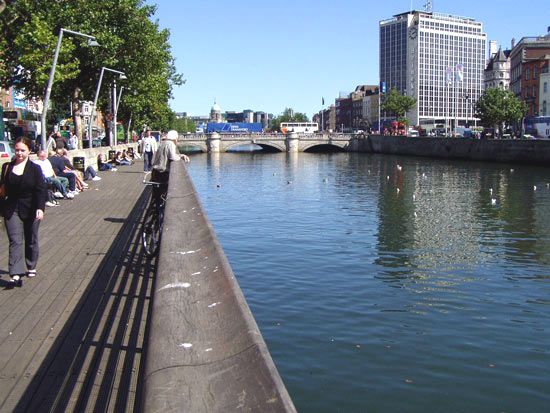
Following a winding course established in preglacial times, the river travels northwesterly toward the Lackan Reservoir before turning westward through the Kildare lowland. It eventually shifts northeast toward Celbridge and Leixlip. Upon reaching the city of Dublin, the river becomes extensively canalized and lined with quays before finally emptying into Dublin Bay, an arm of the Irish Sea.1
What are the Wicklow Mountains like?
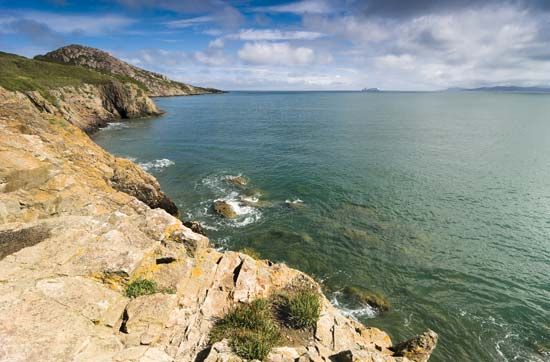
The Wicklow Mountains are an extensive range in eastern Ireland that form part of the Leinster Chain. Geologically, the area is a vast anticline composed primarily of granite, with slates and sandstones also present. The landscape is characterized by smoothly rounded granite hills that generally rise over 2,000 feet, though the highest peak, Lugnaquillia Mountain, reaches 3,039 feet and is capped with hard mica-schist.34
The region is defined by its rugged terrain, featuring deep valleys, river gorges, and waterfalls. Significant glacial activity has shaped the landscape, leaving behind features such as moraines, meltwater channels, and deepened valleys like Glendalough, Glenmacnass, and Glencree. The mountains are not easily crossed, with no pass falling below 1,000 feet in elevation. Historically, this difficult terrain served as a refuge for fugitives and rebels, and it remains a prominent feature of the “Garden of Ireland,” supporting tourism, livestock production, and historical sites.34
How has the River Liffey shaped Dublin’s history?
The River Liffey has been central to Dublin’s identity and development since the city’s inception. Its most fundamental contribution is the very origin of the city: the dark, bog-stained water draining into the river created the “black pool”—or Dubh Linn in Irish—that gave Dublin its name.1
Strategically, the river provided a vital gateway from the sea. By breaking eastward through the hill-ringed plain to the Irish Sea, the Liffey offered a natural opening that attracted Viking raiders and facilitated early Norse settlement, serving as a corridor to the fruitful central plains of Ireland.1
As the city grew, the river became the defining axis of its urban layout, effectively dividing the heart of Dublin into north and south sections. Today, the river is extensively canalized and lined with quays, serving as a physical and social anchor for the capital. While monumental buildings and historic Georgian architecture line its banks, the river remains a constant presence in the city’s evolving landscape, bridging the gap between its aristocratic past and its modern, prosperous present.56
What other major rivers are found in Ireland?
Ireland features a diverse network of rivers, with the River Shannon standing as the longest at approximately 161 miles. Beyond the Shannon, the country’s drainage system includes numerous significant waterways distributed across its regions:78
- East: The Slaney, Liffey, and Boyne.9
- Southeast: The Nore, Barrow, and Suir. The Barrow flows for about 120 miles, while the Suir extends for 114 miles; both join the Nore before entering Waterford Harbour.91011
- South: The Blackwater, Lee, and Bandon.9
- West: The Clare and the Moy.9
Many of these inland rivers are well-known for their salmon fisheries and flow slowly through marshes and lakes before reaching the sea. Due to the porous nature of the underlying limestone, these surface networks are often supported by an extensive underground drainage system.9
Sources
- River Liffey — Encyclopædia Britannica
- Liffey — Merriam-Webster
- Wicklow Mountains — Encyclopædia Britannica
- Wicklow — Encyclopædia Britannica
- Dublin - City site — Encyclopædia Britannica
- Dublin - Character of the city — Encyclopædia Britannica
- River Shannon — Encyclopædia Britannica
- Ireland - Drainage of Ireland — Encyclopædia Britannica
- Ireland — Encyclopædia Britannica
- River Barrow — Encyclopædia Britannica
- River Suir — Encyclopædia Britannica
Published on · 3 min read