Rutabaga
While rutabagas and turnips are both members of the Brassicaceae family, they are distinct species. Rutabagas (Brassica napus) likely originated as a cross…
How do rutabagas compare to turnips in terms of appearance, taste, and culinary use?
While rutabagas and turnips are both members of the Brassicaceae family, they are distinct species. Rutabagas (Brassica napus) likely originated as a cross between turnips (Brassica rapa) and wild cabbage.12
Appearance
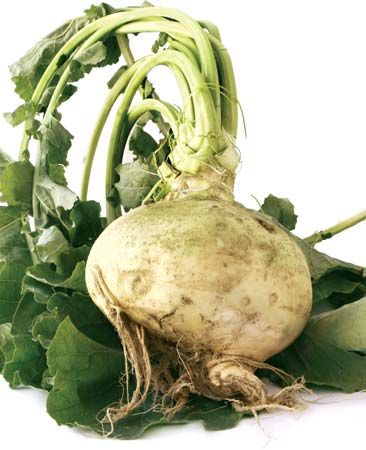
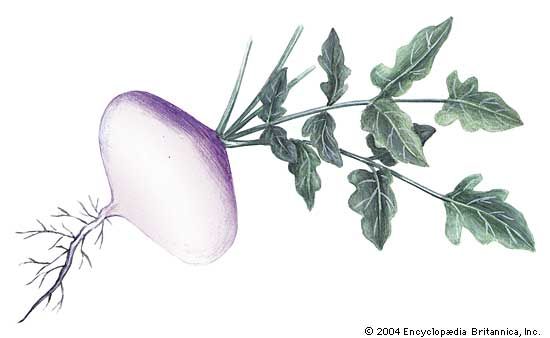
- Rutabagas: These feature an enlarged root with a distinct neck and leaf scars. Yellow-fleshed varieties typically have smooth, green, purple, or bronze skin, while white-fleshed versions are more irregular with rough green skin.1
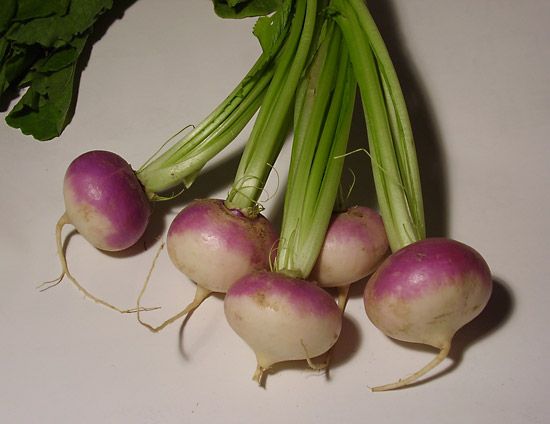
- Turnips: The root is formed by the thickening of the primary root and the base of the stem. Their leaves are grass-green and covered in rough hairs, contrasting with the smooth, waxy leaves of the rutabaga.12
Culinary Use
Both vegetables are versatile in the kitchen. Their roots can be eaten raw, pickled, or cooked—often mashed or added to stews. The edible leaves of both plants are also commonly prepared as greens. Because rutabagas have firm flesh, they are known for storing well throughout the winter.12
Where did rutabagas originate, and how did they spread to other parts of the world?
The rutabaga (Brassica napus, variety napobrassica) is believed to have originated in Russia or Scandinavia during the late Middle Ages. It likely emerged as a natural cross between the turnip and wild cabbage.14
The name “rutabaga” itself is derived from Swedish terms for “root” and “bag,” reflecting the vegetable’s characteristic short, stumpy shape. Because of its origins, the plant is also historically referred to as a “Swedish turnip” or “Swede” in various regions.4
Regarding its spread, the rutabaga is a cool-season crop that thrives in northern climates, which facilitated its cultivation across Great Britain, Canada, and northern Europe. It is widely grown in these regions, often serving as a reliable cattle fodder crop due to its hardiness and ability to store well through the winter, and it is cultivated to a lesser extent in the United States.1
What is a rutabaga and how does it differ from other root vegetables?
A rutabaga (Brassica napus, variety napobrassica) is a root vegetable in the mustard family that likely originated as a cross between a turnip and wild cabbage.1
Distinctions from Other Root Vegetables
While “root vegetable” is a broad culinary category encompassing tubers, bulbs, and rhizomes, the rutabaga is specifically a true root crop. It differs from other root vegetables in several key ways:2
- Botanical Origin: Unlike many other root vegetables, the rutabaga is a biennial hybrid. It is a distinct species from the turnip, despite their shared family and frequent confusion.16
- Physical Characteristics: Rutabagas feature smooth, waxy leaves and an enlarged root with a distinct neck and leaf scars. Their flesh is notably firm, which allows them to store exceptionally well in cool, dark conditions for months without spoilage.12
- Growing Requirements: As a cool-season crop, the rutabaga requires a long growing season due to its slow development, making it distinct from faster-growing root vegetables.1
How are rutabagas typically grown and harvested?
Rutabagas are cool-season crops that require a long growing season due to their relatively slow development. Because they are hardy to cold, they are typically sown as a main or late crop to ensure they reach maturity in cooler conditions.1
The cultivation process involves:
- Sowing: Seeds are planted to allow the plants to develop their characteristic enlarged, fleshy roots.
- Growth: As biennial plants, they spend their first season focusing on root development. If left in the ground for a second season, the plant will produce cross-shaped flowers ranging from pale yellow to orange.1
- Harvesting: The roots are harvested once they have reached an appropriate size. Because the flesh is firm, they are prized for their ability to store well during the winter months, making them a reliable food source.1
While they are commonly grown for human consumption—often eaten raw, pickled, or mashed—they are also extensively cultivated as cattle fodder in regions like Canada, Great Britain, and northern Europe.1
Sources
- Rutabaga — Encyclopædia Britannica
- Turnip — Encyclopædia Britannica
- turnip cabbage — Merriam-Webster
- Ten Harvest Words for the Cornucopia | Rutabaga — Merriam-Webster
- list of economically important members of the family Brassicaceae — Encyclopædia Britannica
- Root vegetable — Encyclopædia Britannica
Published on · 3 min read