Sapodilla
The sapodilla (Manilkara zapota) is a slow-growing, medium-sized tropical evergreen tree belonging to the Sapotaceae family. It is primarily valued for its…
What is the sapodilla tree and where is it primarily grown?
The sapodilla (Manilkara zapota) is a slow-growing, medium-sized tropical evergreen tree belonging to the Sapotaceae family. It is primarily valued for its sweet, edible fruit, which features a flavor often compared to a blend of pears and brown sugar.1
Historically, the tree was significant for its milky latex, which served as the primary source of chicle for the chewing-gum industry and was used by the Aztecs. Additionally, its hard, durable wood has been utilized for centuries, notably in Mayan architecture.1
The sapodilla is native to southern Mexico, Central America, and parts of the Caribbean. While it is not of major commercial importance globally, it is widely cultivated and appreciated in many tropical and subtropical regions where it is consumed fresh.1
How is the sapodilla fruit typically consumed and what are its nutritional benefits?
The sapodilla fruit is primarily consumed fresh once it has reached maturity. It is important to note that the fruit must be fully ripe before consumption; when immature, the flesh contains tannin and milky latex, which makes it unpalatable.1
When ripe, the fruit features a sweet, juicy, yellowish-brown flesh that is often compared to a blend of pears and brown sugar. The fruit contains two to five shiny black seeds that must be removed before eating.1
Regarding your question about nutritional benefits, the provided search results do not contain specific information regarding the nutritional profile or health benefits of the sapodilla fruit.
What are the characteristics of the sapodilla fruit in terms of appearance, taste, and texture?
The sapodilla fruit is characterized by several distinct physical and sensory traits:
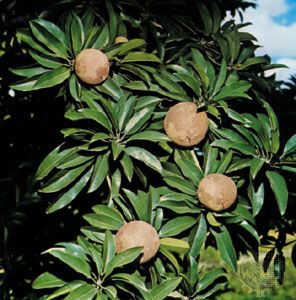
- Appearance: The fruit is spheroid to ovoid in shape, typically measuring 5–10 cm (2–4 inches) in diameter. Its exterior surface is rusty brown in color. Inside, the fruit contains two to five shiny black seeds, which are about the size of flattened beans.1
- Taste: The flesh is noted for its sweet flavor, which is often described as a combination of pears and brown sugar.1
- Texture: When fully ripe, the fruit contains a translucent, yellowish-brown, and juicy flesh. It is important to note that the fruit must be ripe to be palatable; when immature, the flesh is unpalatable due to the presence of tannin and milky latex.1
How long does it take for a sapodilla tree to bear fruit, and what is its typical lifespan?
The sapodilla (Manilkara zapota) is a slow-growing, medium-sized evergreen tree. While the provided information details the tree’s physical characteristics, historical uses of its latex for chicle, and its propagation methods, it does not specify the exact number of years required for the tree to begin bearing fruit or its typical lifespan.1
Because this information is not available in the provided source, I cannot answer your question regarding the tree’s maturity timeline or longevity.
Sources
- sapodilla — Encyclopædia Britannica
- sapote — Encyclopædia Britannica
Published on · 2 min read