Saw Shark
A saw shark (order Pristiophoriformes) is a marine shark distinguished by a long, slender, sawlike snout lined with sharp, toothlike projections. There are…
What is saw shark?
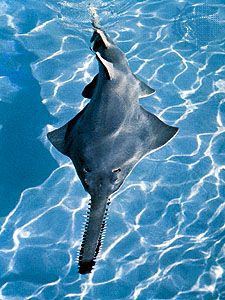
A saw shark (order Pristiophoriformes) is a marine shark distinguished by a long, slender, sawlike snout lined with sharp, toothlike projections. There are approximately nine species of these bottom-dwelling predators, which typically grow to a maximum length of about 1.37 meters (4.5 feet).1
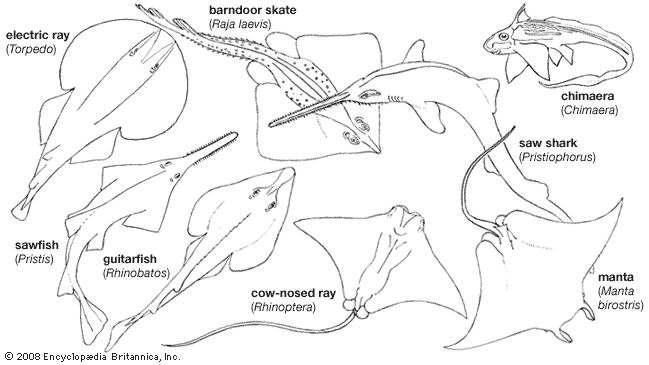
While they resemble sawfishes, which are a type of ray, saw sharks are distinct because they possess a pair of barbels on the underside of their snout and have gill slits on the sides of their head rather than underneath. They use their specialized snouts to slash at prey, stunning or cutting fish to feed, though they are harmless to humans. They are found in tropical and temperate waters across the Atlantic, Indian, and Pacific Oceans.123
How can you tell a saw shark apart from a sawfish?
Although saw sharks and sawfishes both possess a long, bladelike snout lined with teeth, they are unrelated species that can be distinguished by several key physical characteristics.14
Key Differences
- Gill Slits: The most reliable way to tell them apart is by the location of their gill slits. In saw sharks, the gill slits are located on the sides of the head, which is characteristic of sharks. In sawfishes, which are a type of ray, the gill slits are located on the underside of the body.12
- Barbels: Saw sharks have a pair of long, fleshy sensory organs called barbels on the underside of their snout. Sawfishes do not have these structures.1
- Size: Saw sharks are relatively small, reaching a maximum length of about 1.37 meters (4.5 feet). In contrast, sawfishes are much larger, with some species attaining lengths of 7 meters (23 feet) or more.15
While both use their “saws” to stun or cut prey, these anatomical differences clearly separate the two groups.14
What is the purpose of the barbels on a saw shark’s snout?
The barbels on a saw shark’s snout serve as specialized sensory organs. While the specific function of these structures in saw sharks is not detailed in the provided text, barbels in general are known to be highly sensitive to touch and are typically equipped with numerous taste buds. In bottom-feeding fishes, these fleshy, fingerlike projections function to help the animal locate, select, and taste food before ingestion, often working in tandem with the fish’s sense of touch.72
How do sharks use their lateral line system to find food?
Sharks utilize their lateral line system as a sophisticated sensory network to detect prey by sensing movements and pressure changes in the surrounding water. This system consists of a series of mechanoreceptors known as neuromasts, which are arranged in an interconnected network along the shark’s head and body.9
These neuromasts are typically embedded in mucus-filled canals located just beneath the skin. Each neuromast contains sensory hair cells topped with small cilia that are stimulated by water displacement or pressure. By processing these signals, the shark can determine the rate and direction of water movement, allowing it to detect the presence of nearby prey, even when the prey is stationary or moving at a distance.92
While the lateral line system is primarily responsible for detecting vibrations and pressure, it works in concert with other senses, such as smell and electroreception, to create a highly integrated system for locating and capturing food.107
Sources
- saw shark — Encyclopædia Britannica
- chondrichthyan - Sharks — Encyclopædia Britannica
- saw shark — Merriam-Webster
- list of sharks, skates, and rays — Encyclopædia Britannica
- chondrichthyan - Distinguishing features — Encyclopædia Britannica
- sawfish — Encyclopædia Britannica
- chondrichthyan - Senses — Encyclopædia Britannica
- ostariophysan - Barbels — Encyclopædia Britannica
- lateral line system — Encyclopædia Britannica
- shark - Shark behaviour — Encyclopædia Britannica
- 14 Questions About Aquatic Animals Answered - Is it true that a shark can smell a drop of blood from a mile away? — Encyclopædia Britannica
Published on · 3 min read