Viperfish
The viperfish refers to any of nine species of marine fish within the genus Chauliodus. These predators are deep-sea dwellers found in tropical regions of…
What is viperfish?
The viperfish refers to any of nine species of marine fish within the genus Chauliodus. These predators are deep-sea dwellers found in tropical regions of the world’s major oceans.12
Viperfish are characterized by their long, fanglike teeth, which protrude from their upper and lower jaws to help them grip struggling prey. As mid-water inhabitants, they possess luminescent organs along their sides that produce light to attract the smaller fish they consume. Despite their fearsome appearance, these fish are relatively small; the largest species, the Pacific viperfish (C. macouni), reaches a maximum length of about 30 centimeters (1 foot). They are classified within the family Chauliodontidae, though the term is sometimes associated with the related family Gonostomatidae.123
How does bioluminescence help deep-sea creatures survive?
Bioluminescence is a critical survival mechanism for many deep-sea creatures, allowing them to navigate, hunt, and defend themselves in the darkness of the ocean depths. This chemical process, typically involving the oxidation of the pigment luciferin by the enzyme luciferase, produces light that serves several vital functions:456
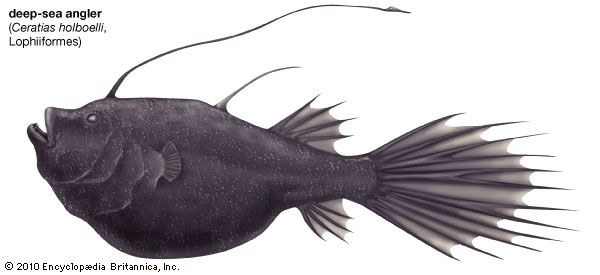
- Predation: Predators like the anglerfish use glowing lures to attract unsuspecting prey directly toward their jaws.74
- Defense and Camouflage: Many organisms use light to startle predators or secrete luminous clouds to confuse enemies during an escape. Additionally, some fish use photophores on their undersides to match the intensity of sunlight from above, effectively concealing their silhouette from predators lurking below.746
- Communication and Mating: Bioluminescence is essential for species recognition and signaling potential mates. Many lantern fishes possess unique patterns of light organs that help individuals identify members of their own species and sex.46
What are some other examples of deep-sea predators?
Beyond the viperfish, the deep-sea environment hosts a variety of specialized predators adapted to extreme pressure and darkness. Notable examples include:
- Deep-sea Anglerfishes: Members of the suborder Ceratioidei, these predators are famous for using a modified dorsal fin spine that acts as a glowing lure to attract prey within striking distance.3
- Bristlemouths: Belonging to the family Gonostomatidae, these are among the most abundant fishes on Earth and serve as significant predators in the deep-sea food web.3
- Goblin Sharks: A rare species (Mitsukurina owstoni) characterized by a long, protruding snout and highly protrusible jaws, which allow them to capture prey in deep marine waters.89
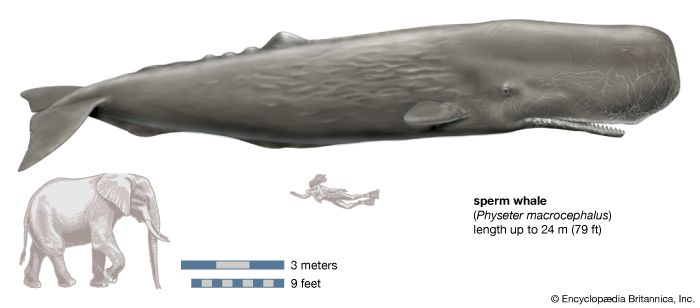
- Giant Squids: These elusive cephalopods (Architeuthis) use their two long tentacles, equipped with suckers and toothed rings, to capture prey such as fish and other cephalopods. They are also known to be preyed upon by the sperm whale.110
- Chimaeras: Also known as ghost sharks, these fish dwell in deep waters—sometimes reaching depths of 2,500 meters—where they actively hunt small invertebrates and fish.11
How do fish adapt to the extreme pressure of the deep ocean?
To survive the extreme hydrostatic pressure of the deep ocean, fish have evolved specialized physiological adaptations that allow them to thrive where pressure can reach hundreds of atmospheres.14
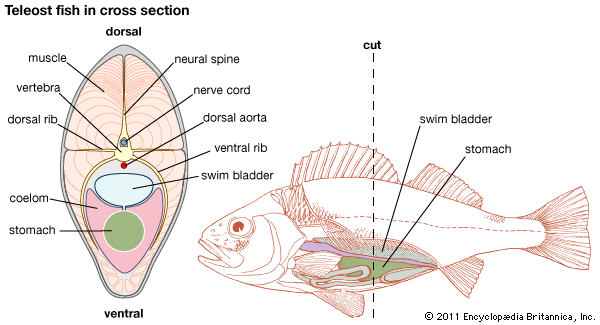
A primary adaptation is the reduction or total loss of air-filled compartments, such as the swim bladder, which would otherwise be crushed by the immense pressure. While many surface-dwelling bony fish use these organs for buoyancy control, deep-sea species often lack them entirely or have replaced gas with oils to maintain buoyancy without the risk of compression.151416
Furthermore, deep-sea organisms often possess bodies with reduced skeletal and muscular structures, frequently appearing gelatinous. By minimizing dense tissues and energy-intensive structures, these fish require less energy to maintain their form in a food-poor environment. These evolutionary traits, alongside specialized metabolic processes, allow deep-sea life to remain among the most highly specialized in the world.1317
Sources
- viperfish — Encyclopædia Britannica
- viperfish — Merriam-Webster
- deep-sea fish — Encyclopædia Britannica
- Bioluminescence: Top Questions — Encyclopædia Britannica
- Marine bioluminescence — Encyclopædia Britannica
- Bioluminescence - The role of bioluminescence in behavior — Encyclopædia Britannica
- Everything’s Illuminated: 6 Bioluminescent Organisms — Encyclopædia Britannica
- goblin shark — Encyclopædia Britannica
- goblin shark — Merriam-Webster
- giant squid — Encyclopædia Britannica
- squid — Encyclopædia Britannica
- chondrichthyan - Rays — Encyclopædia Britannica
- Biosphere - Hydrostatic pressure — Encyclopædia Britannica
- fish - The respiratory system — Encyclopædia Britannica
- protacanthopterygian - Ecology — Encyclopædia Britannica
- swim bladder — Encyclopædia Britannica
- thoracic squeeze — Encyclopædia Britannica
Published on · 3 min read