Deep-sea Fish
Deep-sea fish have evolved diverse and specialized reproductive strategies to overcome the challenges of their extreme, sparsely populated environment.…
How do deep-sea fish reproduce in their extreme environment?
Deep-sea fish have evolved diverse and specialized reproductive strategies to overcome the challenges of their extreme, sparsely populated environment. Because finding a mate in the vast, dark depths can be difficult, some species exhibit hermaphroditism, allowing individuals to produce both eggs and sperm at different life stages to increase reproductive success.12
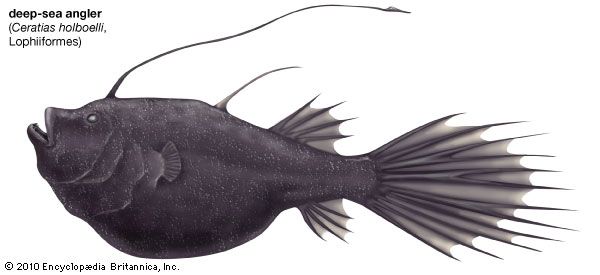
In the case of deep-sea anglerfish, a unique form of sexual parasitism has evolved. Males are significantly smaller than females and lack the specialized “fishing” apparatus. In several families, the male attaches himself to a female by biting her skin; their tissues fuse, and their bloodstreams connect, rendering the male permanently dependent on the female for nourishment.3
While many marine fishes rely on external fertilization by releasing eggs into the water column, deep-sea environments often necessitate more specialized approaches. Some species may produce fewer, larger eggs to improve the survival chances of their offspring in harsh conditions. Additionally, while the life cycles of many deep-sea species remain poorly understood, researchers have observed that some deep-sea organisms hatch as juveniles or immature adults, bypassing vulnerable larval stages.45
How deep can fish live in the ocean, and what are some examples of the deepest-dwelling species?
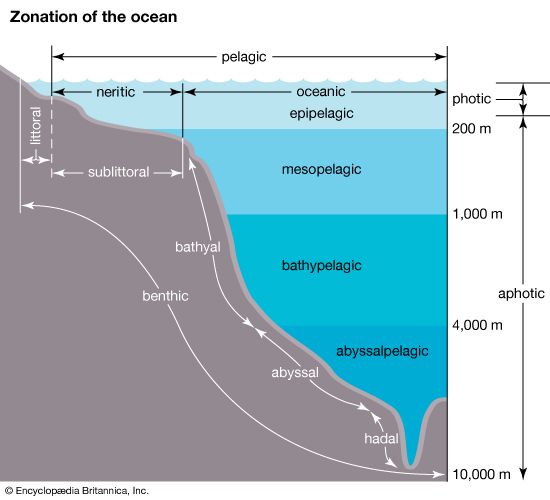
Fish are found at extreme ocean depths, typically ranging from 600 meters to as deep as 8,370 meters (approximately 2,000 to 27,500 feet). The deepest region of the ocean, known as the hadal zone, encompasses depths greater than 6,000 meters.67
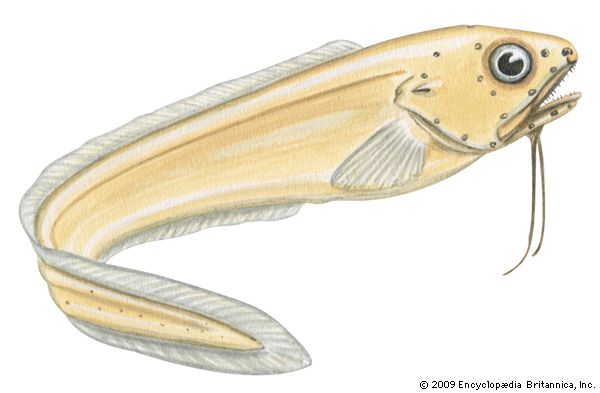
While many deep-sea species inhabit the bathypelagic zone (1,000 to 4,000 meters), some cusk eels (family Ophidiidae) have been recorded at depths of approximately 4,000 fathoms (about 7,300 meters), representing the greatest depth at which any fish life is known to exist.8
Examples of deep-dwelling species include:
- Cusk eels (Ophidiidae): These are the dominant family of teleosts at depths exceeding 2,000 fathoms.8
- Deep-sea anglerfishes (Ceratioidei): These abyssal, midwater fish typically reside at depths between 1,000 and 3,000 fathoms.8
- Grenadiers (Macrouridae): These bottom-dwelling fish are commonly found along continental slopes at depths ranging from 100 to 1,000 fathoms.8
How do deep-sea fish cope with the high pressure and darkness of their habitat?
Deep-sea fish have evolved remarkable biological specializations to thrive in an environment defined by extreme hydrostatic pressure, near-total darkness, and limited food resources.611
Coping with High Pressure
At great depths, hydrostatic pressure is immense, increasing by one atmosphere for every 10 meters of depth. Deep-sea organisms manage this challenge because their internal body pressures are equal to the external pressure. To avoid the complications associated with gas-filled cavities under such force, many deep-sea fish have reduced or completely lost their swim bladder, an organ used by surface-dwelling fish for buoyancy. Some species that retain the organ may use oils instead of gas to maintain buoyancy.12111314
Adapting to Darkness
In the absence of sunlight, deep-sea fish rely on specialized sensory and biological adaptations:
- Bioluminescence: Many species possess photophores or luminous organs. These are used to attract prey, signal potential mates, or provide counter-illumination—a camouflage technique where the fish matches the intensity of light from above to hide its shadow from predators below.615
- Enhanced Sensory Systems: To compensate for limited vision, some species have evolved highly sensitive lateral line systems, which detect vibrations and pressure changes in the water, often featuring exposed sensory cells on raised papillae to increase sensitivity.16
- Physical Morphology: Mid-water species often feature enlarged eyes to capture minimal light, while bottom-dwelling (benthic) forms may have smaller eyes or be blind, relying on other senses to navigate the seafloor.611
What are some examples of bioluminescent deep-sea fish and how do they use this ability?
Many deep-sea fish utilize bioluminescence—a chemical process involving the oxidation of the molecule luciferin—to survive in the darkness of the ocean depths. This light is often produced by specialized organs called photophores or by harboring symbiotic luminous bacteria.11181920
Examples and Uses
- Anglerfish: These predators feature an elongated dorsal spine that acts as a fishing rod, dangling a luminous lure in front of their mouths to attract unsuspecting prey in the dark.1918
- Lanternfishes: These fish possess unique patterns of photophores along their bodies. These patterns serve as species- and sex-recognition signals, which are essential for schooling and mating.1918
- Hatchetfishes: Like many other deep-sea species, they use photophores on their ventral surfaces to perform counter-illumination. By matching the intensity of sunlight filtering down from above, they effectively erase their own silhouette, making them invisible to predators lurking below.1921
- Flashlight fishes: These fish house symbiotic bacteria in organs beneath their eyes. They can control the light by mechanically drawing a fold of black skin over the organ, allowing them to flash or extinguish the light at will.20
Sources
- How do fish reproduce? — Encyclopædia Britannica
- anglerfish — Encyclopædia Britannica
- protacanthopterygian - Life cycle and reproduction — Encyclopædia Britannica
- malacostracan - Reproduction and life cycles — Encyclopædia Britannica
- fish - Reproduction — Encyclopædia Britannica
- deep-sea fish — Encyclopædia Britannica
- Marine ecosystem - Geography, oceanography, and topography — Encyclopædia Britannica
- Respiratory system - Fishes — Encyclopædia Britannica
- paracanthopterygian - Ecology and behavior — Encyclopædia Britannica
- abyssal zone — Encyclopædia Britannica
- Bioluminescence - The role of bioluminescence in behavior — Encyclopædia Britannica
- protacanthopterygian - Ecology — Encyclopædia Britannica
- protacanthopterygian - Sense organs — Encyclopædia Britannica
- swim bladder — Encyclopædia Britannica
- Biosphere - Hydrostatic pressure — Encyclopædia Britannica
- fish - The respiratory system — Encyclopædia Britannica
- Mechanoreception - Generalized hydrostatic pressure — Encyclopædia Britannica
- Marine bioluminescence — Encyclopædia Britannica
- Bioluminescence - The range and variety of bioluminescent organisms — Encyclopædia Britannica
- Everything’s Illuminated: 6 Bioluminescent Organisms — Encyclopædia Britannica
- coloration - Countershading — Encyclopædia Britannica
Published on · 4 min read