Scrub-bird
Scrub-birds (family Atrichornithidae) are unique among passerine birds due to their near-flightlessness and specific anatomical adaptations. Unlike most…
How do scrub-birds compare to other bird species in their ecosystem?
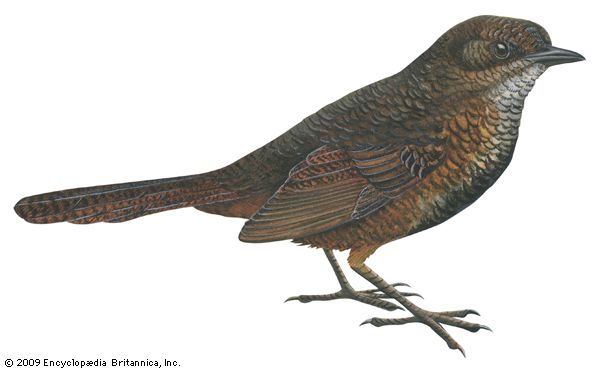
Scrub-birds (family Atrichornithidae) are unique among passerine birds due to their near-flightlessness and specific anatomical adaptations. Unlike most other birds, they lack a wishbone because their clavicles are poorly developed and do not join.1
Compared to other species in their ecosystem, scrub-birds are distinguished by their remarkable vocalizations. Like lyrebirds, they are known for producing loud, complex, and ventriloquial songs, as well as their ability to mimic other sounds. While many birds in Australian scrublands—such as honeyeaters—play a critical role in pollination by feeding on nectar, scrub-birds are primarily ground-dwelling, nesting in bulky, domed structures lined with unique wood pulp that dries into a cardboard-like consistency.123
While other birds in these regions may be highly mobile and active in the canopy, scrub-birds are elusive, seldom flying and preferring to disappear quickly on foot. They occupy a specialized niche within their brushland and forest habitats, distinct from the nectar-reliant species that have coevolved with the local flora.13
What conservation efforts are in place to protect scrub-birds and their habitats?
Conservation efforts for scrub-birds focus primarily on habitat protection to ensure the survival of these rare passerine species.
The rufous scrub-bird, which inhabits wet forests across New South Wales and Queensland, is specifically protected within Lamington National Park. This designation helps safeguard the specialized forest environments required by the species.1
While the provided information highlights that habitat management—such as controlling fire regimes and water levels—is critical for the recovery of other endangered species like the Kirtland’s warbler and the Cape Sable seaside sparrow, the specific management techniques currently employed for the western, or noisy, scrub-bird are not detailed in the available records.145
We could dive deeper into the general principles of ecological restoration or explore how national park protections function to preserve biodiversity in Australia.
What is the scientific classification of the scrub-bird?
The scientific classification of the scrub-bird is as follows:
- Kingdom: Animalia
- Phylum: Chordata
- Class: Aves
- Order: Passeriformes (perching birds)
- Suborder: Passeri (songbirds)
- Family: Atrichornithidae
The family Atrichornithidae consists of two rare Australian species: the western, or noisy, scrub-bird (Atrichornis clamosus) and the rufous scrub-bird (A. rufescens).16
How many species of scrub-birds exist, and what are their conservation statuses?
There are two species of scrub-birds in the family Atrichornithidae:
- Western, or noisy, scrub-bird (Atrichornis clamosus): This species was discovered in the 1840s and was believed to be extinct after 1889, but it was rediscovered in 1961.
- Rufous scrub-bird (A. rufescens): Discovered in the 1860s, this species is found in wet forests across New South Wales and Queensland, where it is protected within Lamington National Park.1
While the provided search results confirm that both species are considered rare, they do not explicitly state their current formal conservation status (such as “endangered” or “vulnerable”). The historical context of the western scrub-bird’s rediscovery underscores its extreme rarity and the ongoing necessity of habitat protection for both species.1
Sources
- Scrub-bird — Encyclopædia Britannica
- Scrubland - Biota — Encyclopædia Britannica
- Passeriform - Sound production — Encyclopædia Britannica
- conservation - Fire control — Encyclopædia Britannica
- conservation - Flood control — Encyclopædia Britannica
- Passeriform - Annotated classification — Encyclopædia Britannica
- Gruiform - Annotated classification — Encyclopædia Britannica
Published on · 2 min read