Sea Hare
A sea hare is any marine gastropod belonging to the family Aplysiidae, which falls under the subclass Opisthobranchia and the phylum Mollusca. These…
What is sea hare?
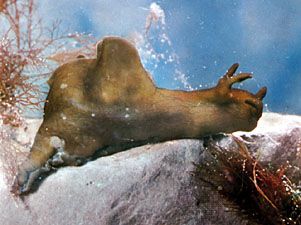
A sea hare is any marine gastropod belonging to the family Aplysiidae, which falls under the subclass Opisthobranchia and the phylum Mollusca. These creatures are characterized by a smooth or warty body, prominent tentacles that resemble rabbit ears, and a shell that has been reduced to a flat plate.1
Sea hares are simultaneous hermaphrodites and feed on large seaweeds. An example is the spotted sea hare (Aplysia dactylomela), a green, ring-spotted species found in the grassy shallows of the Caribbean. Scientific research involving sea hares has been instrumental in advancing the understanding of the biochemical basis of learning.1
It is important to distinguish the sea hare from the seahorse, which is a type of marine fish in the family Syngnathidae. While the names are similar, they are biologically distinct organisms with different habitats and physical characteristics.21
How do sea hares use their ink for defense?
Sorry, the Britannica knowledge base does not contain information regarding how sea hares use their ink for defense.
Why are sea hares important in neuroscience research?
Sea hares, particularly the marine snail Aplysia californica, are vital to neuroscience because their relatively simple nervous systems—composed of few, large, and easily accessible nerve cells—allow researchers to study the cellular and molecular mechanisms of learning and memory.17
By analyzing the neural circuits involved in the animal’s protective gill-withdrawal reflex, scientists have gained significant insights into neuroplasticity, the process by which the strength of synaptic responses changes7. Key findings include:
- Habituation: A decrease in response to repeated stimuli, linked to reduced neurotransmitter release caused by decreased calcium influx.1
- Sensitization: An increase in reflex strength following stimulation, associated with presynaptic facilitation and changes in second messenger levels.1
These studies, notably conducted by Nobel laureate Eric Kandel, established that memory is centered on synaptic function, with chemical changes forming the basis for both short-term memory and long-term memory. This research suggests that the molecular mechanisms of memory are conserved across the phylogenetic tree, providing a foundation for understanding human brain function.71
What does it mean for an animal to be a simultaneous hermaphrodite?
A simultaneous hermaphrodite is an animal that possesses both male and female reproductive organs—specifically ovaries and testes—that are mature and functional at the same time.9
This condition is common among more sluggish or attached animals, such as earthworms, slugs, land snails, flatworms, tapeworms, and barnacles. While these organisms are capable of producing both eggs and sperm simultaneously, they typically avoid self-fertilization. Instead, they engage in mutual copulation, where each individual in a mating pair introduces sperm into the body of the other. This strategy ensures the genetic recombination and variation that are the primary evolutionary advantages of sexual reproduction.9
This differs from sequential hermaphroditism, where an animal changes its sex from male to female or vice versa at different stages of its growth cycle.9
Sources
- sea hare — Encyclopædia Britannica
- seahorse — Encyclopædia Britannica
- gasterosteiform - Ecology and behaviour — Encyclopædia Britannica
- osteoglossomorph - Form and function — Encyclopædia Britannica
- atheriniform - Form and function — Encyclopædia Britannica
- Chemoreception - Predator chemical cues and prey escape — Encyclopædia Britannica
- nervous system - Simple mollusks — Encyclopædia Britannica
- Eric Kandel — Encyclopædia Britannica
- Sex - Sex patterns — Encyclopædia Britannica
- hermaphrodite — Merriam-Webster
- hermaphroditism — Merriam-Webster
Published on · 2 min read