Sheet-web Weaver
A sheet-web weaver is a member of the spider family Linyphiidae, which comprises nearly 5,000 species of small spiders found worldwide. Most of these spiders…
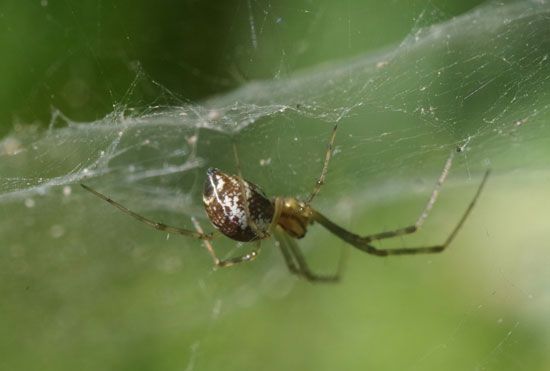
What is sheet-web weaver?
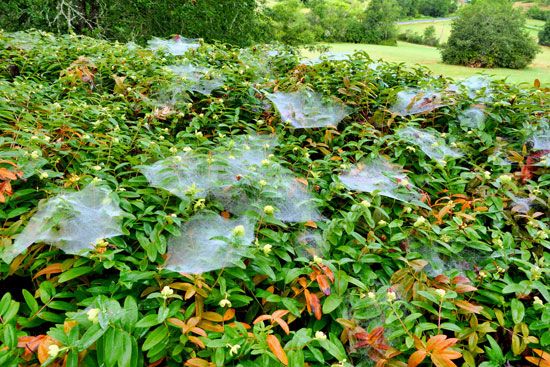
A sheet-web weaver is a member of the spider family Linyphiidae, which comprises nearly 5,000 species of small spiders found worldwide1. Most of these spiders are less than 6 mm (0.25 inch) in length and are rarely seen by humans.12
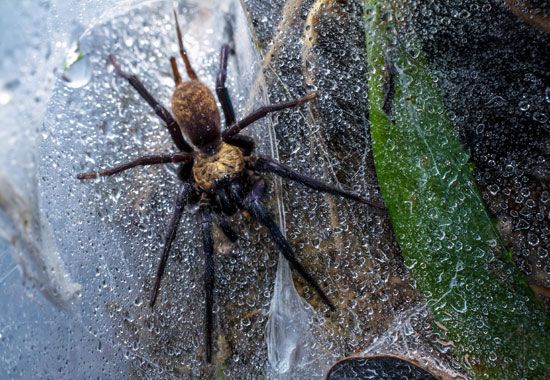
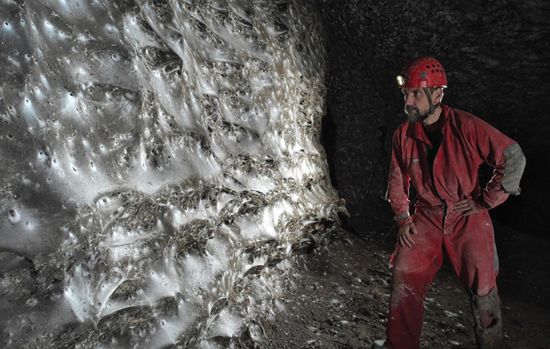
These spiders are named for their characteristic sheet webs, which are flat, dense mats of silk that can be dome- or cup-shaped. The spider typically resides on the underside of the web, often positioning itself between two layers of webbing to wait for prey. While most species are solitary, there have been rare instances of large-scale communal web building, such as a massive structure discovered in 2025 in a cave on the Greek–Albanian border, which involved tens of thousands of sheet-web weavers alongside other spider species.23
How do spiders use different types of silk to build their webs?
Spiders are sophisticated architects that utilize various types of silk to construct functional webs. Produced by specialized glands in the abdomen and extruded through spinnerets, these silk proteins, known as fibroin, vary in strength, elasticity, and tackiness depending on their intended purpose.72
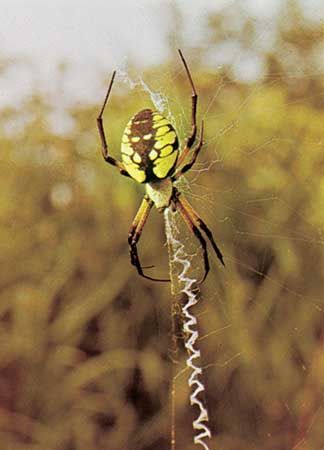
Advanced spiders, such as orb weavers, can produce at least seven different types of silk from distinct glands:7
- Ampullate glands: Produce the primary draglines and frame threads that provide the structural foundation of the web.7
- Aciniform glands: Create silk specifically used for wrapping and securing captured prey.7
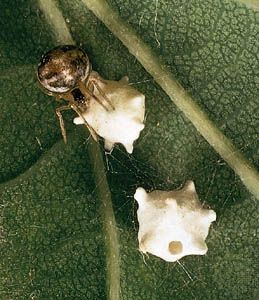
- Cylindrical glands: Used to produce components of the egg sac.7
- Cribellum: Certain spiders possess this specialized plate, which, when combed by a leg structure called a calamistrum, produces a unique, woolly (cribellate) silk used for ensnaring.78
During web construction, spiders often use different silks in tandem. For instance, orb weavers initially build a framework of dry, non-sticky silk to serve as spokes. They then replace temporary spirals with a final, sticky spiral coated in a glue-like substance designed to trap insects. This strategic use of materials allows spiders to create webs that are both structurally sound and highly effective at capturing food.482
What are the main differences between web-weaving spiders and hunting spiders?
The primary distinction between web-weaving spiders and hunting spiders lies in their strategy for capturing prey. While all spiders produce silk, only about half of the more than 51,500 known species build webs to entrap their food.293
Web-Weaving Spiders
Web-weaving spiders are master architects that instinctively construct intricate silk structures to serve as traps. These webs, such as orb webs, sheet webs, tangle webs, and funnel webs, act as passive snares.2
- Mechanism: These spiders rely on the web to detect and immobilize prey. Many use signal threads to sense vibrations when an insect touches the structure.3
- Anatomy: Web-building spiders typically possess three tarsal claws on their legs, which assist in navigating their own silk.10
Hunting Spiders
Hunting spiders, such as wolf spiders and jumping spiders, do not build webs for prey capture.2
- Mechanism: They actively stalk, chase, or ambush their prey. These hunters often possess a highly developed sense of sight or touch to locate victims.49
- Techniques: Some hunters, like crab spiders, wait on flowers to grasp insects, while others, like spitting spiders, use specialized silk to shoot at and entangle prey from a distance.4
- Anatomy: Hunting spiders generally have two tarsal claws on their legs.10
Why do some spiders build communal webs instead of living alone?
While most spiders are solitary, some species have evolved to live in large communal webs that can house hundreds of individuals, primarily females.124
This social behavior offers several advantages for survival and resource acquisition:
- Cooperative Labor: In these colonies, spiders work together to build, maintain, and repair the web structure, which allows for the creation of much larger and more complex traps than a single spider could manage alone.4
- Enhanced Predation: The communal web acts as a massive, shared snare. When prey becomes trapped, the group cooperates to subdue, kill, and consume the insect, increasing the efficiency of their hunting efforts.4
- Shared Space: The web is organized so that individuals occupy the central area, while the outer portions serve as shared space for capturing prey.12
This cooperative lifestyle is particularly notable in certain tropical species, where the collective effort significantly improves their ability to secure food and maintain their environment.4
Sources
- sheet-web weaver — Encyclopædia Britannica
- Types of Spiderwebs — Encyclopædia Britannica
- spider - Annotated classification — Encyclopædia Britannica
- spider - Spiderwebs — Encyclopædia Britannica
- spider - Importance — Encyclopædia Britannica
- sheet web — Merriam-Webster
- spider - Silk — Encyclopædia Britannica
- How do spiders make circular webs? — Encyclopædia Britannica
- spider - Stalking prey — Encyclopædia Britannica
- spider — Encyclopædia Britannica
- spider - External features — Encyclopædia Britannica
- arachnid - Associations — Encyclopædia Britannica
- spider - Courtship — Encyclopædia Britannica
Published on · 4 min read