Slug
Slugs move primarily through a combination of muscular action and cilia, utilizing a specialized organ known as the foot. In many land-dwelling species, the…
How do slugs move and what purpose does their slime serve?
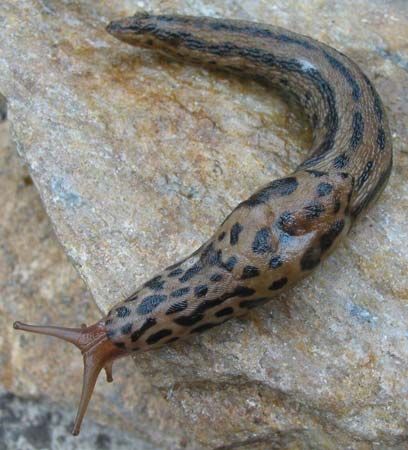
Slugs move primarily through a combination of muscular action and cilia, utilizing a specialized organ known as the foot1. In many land-dwelling species, the foot is divided longitudinally, with the central section gliding along a track of mucus. This movement is often facilitated by contraction waves that travel along the ventral musculature, allowing the slug to pull itself forward.12
The mucus, or slime, produced by slugs serves several vital purposes:
- Locomotion: It provides a lubricated surface that allows the slug to glide across various terrains.13
- Hydration and Protection: The slime helps keep the slug hydrated and can clean its body. In some species, it acts as a defensive mechanism by numbing the tongues of potential predators.3
- Navigation: Slugs leave behind scent trails in their mucus, which they use to find their way back to their home base.3
- Reproduction: Some species secrete a “slime rope” that allows mating pairs to suspend themselves in the air.1
- Survival: When threatened, slugs can secrete copious amounts of slime as a stress response.1
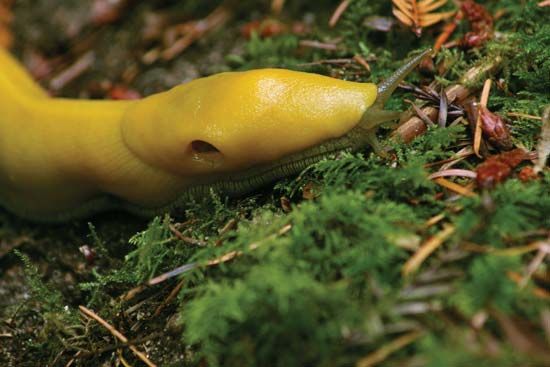
What are the different habitats where slugs can be found?
Slugs are mollusks belonging to the class Gastropoda that have evolved to live in a variety of environments. Their distribution and habitat preferences are primarily dictated by the availability of moisture, as they are highly susceptible to desiccation.
Terrestrial Habitats
Most slugs are members of the subclass Pulmonata and are restricted to moist land environments. They are particularly prevalent in:4
- Humid Mountain Regions: Slugs often evolve in mountain areas where moisture is constant throughout the year, as the lack of a shell—which would otherwise protect against drying out—is not a disadvantage in such wet climates.5
- Gardens and Cultivated Areas: Many species, such as the gray garden slug, thrive in human-altered landscapes where irrigation and watering provide the necessary moisture.456
- Forests and Surface Litter: Slugs frequently occupy the surface litter and upper soil zones, which offer damp niches and abundant food sources like fungi and decaying plant matter.5
Aquatic Habitats
While the term “slug” generally refers to land-dwelling mollusks, there are exceptions:
- Freshwater: There is at least one known species of freshwater slug.4
- Marine: Marine gastropods of the subclass Opisthobranchia are commonly referred to as sea slugs. These creatures inhabit various marine environments, ranging from the ocean surface to deep-sea regions.457
How do slugs breathe and what kind of respiratory system do they have?
Slugs breathe using specialized respiratory systems that vary depending on their environment. Most land-dwelling slugs are pulmonates, meaning they have lost their ancestral gills and instead utilize a “lung”—a highly vascularized, saclike modification of the mantle cavity.8
To facilitate gas exchange, these slugs use muscular contractions to pump air in and out of a small respiratory opening known as a pneumostome, which is located at the anterior edge of the mantle cavity. This structure helps protect the internal respiratory surface from drying out by limiting exposure to the external environment.9510
In some species of slugs, particularly those with reduced shells, respiratory functions have shifted away from the mantle cavity. In these cases, gas exchange may occur through the skin or via external projections from the mantle collar. Conversely, marine slugs (sea slugs) typically breathe through projections from their body surface, as they do not rely on the lung-like structures found in their terrestrial counterparts.9
How do slugs use their tentacles to navigate and find food?
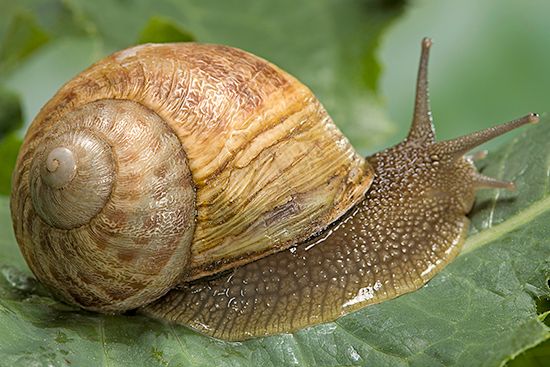
Terrestrial slugs rely on their four tentacles to navigate their environment and locate food sources. These tentacles serve distinct sensory functions: the two upper tentacles, known as ommatophores, act as eyestalks that bear eyes at their tips, while the lower pair is primarily used for smelling.13314
These sensory organs are essential for the slug’s survival, allowing them to detect chemical cues in their surroundings. By using their smelling tentacles, slugs can track scents to find food and even follow their own mucus trails to navigate back to familiar locations. In addition to these tentacles, slugs possess chemoreceptors scattered across their skin surface and on their palps, which help them gather further environmental information.1314
While their eyes are primarily light-sensitive rather than image-forming, the combination of vision and highly developed chemoreception allows slugs to effectively interact with their habitat. This sensory input is processed by a central nervous system consisting of paired ganglia, enabling the slug to respond to its environment and maintain its nutrient intake.14
Sources
- gastropod - Locomotion — Encyclopædia Britannica
- Locomotion - Bottom locomotion — Encyclopædia Britannica
- 10 Reasons to Love Slugs — Encyclopædia Britannica
- slug — Encyclopædia Britannica
- gastropod - Ecology and habitats — Encyclopædia Britannica
- garden slug — Merriam-Webster
- gastropod - Distribution and abundance — Encyclopædia Britannica
- pulmonate — Encyclopædia Britannica
- gastropod - Respiration — Encyclopædia Britannica
- Respiratory system - Gills of invertebrates — Encyclopædia Britannica
- pneumostome — Merriam-Webster
- How do gills work? — Encyclopædia Britannica
- crustacean - The nervous system — Encyclopædia Britannica
- Chemoreception - Finding and recognizing food — Encyclopædia Britannica
- cnidarian - Nervous system and organs of sensation — Encyclopædia Britannica
- Chemoreception - Phagostimulation — Encyclopædia Britannica
- gastropod - The head — Encyclopædia Britannica
- gastropod - The nervous system and sense organs — Encyclopædia Britannica
- arthropod - Nervous system and organs of sensation — Encyclopædia Britannica
Published on · 4 min read