South Pole
The climate at the South Pole is distinguished from coastal regions of Antarctica primarily by its extreme elevation and distance from maritime influences.…
How does the climate at the South Pole differ from other parts of Antarctica?
The climate at the South Pole is distinguished from coastal regions of Antarctica primarily by its extreme elevation and distance from maritime influences. While coastal areas experience milder temperatures—ranging from -20° to -9° C (-4° to 16° F)—the South Pole sits on a high polar plateau at an altitude of approximately 2,800 meters, where the mean annual temperature is about -50° C (-58° F).12
Key differences include:
- Wind Patterns: Coastal regions are characterized by fierce katabatic winds that flow down from the interior, often reaching high velocities. In contrast, winds at the South Pole are typically light, with monthly mean velocities ranging from 4 to 8 meters per second.12
- Precipitation: The South Pole is part of a vast desert, receiving only about 2 inches (50 mm) of precipitation annually. Coastal belts receive significantly more, sometimes up to 10 times that amount.2
- Maritime Influence: Unlike the Antarctic Peninsula, which benefits from maritime warming, the South Pole lacks any nearby heat source, as the surrounding sea freezes in winter, pushing oceanic influence nearly 1,800 miles away.2
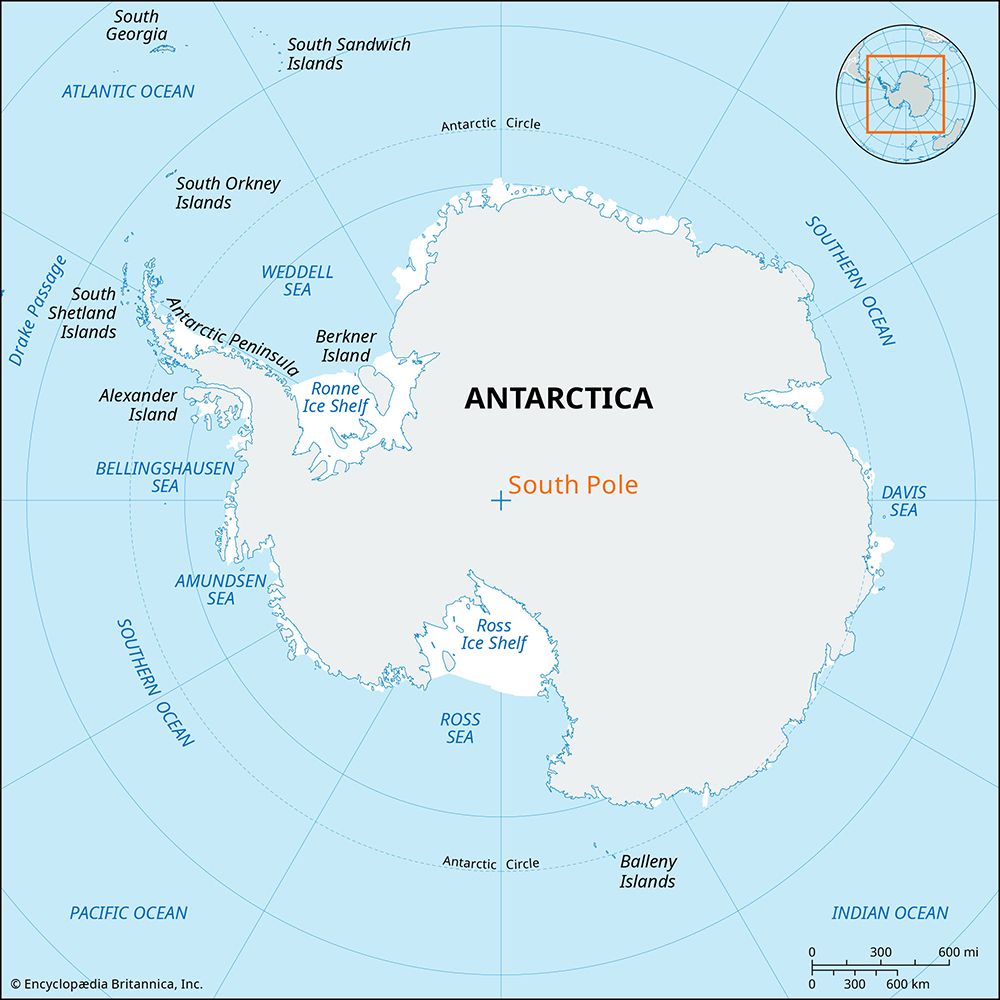
What is the geographical location and definition of the South Pole?
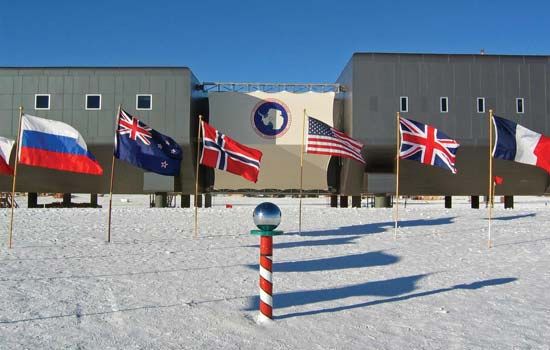
The geographic South Pole is defined as the southernmost point on the surface of the Earth, representing the southern end of the planet’s axis of rotation.478
Located in Antarctica, it sits approximately 300 miles (480 km) south of the Ross Ice Shelf at an elevation of about 9,300 feet (2,830 meters) above sea level. Because the polar ice cap is constantly in motion, the exact location of the rotational pole is marked periodically by personnel at the Amundsen-Scott station.4
It is important to distinguish the geographic South Pole from other polar points:
- South Magnetic Pole: The point toward which magnetic compasses point, located on the Adélie Coast.4
- Geomagnetic South Pole: The southern end of the Earth’s geomagnetic field.4
Due to its position, the geographic pole experiences six months of continuous daylight followed by six months of total darkness.4
What international agreements govern activities and research at the South Pole?
Activities and research at the South Pole and across the Antarctic continent are governed by the Antarctic Treaty System (ATS), a framework established to ensure the region remains a demilitarized zone dedicated to peace and science.910
The Antarctic Treaty (1959)
Signed by 12 nations and enacted in 1961, this landmark agreement reserves the continent for peaceful purposes. Key provisions include:910
- Scientific Cooperation: It mandates the freedom of scientific investigation and the open exchange of research results and personnel.910
- Demilitarization: The treaty prohibits military bases, maneuvers, and weapons testing.910
- Nuclear-Free Zone: It explicitly bans nuclear explosions and the disposal of radioactive waste.910
- Territorial Claims: It suspends new territorial claims and prevents existing claims from being reinforced by activities conducted during the treaty’s duration.1011
- Inspection: It allows for the open inspection of any nation’s operations by other signatory parties.10
The Madrid Protocol (1991)
Formally known as the Protocol on Environmental Protection to the Antarctic Treaty, this agreement designates Antarctica as a “natural reserve, devoted to peace and science.” It enforces strict environmental regulations, including:12
- Mining Ban: It prohibits all mineral resource activities, except for scientific research.12
- Environmental Management: It regulates infrastructure development, waste management, and the protection of native flora and fauna, including the removal of non-native species.12
How do the unique conditions at the South Pole make it an ideal location for certain types of scientific observations?
The South Pole is a premier location for scientific research due to its unique environmental conditions, which provide an unparalleled vantage point for observing the universe and studying Earth’s systems.
Astrophysical and Astronomical Advantages
The South Pole is considered a unique astronomical location, offering unequaled atmospheric clarity and the ability to view the Sun continuously during the summer months. Its high altitude and dry, cold atmosphere—which contains very little water vapor—minimize interference for sensitive observations.6
Specifically, the deep Antarctic ice serves as a massive, high-quality detector for cosmic particles:
- Neutrino Detection: Observatories like the Antarctic Muon and Neutrino Detector Array (AMANDA) and its successor, the IceCube Neutrino Observatory, utilize the deep ice to detect high-energy neutrinos.613
- Ideal Medium: Unlike underwater detectors, which must contend with bioluminescent life, natural radioactivity, and storm interference, the deep Antarctic ice is in total darkness and provides a stable, clear medium for detecting Cherenkov radiation.413
Geophysical and Atmospheric Research
The region is also critical for understanding global environmental changes. The ice sheets act as a record of climate history, and the polar atmosphere is a primary site for studying the ozone hole and the polar vortex. Furthermore, automatic geophysical observatories on the polar plateau provide essential data on the ionosphere and magnetosphere, helping scientists understand how Earth responds to solar activity.6
Sources
- glacier - Climatic conditions — Encyclopædia Britannica
- What is the coldest temperature ever recorded on Earth? — Encyclopædia Britannica
- Indian Ocean - Subantarctic and Antarctic zone — Encyclopædia Britannica
- South Pole — Encyclopædia Britannica
- polar vortex — Encyclopædia Britannica
- Antarctica - Climate of Antarctica — Encyclopædia Britannica
- the South Pole — Merriam-Webster
- south pole — Merriam-Webster
- Antarctic Treaty — Encyclopædia Britannica
- Antarctica - The Madrid Protocol — Encyclopædia Britannica
- Antarctica - The Antarctic Treaty — Encyclopædia Britannica
- International law - Antarctica — Encyclopædia Britannica
- Francis Halzen: Top Questions — Encyclopædia Britannica
- Francis Halzen — Encyclopædia Britannica
Published on · 4 min read