Stegosaur
A stegosaur is any member of a group of plated dinosaurs that lived from the Early Jurassic to the Early Cretaceous periods. These herbivores were…
What is stegosaur?
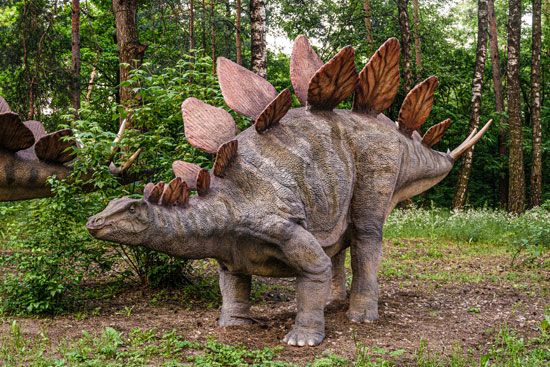
A stegosaur is any member of a group of plated dinosaurs that lived from the Early Jurassic to the Early Cretaceous periods. These herbivores were quadrupedal, characterized by a small skull, an arched back, and short, broad feet.123
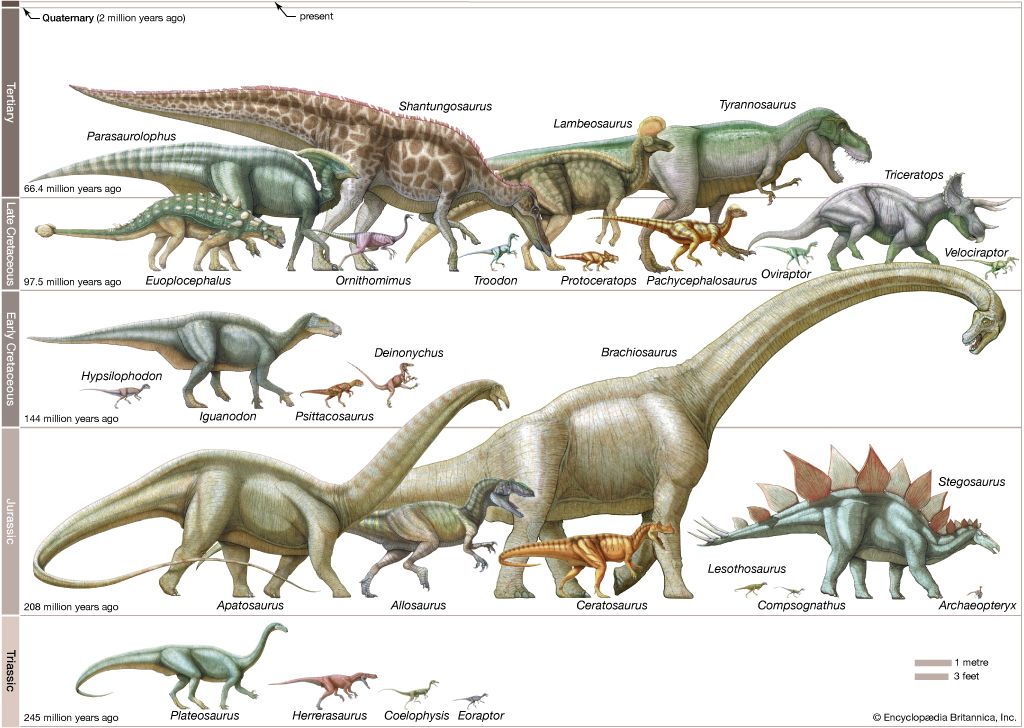
The most iconic genus, Stegosaurus, is famous for the double row of large, bony plates along its back and the long, pointed spikes on its tail. While these plates were once thought to be armor, their high vascularization has led to the hypothesis that they functioned as thermoregulation devices, acting like radiators to dissipate heatthermoregulation](https://www.britannica.com/science/thermoregulation) devices, acting like radiators to dissipate heat. However, because plate arrangements and shapes vary significantly among different stegosaur species—such as Kentrosaurus—many scientists now consider display or species recognition to be equally likely functions. The tail spikes are generally interpreted as defensive weapons.132
Due to their limb proportions, stegosaurs were likely very slow-moving. Their small, weakly developed teeth suggest they may have relied on specialized digestive processes to process plant material.2
What are some other types of armored dinosaurs?
Beyond the plated stegosaurs, the other primary group of armored dinosaurs is the infraorder Ankylosauria. These herbivores are characterized by an extensive mosaic of interlocking bony plates (osteoderms) that encased their backs and flanks, providing robust protection against predators.456
Ankylosauria is generally divided into two main groups:
- Ankylosauridae: These advanced forms are distinguished by a massive bony club at the end of their tails, which they likely used as a defensive weapon. They typically possessed broad, boxlike skulls that were also heavily armored. A well-known example is the genus Ankylosaurus, which could reach lengths of up to 10 meters.46
- Nodosauridae: These are considered more basal and generally lived earlier than the ankylosaurids. Unlike their relatives, nodosaurs lacked a tail club and typically had narrower skulls that were not as heavily armored. Examples include Nodosaurus and Euoplocephalus.42
Additionally, the broader group known as Thyreophora includes more primitive, early armored relatives such as Scutellosaurus and Scelidosaurus, which featured smaller bony plates or scutes along their bodies.5
Why did scientists once believe Stegosaurus had two brains?
The belief that Stegosaurus possessed two brains was a misconception based on the anatomy of its spinal cord.
Paleontologists observed that the spinal canal in the region of the sacrum—the area near the hips—was significantly enlarged, creating a cavity that was actually larger than the animal’s small brain. This anatomical feature led to the erroneous theory that the dinosaur required a “second brain” in its hindquarters to help coordinate the movements of its massive body and tail.
Modern scientific consensus suggests this cavity did not house a brain. Instead, it is more likely that the space was used for storing glycogen, a form of energy storage found in many present-day animals. This interpretation aligns with the understanding that Stegosaurus had a relatively small brain compared to its overall body size, a common trait among many large dinosaurs of the period.2
How did Stegosaurus digest its food with such small teeth?
The small, weakly developed teeth of Stegosaurus present a biological puzzle, as they appear ill-equipped to process the large quantities of tough, cellulose-rich plant material required to sustain such a massive animal. Because these teeth were small, laterally compressed, and arranged in short rows with little space for powerful jaw muscles, scientists have proposed several theories regarding how these dinosaurs achieved adequate digestion.3
One leading hypothesis is that Stegosaurus relied on internal fermentation within its digestive tract. It is likely that the dinosaur hosted a specialized population of bacteria capable of breaking down fibrous plant tissues, a process similar to that seen in many modern herbivores.310
Additionally, digestion may have been assisted by a gizzard or crop containing gastroliths—stomach stones used to pulverize food. While such stones have been found in other dinosaurs, they have not yet been definitively discovered in association with Stegosaurus specimens. Despite these theories, the exact mechanism remains a subject of scientific speculation.310
Sources
- stegosaur — Encyclopædia Britannica
- Stegosaurus — Encyclopædia Britannica
- dinosaur - Stegosauria — Encyclopædia Britannica
- dinosaur - Ankylosauria — Encyclopædia Britannica
- Ankylosaurus — Encyclopædia Britannica
- dinosaur - Thyreophora — Encyclopædia Britannica
- Nodosaurus — Encyclopædia Britannica
- dinosaur - Tetanurae — Encyclopædia Britannica
- dinosaur - Theropoda — Encyclopædia Britannica
- dinosaur - The plant eaters — Encyclopædia Britannica
- mammal - Teeth — Encyclopædia Britannica
Published on · 3 min read