Stromatoporida
Stromatoporida is an extinct order of colonial corals that existed from the Cambrian to the Cretaceous periods (approximately 542 million to 65.5 million…
What is Stromatoporida?
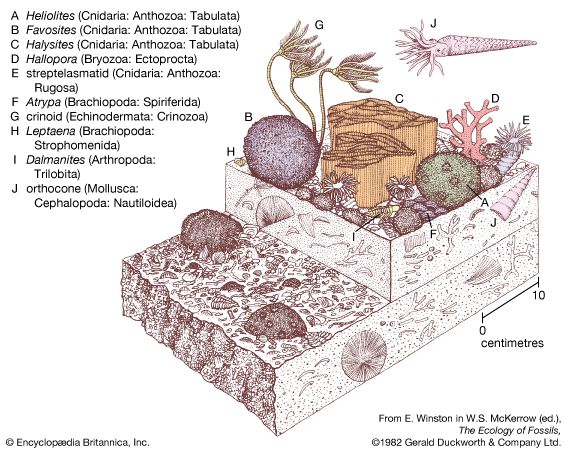
Stromatoporida is an extinct order of colonial corals that existed from the Cambrian to the Cretaceous periods (approximately 542 million to 65.5 million years ago). These organisms are found as fossils in marine rocks and are characterized by their dense, laminated masses of calcium carbonate. Some species were significant reef-builders, constructing extensive reeflike structures.1
It is important to distinguish Stromatoporida from stromatolites, which are entirely different structures. While stromatoporids were colonial animals, stromatolites are layered sedimentary structures formed by communities of microorganisms, such as blue-green algae, and are not corals.2
Within the order Stromatoporida, the genus Stromatopora represents a group of extinct hydrozoans. These organisms formed thick, concentric layers of reticulated calcareous tissue containing small tubules for their zooids, and their remains often constitute significant beds within Paleozoic and Devonian rock formations.3
How do stromatoporoids differ from modern reef-building corals?
Stromatoporoids and modern reef-building corals differ primarily in their biological classification and skeletal structure.
Stromatoporoids were an extinct order of colonial hydrozoans that thrived from the Cambrian to the Cretaceous periods. They were characterized by dense, laminated masses of calcium carbonate, forming thick, concentric layers of reticulated tissue that contained small tubules for their zooids. These organisms were significant reef-builders during the Paleozoic era, particularly in the Devonian.14
In contrast, modern corals are typically cnidarians that secrete a skeleton composed of calcareous cups, or corallites, into which individual polyps can contract. While modern corals also build massive reef structures, their skeletal growth involves the secretion of calcium carbonate by the ectoderm, often resulting in branching or cup-like forms where the soft tissue resides both inside and outside the skeleton. Unlike the extinct stromatoporoids, which are known for their specific laminated, reticulated tissue structure, modern corals rely on the activity of individual polyps to expand the colony.34
What caused the extinction of the Stromatoporida order?
The provided Britannica knowledge base does not contain specific information regarding the causes of the extinction of the Stromatoporida order. While the records confirm that these colonial organisms existed from the Cambrian to the Cretaceous periods (approximately 542 million to 65.5 million years ago), the specific environmental or biological factors that led to their disappearance are not detailed in the available documentation.1
How are stromatoporoid fossils used to study ancient marine environments?
Stromatoporoid fossils are primarily used by paleontologists to identify and reconstruct ancient marine environments, particularly those characterized by shallow-water conditions. Because these colonial organisms constructed dense, reeflike masses of calcium carbonate, their presence in the geological record serves as a key indicator of the existence of coral reefs and similar carbonate-producing ecosystems during the Paleozoic and Mesozoic eras.18
By analyzing the distribution and structure of these fossils, researchers can determine the location of ancient continental shelves and shallow seas where these organisms thrived. Since stromatoporoids first appeared in the Middle Ordovician Epoch and persisted through the Cretaceous, they provide essential data for mapping the development of marine habitats over millions of years, helping scientists understand how reef-building communities evolved and occupied specific ecological niches along continental margins.8
Sources
- Stromatoporida — Encyclopædia Britannica
- Precambrian - Microfossils and stromatolites — Encyclopædia Britannica
- Stromatopora — Merriam-Webster
- skeleton - Calcareous structures — Encyclopædia Britannica
- Cretaceous Period - Paleogeography — Encyclopædia Britannica
- Pleistocene Epoch - Coastal environments and sea-level changes — Encyclopædia Britannica
- coral reef - Sedimentation — Encyclopædia Britannica
- Ordovician Period - Reefs — Encyclopædia Britannica
Published on · 2 min read