Suboscine
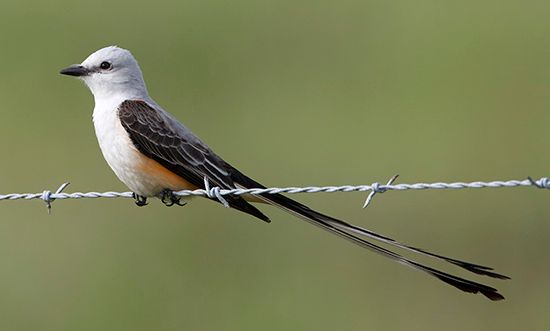
A suboscine is any bird belonging to the suborder Tyranni within the order Passeriformes (perching birds). They are distinguished from oscines, or songbirds…
What is Suboscine?
A suboscine is any bird belonging to the suborder Tyranni within the order Passeriformes (perching birds). They are distinguished from oscines, or songbirds, which belong to the suborder Passeri.1
The term suboscine suggests that these birds are more primitive in their anatomy and behavior compared to oscines, which are generally considered the most highly specialized birds. While oscines possess a highly complex vocal organ known as a syrinx, suboscines typically have a simpler vocal structure. Despite this, suboscines are still capable of producing a variety of vocal sounds, ranging from simple whistles and trills to the loud, far-carrying calls of bellbirds.12
The suborder Tyranni includes diverse families such as tyrant flycatchers, ovenbirds, antbirds, and broadbills. Modern DNA studies have been instrumental in clarifying the evolutionary relationships between these various groups.34
What are the main anatomical differences between oscine and suboscine birds?
The primary anatomical distinction between oscine and suboscine birds lies in the structure and complexity of the syrinx, the vocal organ located at the base of the trachea.14
The Syrinx and Musculature
The classification of passerines is largely based on the morphology of this organ, specifically the number and attachment points of the intrinsic muscles.1
- Oscines (Songbirds): These birds possess a highly specialized, complex syrinx. It typically features four pairs of intrinsic muscles that insert onto the ends of the bronchial semi-rings (a condition known as acromyodian). This advanced structure allows for sophisticated vocal control, often enabling the bird to use the left and right sides of the syrinx independently to produce two voices simultaneously.14
- Suboscines: Generally considered more primitive, suboscines have a simpler vocal apparatus. Most members of the suborder Tyranni are mesomyodian, meaning their intrinsic muscles insert onto the middle of the bronchial semi-rings. Some groups, such as the broadbills, lack intrinsic muscles entirely.1
Vocal Diversity
While oscines are anatomically equipped for complex song, the presence of a complex syrinx does not always correlate with song complexity; some oscines produce simpler sounds than certain suboscines. Suboscines, despite their simpler anatomy, are capable of a wide range of vocalizations, from basic whistles and trills to the powerful calls of bellbirds.5
How does the syrinx affect the way different birds produce sound?
The syrinx is the primary vocal organ in birds, located at the base of the trachea where it divides into the bronchi. It functions as a “song box” by using specialized membranes, cartilages, and muscles to modulate airflow from the lungs, creating sound vibrations.65
The complexity of this organ significantly influences a bird’s vocal capabilities:
- Oscines (Songbirds): These birds possess the most complex syrinx, typically featuring four pairs of intrinsic muscles. This structure allows them to control the right and left halves of the syrinx independently, enabling them to produce two distinct voices simultaneously.65
- Suboscines: These birds generally have a simpler vocal apparatus. Many lack intrinsic muscles entirely, while others have fewer pairs that attach to the middle of the bronchial semi-rings. Despite this simpler anatomy, they are still capable of a wide range of vocalizations.7
- Structural Variations: Beyond muscle complexity, some birds possess elongated or coiled windpipes, which can provide additional resonance to their calls. Conversely, some groups, such as New World vultures, lack a syrinx entirely and are limited to hissing or grunting.56
What are some examples of unique courtship behaviors in suboscine families like manakins?
Manakins (subfamily Piprinae) are renowned for their elaborate and highly ritualized courtship displays, which often take place in communal areas known as leks. Because males provide no parental care, they have evolved complex behaviors to attract females, often involving a combination of acrobatics, vocalizations, and unique nonvocal sounds.
Unique Courtship Behaviors
- Mechanical Sound Production: Many manakins produce startling, firecracker-like snaps during their displays by rapidly striking their wings together over their backs. Additionally, modified wing feathers allow some species to create rasping or crackling sounds.
- Cooperative Dances: In some species, males work together to perform intricate displays. For example, blue-backed manakins (Chiroxiphia pareola) perform a circular dance, moving together like a rotating fireworks wheel. Long-tailed manakins (Chiroxiphia linearis) engage in a sequential display where multiple males flutter over one another on a perch, turning cartwheels in midair while singing.
- Hierarchical Systems: These cooperative displays often involve a strict hierarchy. In long-tailed manakins, a dominant “alpha” male performs alongside a “beta” male. The alpha male may monopolize matings for over a decade, with the beta male only gaining access to females after the alpha dies.
- Lek Variations: While many manakins gather in small, concentrated leks, others utilize “exploded leks,” where males are spaced hundreds of meters apart. In these cases, males rely on extremely loud vocalizations to attract females across the forest.
Sources
- Suboscine — Encyclopædia Britannica
- Passeriform - Annotated classification — Encyclopædia Britannica
- Passeriform - Sound production — Encyclopædia Britannica
- Passeriform - Critical appraisal — Encyclopædia Britannica
- Passeriform - Syrinx — Encyclopædia Britannica
- Syrinx — Encyclopædia Britannica
- Songbird — Encyclopædia Britannica
- Manakin — Encyclopædia Britannica
- Reproductive behaviour - Courtship — Encyclopædia Britannica
- Reproductive behaviour - Birds — Encyclopædia Britannica
Published on · 4 min read