Swordtail
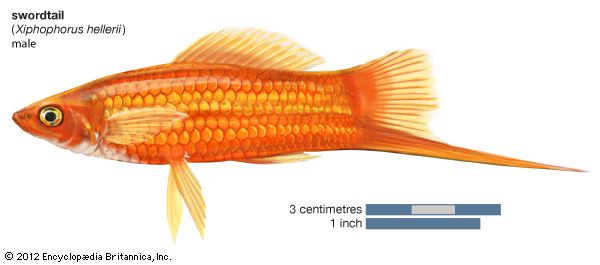
The swordtail (Xiphophorus hellerii) is a popular tropical fish belonging to the live-bearer family Poeciliidae.

What is swordtail?
The swordtail (Xiphophorus hellerii) is a popular tropical fish belonging to the live-bearer family Poeciliidae.12
These elongated fish typically grow to about 13 centimeters (5 inches) in length. They are most easily identified by the male’s distinctive, swordlike extension of the lower tail fin lobe. While the species was originally green with a red stripe along each side, selective breeding has produced a wide variety of colors for the aquarium trade.12
Closely related to the platy, the swordtail is frequently utilized in scientific studies, particularly within the fields of genetics and medicine.1
What does it mean for a fish to be a live-bearer?
A fish is considered a “live-bearer” when it gives birth to live young rather than laying eggs that develop externally. In these species, fertilization occurs internally; males possess a specialized organ, such as the gonopodium in the family Poeciliidae, to transfer sperm into the female’s body.345
Once fertilized, the developing embryos are retained within the female. Depending on the species, these embryos are nourished either by the egg yolk (ovoviviparous) or directly by the female’s body (viviparous). Because the young are often born at a larger size and in smaller numbers than those of egg-laying species, this reproductive strategy can provide a survival advantage by reducing the offspring’s vulnerability to predators.3
Common examples of live-bearing aquarium fish include the guppy, molly, platy, and swordtail.4
How are swordtails related to platy fish?
Swordtails and platy fish are closely related members of the same genus, Xiphophorus, within the family Poeciliidae.178
Their relationship is defined by several key factors:
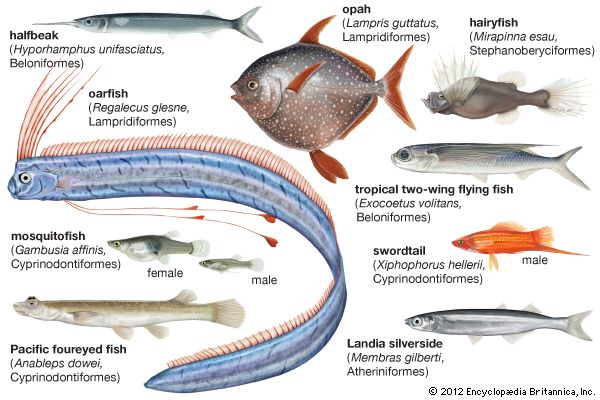
- Shared Classification: Both are tropical live-bearing fish that share the same taxonomic order (Atheriniformes) and family (Poeciliidae).17
- Hybridization: The two species are so closely related that they can be crossbred with one another.7
- Scientific Utility: Because of their close biological connection, both species have been used extensively in genetic and medical research.17
While they share these fundamental traits, they remain distinct in appearance; the swordtail is characterized by its elongated body and the male’s swordlike tail extension, whereas the platy is typically more compact in size.17
Why are swordtails used in genetic and medical research?
Swordtails (Xiphophorus hellerii) are valuable in scientific research primarily due to their close biological relationship with platy fish and their status as live-bearing organisms.1
Their utility in genetic and medical studies stems from several factors:
- Hybridization Potential: Because swordtails and platies are closely related, they can be crossbred. This ability to produce hybrids allows researchers to study the inheritance of specific traits and the genetic basis of various conditions.1
- Genetic Mapping: The ability to cross these species has historically facilitated the mapping of genes, particularly those related to pigmentation and the development of certain diseases, such as melanoma.1
- Model Organism: Their well-documented reproductive biology and the ease with which they can be bred in laboratory settings make them efficient models for observing developmental processes and genetic mutations.1
We could dive deeper into how these genetic studies have contributed to our understanding of cancer research or explore other model organisms used in genetics.
Sources
- swordtail — Encyclopædia Britannica
- swordtail — Merriam-Webster
- live-bearer — Encyclopædia Britannica
- How do fish reproduce? — Encyclopædia Britannica
- Poeciliidae — Merriam-Webster
- perciform - Aquarium fishes — Encyclopædia Britannica
- platy — Encyclopædia Britannica
- Xiphophorus — Merriam-Webster
Published on · 2 min read