Guppy
The guppy (Poecilia reticulata) is a small, colorful, and hardy freshwater fish belonging to the family Poeciliidae. Widely kept as a pet in home aquariums…
What is guppy?
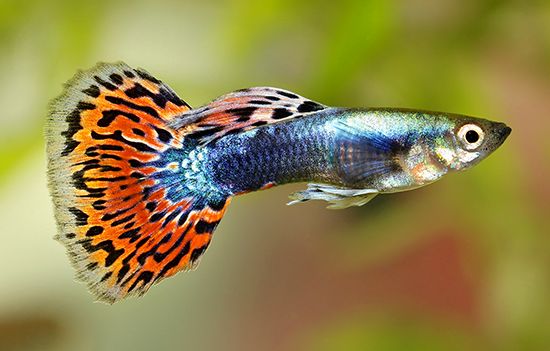
The guppy (Poecilia reticulata) is a small, colorful, and hardy freshwater fish belonging to the family Poeciliidae. Widely kept as a pet in home aquariums, these fish are known for being energetic and prolific breeders.1
There is a notable physical difference between the sexes:
- Males: Typically grow to about 4 centimeters (1 1/2 inches) and are much more brightly colored than females.1
- Females: Generally larger in size but possess duller coloration.1
Through selective breeding, enthusiasts have developed numerous ornate strains that vary significantly in their color patterns, as well as the shape and size of their dorsal and tail fins. As a live-bearer, the guppy gives birth to free-swimming young rather than laying eggs, which contributes to its popularity among hobbyists.1
What does it mean for a fish to be a live-bearer?
In the context of fish, being a “live-bearer” refers to a reproductive strategy where the female gives birth to free-swimming young rather than laying eggs. This process involves internal fertilization, where the male uses a specialized organ—such as the gonopodium found in members of the family Poeciliidae—to transfer sperm into the female’s body.23
Depending on the species, the developing embryo receives nourishment in one of two ways:
- Ovoviviparous: The embryo is nourished primarily by the egg yolk while developing inside the female.2
- Viviparous: The embryo receives nourishment directly from the female’s body.2
This reproductive method often provides a survival advantage, as the young are typically born at a larger size than those of egg-laying species, making them less vulnerable to predators. Common examples of live-bearing aquarium fish include the guppy, molly, platy, and swordtail.23
How do male and female guppies differ in appearance?
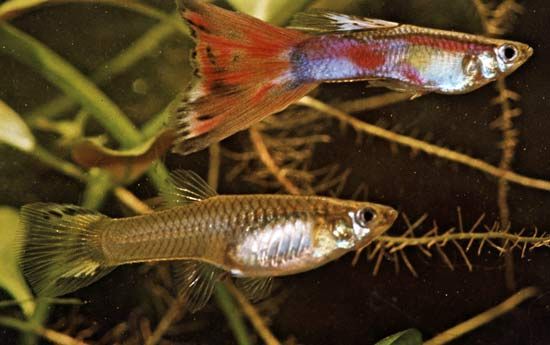
Male and female guppies exhibit significant physical differences, a phenomenon known as sexual dimorphism. These differences are primarily driven by sexual selection, where males display striking traits to attract mates.1
The key differences in appearance include:
- Coloration: Male guppies are much brighter and display a wide variety of patterns, which serve to increase their appeal to females. In contrast, females lack this brightness and variation, typically appearing duller in color.61
- Size: Females are generally larger than males. Males typically grow to about 4 centimeters (1 1/2 inches) in length.6
- Anatomy: Male guppies possess a gonopodium, which is a modified anal fin that serves as a copulatory organ for internal fertilization. Additionally, selective breeding has resulted in ornate strains where males often feature more elaborate tail and dorsal fin shapes and sizes compared to females.76
What are some common aquarium fish related to the guppy?
The guppy belongs to the family Poeciliidae, a group of small, live-bearing freshwater fish that are highly popular in home aquariums. Because they share the same family and reproductive characteristics, several other common aquarium fish are closely related to the guppy:18
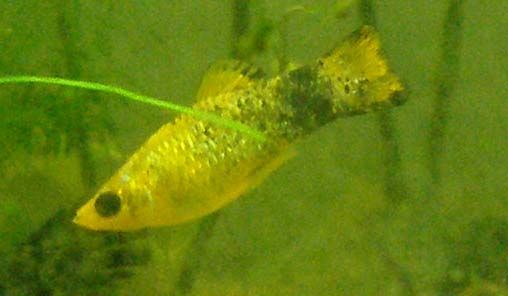
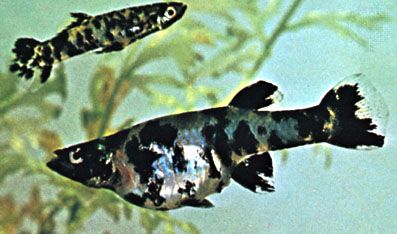
- Molly: Members of the genus Poecilia, these hardy fish come in various colors and types, such as the black molly and the showy sailfin molly.3
- Platy: Known for being peaceful and easy to care for, platies are another staple in the aquarium hobby that share the live-bearing trait.8
- Swordtail: Named for the elongated, sword-like extension on the lower part of the male’s tail, these fish are closely related to platies and guppies.89
- Mosquito fish: While often used for pest control due to their appetite for mosquito larvae, they are also members of the Poeciliidae family.8
These fish are all characterized by their internal fertilization and the male’s use of a specialized anal fin, called a gonopodium, to reproduce.89
Sources
- guppy — Encyclopædia Britannica
- How do fish reproduce? — Encyclopædia Britannica
- live-bearer — Encyclopædia Britannica
- Animal reproductive system - Provisions for the developing embryo — Encyclopædia Britannica
- perciform - Aquarium fishes — Encyclopædia Britannica
- Why are male animals more colorful? — Encyclopædia Britannica
- gonopodium — Merriam-Webster
- molly — Encyclopædia Britannica
- fish - Reproduction — Encyclopædia Britannica
- Poeciliidae — Merriam-Webster
- tropical fish — Encyclopædia Britannica
Published on · 3 min read