Live-bearer
Live-bearing fish and egg-laying fish differ primarily in their reproductive strategies and fertilization methods.
What are live-bearing fish and how do they differ from egg-laying fish?
Live-bearing fish and egg-laying fish differ primarily in their reproductive strategies and fertilization methods.
Egg-Laying Fish (Oviparous)
Most bony fishes are oviparous, meaning they lay eggs that develop externally. This process typically involves external fertilization, where the female releases a large number of eggs into the water and the male fertilizes them with milt. Because these eggs are often left in the open water or on the substratum, they face a higher mortality rate from predators.1
Live-Bearing Fish
Live-bearing fish retain their embryos inside the female’s body, which provides a survival advantage by protecting the young from external threats. Fertilization is internal; for example, male live-bearers in the family Poeciliidae use a specialized organ called a gonopodium to transfer sperm.12
Depending on the species, the developing embryo is nourished either by the egg yolk (ovoviviparous) or directly by the female (viviparous). Consequently, live-bearing fish typically produce fewer offspring than egg-layers, but the young are often born at a larger, more developed size.1
Which fish families are known for having live-bearing species?
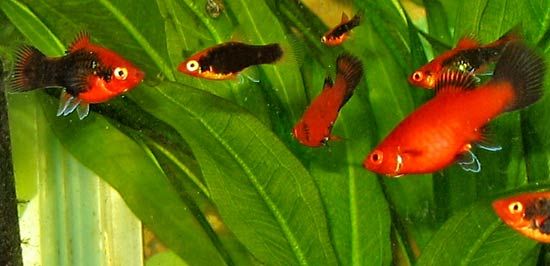
While many fish species are egg-layers, several families have evolved to give birth to live young. Within the order Atheriniformes, the family Poeciliidae is the most well-known group of live-bearing fishes, commonly referred to as viviparous topminnows. This family includes popular aquarium species such as guppies, mollies, platies, swordtails, and mosquito fish.12
Other families within the order Atheriniformes also exhibit live-bearing traits, though they may differ in their reproductive anatomy:
- Goodeidae: Known as Mexican topminnows, these fish are live-bearers, though males lack the specialized intromittent organ (gonopodium) found in poeciliids.2
- Anablepidae: Commonly called four-eyed fishes, these are also live-bearing species.2
- Jenynsiidae: This family consists of small fishes that possess asymmetrical genital organs.2
Beyond these specific families, internal fertilization and live-bearing reproduction are also found in various cartilaginous fishes, including certain species of sharks and rays.4
How does the reproductive process work in live-bearing fish?
In live-bearing fish, the reproductive process differs significantly from the common oviparous (egg-laying) strategy by utilizing internal fertilization.27
Internal Fertilization
Unlike species that release eggs and sperm into the water, live-bearing males use specialized structures to transfer sperm directly into the female. In many bony fishes, this is achieved via a gonopodium—a modified anal fin that acts as a copulatory organ. Cartilaginous fish, such as sharks and rays, typically use structures known as claspers to facilitate this transfer.28
Development and Birth
Once fertilized, the embryos are retained within the female’s body, which protects them from external predators. Depending on the species, the process follows one of two paths:2
- Ovoviviparous: The developing embryo is nourished primarily by the yolk of its egg while remaining inside the mother.27
- Viviparous: The embryo has a direct tissue connection to the female, receiving nourishment directly from her body.27
Because of this internal development, live-bearing fish typically produce fewer offspring than egg-layers, but the young are born at a larger, more developed size.2
Are there any live-bearing fish species that are commonly kept in aquariums?
Yes, there are several live-bearing fish species that are very popular in home aquariums. These fish belong primarily to the family Poeciliidae, a group of topminnows native to the New World, particularly Mexico and Central America.1
The most well-known live-bearing aquarium fish include:
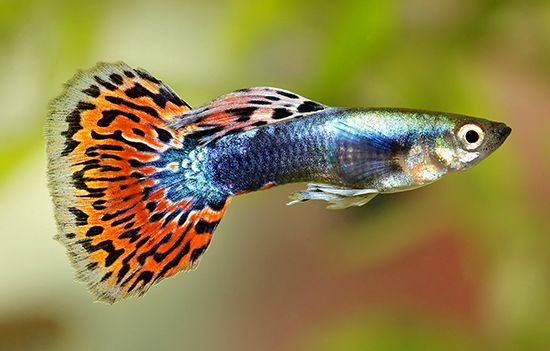
- Guppy: Highly popular due to their hardy nature, energetic behavior, and vibrant colors. They are prolific breeders and have been developed into many ornate strains with various fin shapes and patterns.110
- Molly: Another common choice for aquarists, known for their diverse varieties.1
- Platy: Frequently kept for their ease of care and variety of colors.1
- Swordtail: Named for the elongated lower lobe of the male’s tail fin, these are also staple species in the hobby.1
These fish are distinguished from egg-layers by the male’s possession of a gonopodium, a specialized organ derived from the anal fin used to transfer sperm into the female’s body.1
Sources
- live-bearer — Encyclopædia Britannica
- How do fish reproduce? — Encyclopædia Britannica
- perciform - Aquarium fishes — Encyclopædia Britannica
- Poeciliidae — Merriam-Webster
- atheriniform - Annotated classification — Encyclopædia Britannica
- Animal reproductive system - Provisions for the developing embryo — Encyclopædia Britannica
- gonopodium — Merriam-Webster
- Reproductive behaviour - Fishes — Encyclopædia Britannica
- ostariophysan - Reproductive cycle — Encyclopædia Britannica
- guppy — Encyclopædia Britannica
- ostariophysan - Breeding — Encyclopædia Britannica
- aquarium - Maintenance problems — Encyclopædia Britannica
Published on · 3 min read