Tailless Whip Scorpion
A tailless whip scorpion (order Amblypygi) is an arthropod belonging to the class Arachnida. While they resemble whip scorpions (order Uropygi), they are…
What is tailless whip scorpion?
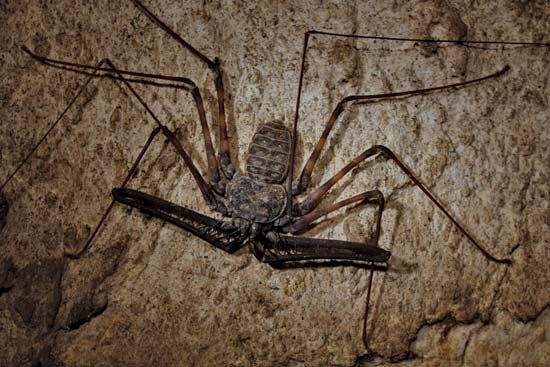
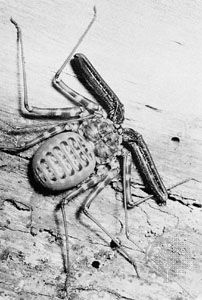
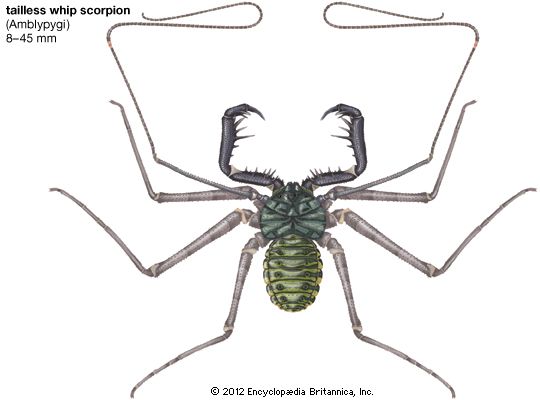
A tailless whip scorpion (order Amblypygi) is an arthropod belonging to the class Arachnida. While they resemble whip scorpions (order Uropygi), they are distinguished by the lack of a telson, or tail.1
These arachnids typically range from 8 to 45 mm (0.3 to 1.8 inches) in length. They are equipped with thorny-edged pedipalps used to seize prey, and their third pair of appendages functions as long, whiplike feelers.1
Tailless whip scorpions are primarily found in tropical and subtropical regions across North and South America, Africa, and Asia. They are nocturnal, spending their days hiding under stones or bark, though they are known to occasionally enter houses. Despite their intimidating appearance, they are terrestrial predators that are generally not considered a threat to humans.12
How do their whiplike feelers help them navigate?
The provided search results do not contain specific information regarding how the whiplike feelers of a tailless whip scorpion function to assist in navigation. While the articles confirm that these appendages are the third pair of limbs and serve as long, whiplike feelers, they do not detail the sensory or navigational mechanisms associated with them.1
What are the main differences between spiders and arachnids?
It is important to clarify that spiders are not a separate category from arachnids; rather, spiders are a specific order (Araneae) within the class Arachnida. Therefore, the comparison is between a specific group and the broader class to which it belongs.789
Understanding the Relationship
- Arachnids: This is a diverse class of arthropods that includes over 100,000 species, such as spiders, scorpions, mites, ticks, and daddy longlegs.79
- Spiders: These represent just one of many orders within the class Arachnida. While all spiders are arachnids, not all arachnids are spiders.78
Shared Characteristics
All members of the class Arachnida, including spiders, share several fundamental traits:
- Body Structure: They possess a hard external skeleton and a body typically divided into two main regions.10
- Legs: They have four pairs of legs (eight total) and lack antennae.108
- Feeding: Most are carnivorous and rely on external digestion, injecting prey with fluids to liquefy them before consumption.10
While spiders are distinguished by their highly developed use of silk for webs or hunting, other arachnids have their own unique anatomical and behavioral specializations.8
How do these creatures hunt their prey?
Arachnids, including spiders, scorpions, and tailless whip scorpions, are primarily predatory creatures that have evolved diverse strategies to capture and consume their prey.
Hunting Strategies
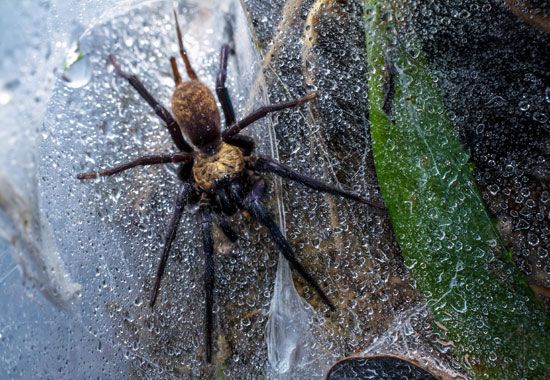
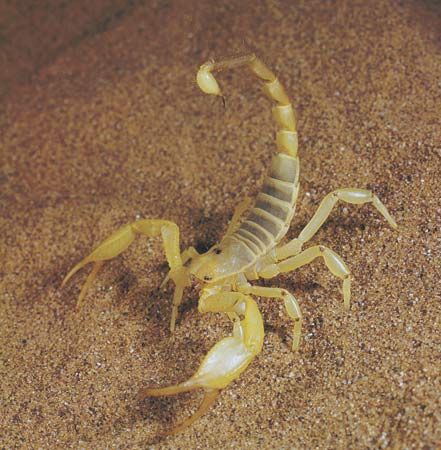
- Sit-and-Wait Predation: Many arachnids, such as scorpions, remain motionless in an ambush zone, using sensitive organs to detect ground or airborne vibrations to locate prey. Similarly, many spiders use silk to construct webs or snares, waiting for insects to become trapped before moving in to secure them.11213
- Active Hunting: Some species, such as wolf spiders and jumping spiders, use keen eyesight to stalk and pounce on prey. Other arachnids, like sunspiders, run at random, using tactile and visual cues to recognize and capture victims. Tailless whip scorpions move slowly with their pedipalps extended to seize prey.12141516
- Specialized Techniques: Certain spiders use unique methods, such as throwing sticky silk “bolas” at moths or spitting streams of silk to entangle prey.12
Feeding Process
Because most arachnids lack conventional jaws, they rely on external digestion. They typically inject digestive fluids into the prey or pour them over torn pieces of the victim’s body. These fluids liquefy the soft tissues, which are then sucked into the stomach. Most spiders also use venom to quickly immobilize or kill their prey before feeding.1151713
Sources
- tailless whip scorpion — Encyclopædia Britannica
- arachnid - Distribution and abundance — Encyclopædia Britannica
- tailless whip scorpion — Merriam-Webster
- whip scorpion — Encyclopædia Britannica
- arachnid - External features — Encyclopædia Britannica
- insect - Nervous system — Encyclopædia Britannica
- Did you know? — Merriam-Webster
- arachnid - Distinguishing taxonomic features — Encyclopædia Britannica
- arachnid — Encyclopædia Britannica
- spider — Encyclopædia Britannica
- list of arachnids — Encyclopædia Britannica
- scorpion - Food and feeding — Encyclopædia Britannica
- spider - Stalking prey — Encyclopædia Britannica
- arachnid - Food and feeding — Encyclopædia Britannica
- spider: Top Questions — Encyclopædia Britannica
- arthropod - Nervous system and organs of sensation — Encyclopædia Britannica
- arachnid - Nervous system and sense organs — Encyclopædia Britannica
Published on · 3 min read